
Translated material
Crying Berdyaev
The New Times opens a new section that writer Viktor Erofeev will lead. His first essay - about the memoirs of the widow of an outstanding Russian philosopher, which confirm: our story is constantly spinning around its "rotten axis"
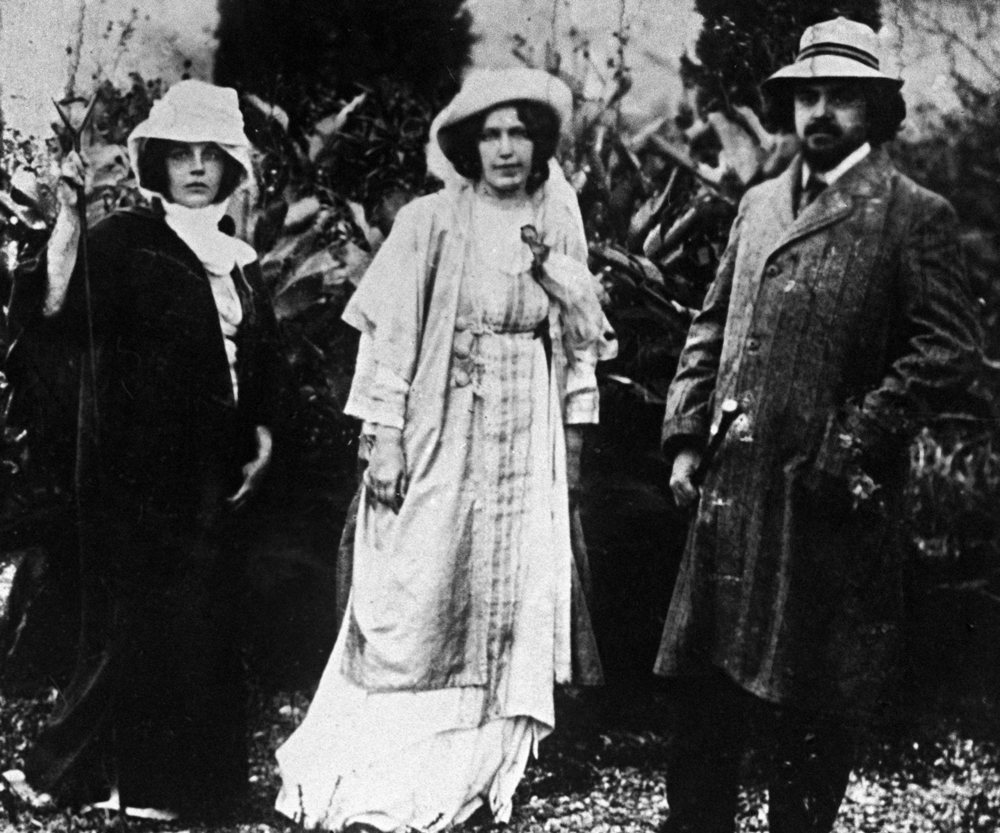
Nikolai Berdyaev with his wife Lydia (left) and Adelaida Gertsyk-Zhukovskaya. 1946
| *Lev Shestov (1866–1938)-philosopher-explorationist. Shestova’s philosophical manifesto became the work “Apotheosis of the Enlightenment (Ado -Gamatic Thinking)”, which caused the most acute disputes in the intellectual circles of Moscow and St. Petersburg, published in 1905. In 1920 he left Russia, lived and died in Paris. ** Lidia Berdyaeva. "Profession: the wife of a philosopher." M., "Young Guard", 2002 |
The tougher the loop of politics is tightened, the more you suffocate from existential problems. After the defeat of the 1905 revolution, Russian existentialism was born (Nikolai Berdyaev, Lev Shestov*). Gorky called that time a “shameful decade” - it was the heyday of the Silver Age.
Now our existential philosophy is becoming significant again. Recently celebrated the 100th anniversary of the birth of Albert Camu. All his topics of the absurd and fragility of life are whining again, like wounds. Mobile phones and computers only sprinkled them with their sparkling triumph.
With some distrust, I picked up the book of Lydia Berdyaeva **, her Parisian diaries - what can the philosopher’s wife know about the internal sources of the philosophy of her husband? But I was mistaken. Sometimes it seems that she knew them better than him.
It is amazing, of course, the obsessive repeatability of Russian social thought. The independence of Berdyaev’s thought in exile was interpreted as a red provocation, and in the USSR Nikolai Bukharin in Izvestia shamelessly wrote about him as the son of a gendarme general. True, his mind recognized his year - this is 1935, perhaps the last year, when it was still allowed to recognize the mind of the enemy (they still refuse the enemy, and first of all in the mind).
A large place in the book of Lydia Yudifovna is given religion and death. She, a Catholic,, together with her husband, an extra -facilities of a Christian, is looking for a cozy concept of the tragedy of death. She denies hell as something in vain attributed to God, who is love. Her torment: How to combine the twentieth century with such an understanding of God? But the joy is ahead: instead of hellish torment (for Berdyaev), the afterlife consists of degenerations, but not a Buddhist sense with a return to the Earth, but addressed to other extraterrestrial dimensions of a higher and lower type. At the same time, a person retains the form of his body and salvation acquires a personal character. You read and think: how nice it is! One can imagine how such thoughts were infuriated by Konstantin Leontyev, who even called Dostoevsky and Tolstoy “pink Christians”. On the other hand, do we have confidence that the creation of a personal afterlife will not affect the realities of public afterlife? The very thoughts of worthy, enlightened death and afterlife bonuses create possible prerequisites to overcome the tragedy. But then the mother of Lydia fades and dies - and old age in the diaries of the daughter is not a rest, but the last cruel test, but death, although enlightened, remains grief.
"
He was sick with Russia. He deeply hated fascism and opposed Hitler’s victory, but he treated Stalin no better than Hitler
"
Berdyaev lived near Paris in clamar tolerably, although poor. There was a house, there was a garden with roses. There was a small circle of Russian and French friends. Among them are the founder of French existentialism Gabrielle Marseille. I remember how many years ago I came to visit him when I wrote the dissertation “Dostoevsky and French existentialism” - the great old man showed me the sofa and said that Berdyaev and Shestov were sitting on him and always argued. They argued, however, Lydia writes that only with the Shestoye Berdyaev was on "you." It seemed to me that, reading her diaries (she describes the same Marseille’s apartment), I entered my dissertation from the Black Stairs and in this house I saw the household details of the life of my beloved heroes.
Despite the circle of friends, Berdyaev, the author of the philosophy of freedom, felt awkward in Russian culture. The Russians always mainly scolded him (except Rozanov) or silent. But for some reason, foreigners understood its significance and replicated in all languages. Is it not in this conspiracy against their own, when they become their most terrible strangers, and there is a mystery to our rotten axis of history spinning around the rotten axis? Berdyaev writes about this cycle of piercing words. Nikolai Aleksandrovich, after reading Khomyakov’s sad poems about Russia, cried. He rarely cried, but then he cried, because nothing in the country has changed since then. He was sick with Russia. He deeply hated fascism and refused, unlike Merezhkovsky, to go to Mussolinian Italy. During the war, he, unlike Merezhkovsky, opposed Hitler’s victory, but he treated Stalin no better than Hitler.
Once, as a student, I walked with my parents on the beach in Doville. It was a wonderful windy day. Suddenly we came across a large kagabashnik from the Parisian residency in the way. At first he said that French counterintelligence was following us and he was ready to beat them all. Then he said that now the issue of Berdyaev’s archive is being decided in their department. Take it or not to take it to Moscow? "It was such a confusion!" - Carelessly, with a crooked smile, explained the Kagabashnik.
Photo: RIA Novosti