
Translated material
Instant propaganda
2014 by the Presidential Decree was declared the Year of Culture. What awaits us?
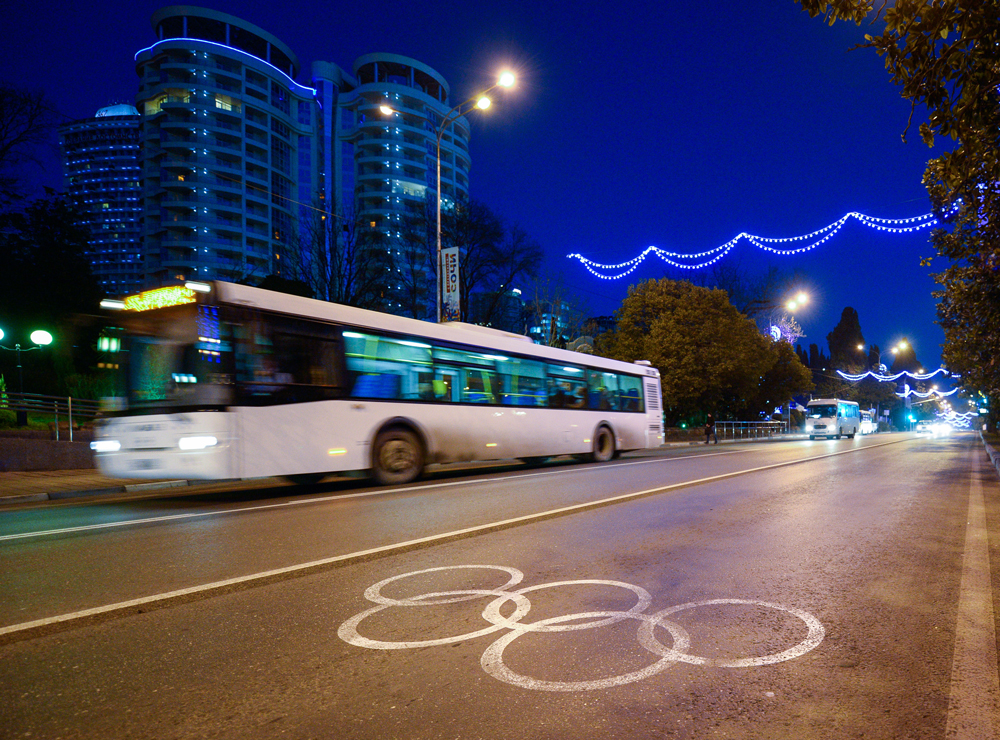
Road marking in the form of Olympic rings in Sochi
During 2013, officials and deputies preoccupied with the fall of morality intensively introduced into the mass consciousness the wording familiar from the Soviet era on the “patriotic” (almost partisanship) of art and the integral right of the state to influence the content of cultural products. The state carefully avoids the words “censorship” in the person of the Minister of Culture of Medinsky, but insists: “Let all the flowers bloom, but the state will water only those flowers that correspond to the mission of the state, national and state interests.”
What does the current state “water”? The current Kremlin’s “human souls” did not invent anything new: the rate (and the main part of financing) is made on folklore and folk art, on regional creative groups, on patriotic actions, patriotic films and patriotic festivals. The list of cultural measures dedicated to the year of culture, published on the website of the Government of the Russian Federation, is impressive by the “Scope”-125 large-scale events as much as 6 billion rubles (for comparison-about 100 billion rubles allocated to the Moscow Regional Cultural and Ethnographic Park!).
Judging by this list, the 2014 culture will be based at regional festivals of folk art, and the central events of the year will be the cultural program of the Olympiad, the 100th anniversary of the First World War and the All-Russian festival of traditional folk culture on the Day of National Unity.
The cultural program of the Olympic Games in Sochi is our ceremonial facade, in which folk choirs, symphonic orchestras and jazz beigs are randomly mixed, for which the proxies of President Gergiev, Bashmet and Butman are respectively responsible. The favorite of the Kremlin Leps was left without sweets - foreign guests will not hear his songs. But within the framework of the Olympic leisure, a mini-festival of the best world cinema will be held, the program of which is drawn up by Nikita Mikhalkov, Milos Forman and Wong Kar-Vai. Theatrical art will be represented by a proven hit of the Theater of Nations - “Shukshin's Stories”, a high -quality export product connecting Russian traditional values with the European style. And of course, the choir of Alexandrov and the Moiseev ensemble - almost in the daily regime. In general, the fascination with choral singing becomes one of the main brands of the Year of Culture: the pride of the cultural Olympic program - a combined children's choir led by Valery Gergiev - has already moved President Putin by the immortal “sunny circle” and “eagles”, who “learn to fly”. During the year, it is planned to conduct several large -scale choral festivals, introduce choral singing lessons to schools and start every morning with singing the state anthem.
Crusade
Among the main anniversary dates of the year, on which the main monetary and spiritual forces are abandoned-the 100th anniversary of the First World War, the 250th anniversary of the Hermitage and the 200th anniversary of Mikhail Lermontov (which was first forgotten, and then in a fire order was urgently included in the list of main dates from the submission of Stanislav Govorukhin). Mikhail Piotrovsky, the center of anniversary celebrations, makes a large -scale festival of contemporary art “Manifesto”, which promises to bring the most striking and significant contemporary artists of the world -class. Piotrovsky is one of the few state cultural managers who freely and fearlessly defend the rights of modern actual art.
The past year has become the year of the Crusades of the state and the church against the “liberal occupation”, the year of the fight against actionism, with artistic actualization, with modern forms of art. The Minister of Culture himself repeatedly demonstrated his artistic tastes publicly and after Khrushchev, who called the paintings of the avant -garde "Men Pidarasov", very frankly expressed himself addressing the installations on the Moscow Biennale in the arena, made it clear that there would be no more such "installations" on state money. The minister has repeatedly expressed his attitude to the “incomprehensible”, urged artists to turn to face the people and insisted that modern art could hardly be called what is not clear to the majority. The “Orthodox activists” with the Cossacks who ampluting the exhibitions, break the performances, poison and insult artists and directors adhere to approximately the same point of view. Many perceived the installation on traditional conservative values as a call to the struggle with foreigners and Gentiles in culture, with the fact that “Tolerasts” and atheists are personifying for them, all this “liberalized abomination” alien to the Russian man.
However, despite this ideological war - simple with a difficult, collective with personality, hypocritical with free, despite the obvious attempts with the help of idiotic laws to hook the “cultural iron curtain” - the boundaries of art remain open, and the artists are persistent. And in the government register of the Year of Culture, the Moscow International Biennale of Young Art, and the Ural Biennale of Contemporary Art, and the Territory, Net (New European Theater), Baltic House, the Stanislavsky season and, finally, the World Theater Universiade, which will be held in Moscow and will become the main theatrical event of the year of culture.
The ghost of censorship
A positive part of the cultural concept of the Ministry of Culture can be called the return of the intra -Russian touring activities of the largest central theaters and musical groups. The provincial audience, corrupted by vulgar entreprises and fraudsters-producers, outstanding hacks for high art, will have to be educated and reed again, this process is incredibly difficult, but important. It is wonderful if the state takes on financial support for large touring tours and avoids the temptation to form a touring repertoire based on the considerations of “patriotism” and “conservatism”.
What is not yet possible in the theater is fully implemented in cinema. The special “pride” of the Minister of Culture is the introduction of a historical examination of art scenarios and films. Following the formula “We will not allow state money to spat on our past”, Medine historians, modestly calling themselves “consultants”, de facto perform the functions of state censors. The attack on the maintenance of creative applications in the year of culture will inevitably continue, and new forms of veiled censorship will certainly be presented as a noble struggle for traditional values, historical continuity and ideals of our ancestors.
State propaganda in the federal media gradually spreads out in other ideological directions - into the army, into the education system, and of course, into culture. “Monumental propaganda”, which began with commemorative boards in honor of the leaders of the Soviet state and pompous celebrations in honor of state and religious holidays - is rapidly turning into propaganda “instant”, based on the bureaucratic crackling, lashing, personal interest and uncontrolled budget injections. Instant propaganda - has no practical expediency, its effectiveness is recorded only in linden reports, it is loud, hysterical, meaningless, mediocre and has the minimum shelf life.
It is by propaganda that the cultural bins of the Motherland were littered-how many rubbish were accumulated over decades of Soviet power, rubbish, which once fed the army of Soviet officials and from which the Soviet people were sick.
In today's appearance, this type of state culture is not so effective due to the openness of the information space, but destructive for Russian art, for the Russian artist, for social thought, for understanding personality and creativity. I would not want the year of culture to become the year of the triumph of cultural totalitarianism, the celebration of intellectual mediocrity and aggressive obscurantism, the celebration of Lakes of Lake Shamelessness and bureaucratic stupidity. "Get out, fools!"
Photo: Arthur Lebedev/ITAR-TASS