
Translated material
About the boundaries of political discourse
Singapore is a state that, in some parameters, resembling Russia. Here, one party actually rules, if not - a grouping, although others formally exist. The opposition is brutally persecuted. There are censorship and many prohibitive laws. For example, the Law against LGBT , similar to the Russian law on the “propaganda of homosexuality”, is used by the authoritarian regime selectively-where it is necessary to punish someone for the same opposition activity. In the country, on the political and economic systems of which the Russian authorities are largely oriented , there are many galleries and Boyko is being traded, and the Biennale of contemporary art is also held. What does it look like?
I expected my interlocutor in the coffee shop, sorting out the names, works, biographies of artists on a rather informative website of Singapore Biennale . We did not meet before, but easily identified each other in the crowd. A miniature Asian with a geometric haircut came up to me, with a bright appearance and definitely not a banal name Vienna . With the 23-year-old Malayka, who grew up in Singapore, I accidentally brought me the rule of six handshakes, and when it turned out that we are both interested in contemporary art, Vienna kindly agreed to become a guide to Asian realities and spend the day with me on the Biennale sites.
The Singapore Art Museum , where we were heading, is located in the former building of the Catholic school for boys, built in 1867 - a rare reminder of the colonial past in the business center of the city. Singaporets tended to abbreviations affectionately call it SAM . Each at the entrance is given a sticker with the inscription "I am made of sam" . To me, the victim of globalization, all this inspired the image of Uncle Sam from the poster "I Want You For US Army" . My companion, as a citizen of Singapore, was passed to the museum for free, but, as a foreigner, I purchased a ticket.
Already the fourth in a row Biennale attracted mainly regional contemporary art (90% of participants from Southeast Asia) and a large team of curators (27 people). This time, for the first time in the history of the event, the Singapore Art Museum is engaged in the organization, while before that Biennale did the Council for the Arts of Singapore . The theme of Singapore Biennale is “If the world changes”. It is assumed that artists and spectators will rethink two worlds: the one in which we live, and the one in which we want to live. It would seem that the jump of one of the four “Asian tigers” in some 30 years, futuristic landscapes, developed infrastructure and a high standard of living in the city-state make Singapore an ideal place to study such topics.
Crossing the threshold of the museum, I asked a question that worried me the most: how much the reality of the observation of the famous writer and journalist William Gibson in the legendary Disneyland with the death penalty , published in 1993 in Wired magazine, corresponds. To my surprise, Vienna did not hear about this article (after a loud publication, not only the author and the article was banned in the country, but also the publication itself ). In Singapore, there is the so -called media development management , relating to the Ministry of Information and Communication, which is engaged in censorship. There is even a special term borrowed from golf - “ Out of Bounds Marker) , which means the border of political discourse. In a nutshell, I explained that Singapore in the report seems to be a megacorporation, the state without history, whose society is mired in conformism and is inability to creative activity. My interlocutor picked up these theses, nodding confidently: “There is a mainstream: he includes a pursuit of brands and gastronomic experiments. This policy is deliberately planted by our government. Most lives in given coordinates. ”
At the very entrance, our views were attracted by the installation of Ahmad Abu Bakar called Telok Blangah (this is one of the districts of the city-state). This artist, like Vienna, is a native of Malaysia, who grew up in Singapore. The work is a traditional fishing boat filled with glass bottles with notes of prisoners from Singapore prisons. She is about hope and forgiveness. I could not help but ask a question: "Do you have political prisoners?" She confirmed: “I recall the prisoner of the conscience of Chia Tai Po . He opposed the authorities in the 1960s and was imprisoned without trial. Something like your Khodorkovsky, only the communist served a lot of time-23 years. Now this is no longer there, although, maybe I don’t know about it. ” To my question about political protests, she even found it difficult to answer whether they were legal, and to recall at least one over the past 10 years (the history of repression in Singapore “sovereign democracy” can be seen here . - Ed .). I was most amazed that Vienna did not know exactly where the norms and punishment are enshrined (although all this can be found on the Internet on the website of the Ministry of Justice), which makes me draw the only conclusion: the Singaporeans really developed an “internal policeman”.
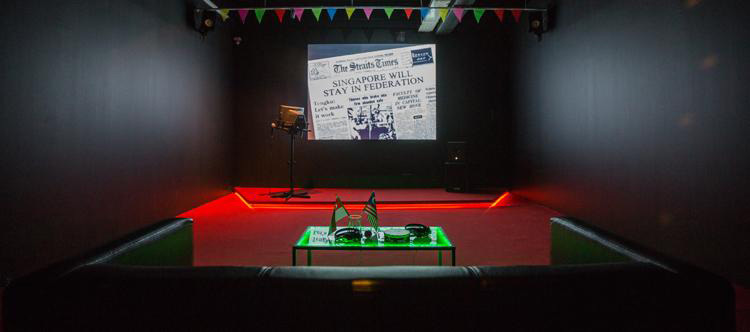
We went into the room allocated for the installation of Bo Junfen "Happy and Free". A small hall of glory, memorable posters hang on the walls, reflecting the milestones in the association of Singapore and Malaysia. The crown of this anniversary collection is the wall schedule “50 years of association” with crossed flags of the two countries. “Stop,” I say, “because this merger was not successful. Singapore did not last two years in Malaysia. In 1965, independence was already proclaimed. " Perplexing, we are moving inland with Veinnaya and fall into the karaoke bar. The video sequence, plays music that causes associations with North Korea, and the run -in line in English, which hypnotize with numerous repetitions and eat into the brain. Everyone can sing to the phonogram or take headphones and hear the original sound. We and I and several more visitors fell into a collective trance, observing poor quarters with low buildings - the result of the installation of photographs of Singapore and Malaysia. No Marina Bay Sands (a huge hotel, which houses the most expensive casino in the world. - Ed .), Skyscrapers, high -tech buildings and other landscapes of the city of the future. We went out silently. "What is the national idea of Singapore?" - I turned to Vienna. “Oddly enough, tolerance. But I don't like this word. It means that you endure someone or something not of your own free will. It would be more correct to use the word “acceptance”, it is necessary to perceive everything for granted as a norm of things, as a fact. However, in Singapore there is ethnic inequality, discrimination, if you want. More favorable is the attitude to white people and Singaporeans of Chinese origin than to citizens of the country of other nationalities. ” In my view, Singapore is a successful example of a multi -confessional and multicultural society, so I hastened to clarify: “The matter is in education? In Harvard's diploma? " The answer Vienna struck me: “No, just in the color of the skin. How are you. "
Singapore is known for the policy of rational use of land and urban space. The work of the “old man and the sea” of the photographer Erica Lei (addressed to the book of the same name by Ernest Hemingway) casts doubt on the success of land reclamation - the expansion of the coastal strip due to the water space. The installation is a series of photographs, a video and a collection of glass cans with the ground. In the novel, the struggle against the elements is reflected in a fisherman’s fight with a giant fish. The Singapore artist, together with a group of students from schools on mastered land, shows this confrontation with the example of reclamation. Each photograph is taken on an artificially created piece of land and is accompanied by the signature of the student himself - the participant of the experiment, meaning a symbolic return of the earth back to the water space. “Everyone knows about the artificial islands of Dubai. Have you heard about Semak, for example? " Vienna asked me. I shook my head negatively. “The island was created from millions of cubic meters of garbage. Incredibly, layers of garbage alternate with layers of earth, which provides 350 hectares of space, which is suitable not only for waste disposal, but also for plant growing. There are still golf fields. ”
The interactive part of the Biennale - each visitor can glue a colored sticker with his idea of transforming the world. Alas, after the story of the garbage island, any idea that came to mind seemed to me not enough innovative or at least something remarkable. We agreed with the opinion that in the Singapore Biennale there is no work with political subtext or capable of provoking a large public outcry. It is likely that each work is carefully checked by the Media Development Office or some other structure. Even an installation about the utopian fusion of Malaysia and Singapore is somewhere beyond. If this is a socially oriented and politically engaged art, then the authors are not Singaporeans, but the inhabitants of countries with an unstable political situation - the Philippines, Malaysia, Cambodia. However, can we say with confidence that the authoritarian political regime strangles the development of art? Or what is an absolutely free climate necessary for the development of festival activities (and Singapore Biennale in particular)? After following the history of one of the main forums of world art - the Venetian Biennale, we can notice that during the time of Mussolini, the festivals of music, cinema and theater began to be held in parallel with the largest art exhibition, and in the heyday of counterculture, student protests and the sexual revolution, the Venetian Biennale was in a crisis state, and the development of art. There was more and more outside the walls of the pavilions. By arm with a regime, whether it is democratic or authoritarian, or not, art will find an opportunity to declare itself. The main thing is to be honest, let even within the golf field.