
Translated material
The harsh path of the poetic self
It is strange to describe the poems of Porvin: almost the most “affirmed” author of the generation of thirty -year -olds, about which everything seems to be “clear” to everyone. Already the third book of poems (plus one was translated into English); translations from English and Russian (and modern authors); Laureate of the Debut Award, finally. There is some kind of cold consensus regarding the fact that such texts of the collapse. In addition to countless shakes and compliments, it is customary to see some “lyrical abstractions” in these verses, indicate the “artificiality of strict form” of the port in the form of “increased poem hardening”, note “formality”, “rhetorical elevation” of poems, which are as if fincerely “slowed”, are not distinguished by “shortness and accuracy”.
The new book is the exact opposite of this image. A huge, long, detailed statement, at each moment of his path, moreover, extremely concise, honed. The first two books against this background can already appear pale and gastric ("infantile imagery").
What to say about the language of Perevin besides that this is the language of real poetry? She at the same time completely freely uses the instrumentation of the poetry that it is customary to look at at the most avant -garde ( in children are silent fear of winter ), and at the same time - which is much more important - confidently relies on the most powerful layer of tradition - the one that is more “more“ more ”of any“ poetic ”“ extensions ”. The voices of W. Blake, R. Frost (echoing immediately G. Dashevsky) are heard. Indeed, these verses are plastic, sparkling in their virtuosity-literally explodes from the inside the iron frame in which they live (every time it is four cathedrons, in each head of 10-15 texts, only 15 chapters, all of them are collected together with a 16-stringed “wreath”-epigraph-and still conservative punctuation and the apparent (!) Inertial intonation ...). All hints of baroque rhetoricity, a solid form - a trick, a way to shade of the semantic and rhythmic explosions with which this poetry operates. Pushkin was engaged in similar, what a “hard verse” is already here - everything burns.
How does this virtuosity work? This is meticulous work on the meaningful transformation of each element of a poetic text into a meaningful unit. Distribution virtuosity here is achieved due to the fact that any versioning is denied. Sometimes it seems that the text that we now read was originally written by the usual regular verse, such a completely toothless lyrical poem, and then the poet sat down again for work and mercilessly exhausted everything that could at least resemble consistent metrics and accurate rhymes. This “artificiality”, however, was born in the same empires as the bold spondes of Mandelstam or the elegant rhymes J.M. Hopkins: They are still semantically loaded. Reading these verses requires a huge concentration, no less than the texts of M. Eremin, E. Suslova. The author - a harsh, monologue, collecting a concentrate of phrases at each point of his poetic body - consistently solves the titanic poetic problem.
 © Inapress
The burden of the subject of these poems is truly unbearable. One of the rarest cases in modern poetry, where the aesthetic problem is solved by working with ethical categories. In fact, who else today, without going beyond the “traditional lyrics,” describes the task, choice, will, fate, burden, responsibility ? Moreover, all those paradoxical semantic explosions that arise in this speech are already given in a line calling the first head: to wait if the correct seas . The right seas - this oxymoron is the initial note of the overture, this is the correctness that wants to affirm itself, it is absolute, the epithet is not specified in any way: correct as a definition of essence, spirit, if you like. And at the same time, it is about the seas , about the vast, uncontrolled (and therefore initially not correct !), Threatening even - and the whole human self (so, it was necessary to stand by the sea - contemplating all itself in an unknowable essential completeness). The conflict intensifies by the fact that the uncontrolled seas (also in the plural! Apotheosis of chaos-but still correct ) can somehow be expected , and yet “wait” as a verb with the meaning of a directed action already implies a certain control over the situation. And here is a paradox: this control is nevertheless grammatically formalized by an imperfect type of infinitive (i.e., it is finally never embodied), and semantically, in the form of passive expectation. Do not “wait”, but wait : this uneven anapest of the first verse, adjacent to the iambic, as if emphasizes: do not swim to them, in fact. No, but, sitting in his boat (layering?), Wait until it throws it into the right sea - and at the same time I waited even so much, moving in the boat, how much a static shore: the second Katren Okutura begins from the verse , the boats are waiting for the coast and waits - that is the change of prospects, the boat is not waiting for the sea (leaving). Finally, the whole tense situation is transferred to the virtual sphere: if . That is, it is quite possible, neither a boat - the sea, nor the shore - the boats will not wait.
Porvin directly explains in the first headquarters that he is interested in choosing. In a situation where [poetic] fever constantly comes and requires fire , which I do not have ( only a blizzard, raw ), it is necessary to build the existence around at least some rod-will. This will should choose fire:
The local morning - to do what a person?
The choice - utterly - life - is simple.
Ringing pitch blunt
wing in an angelic manner
Cloby pair
Time until the first northern stars.
The “simple” choice is ironic and at the same time artlessly expressed in a rather opaque - at first glance - Katrena. The imperfect type of the verb either movement (beating wings), or transformations (extensively wings) wing , given in the infinitating, actually rejects the idea of choosing (choice as a change in the condition, I suddenly expressed in infinitations-indiscriminate and improper form). But this blizzard , which we have already seen as a state of the subject of the subject, is transformed here (almost in the Christian sense): the sound of wings and there is angelic singing (therefore ringing ), pure creation (how much white in this stanza!-a blizzard, a tusk, a couple, northern ones ), it ceases to be cold, now it is a hot vapor, and this is an icy vapor-head. The space until night comes again - and with it the cold of the northern stars. It is important, however, to notice how ambivalent this is the poetic beginning: the angelic is angelic, it is only this completely clumsy wing (such a “carnal” suffix, cf. some “envelop”, “cram”), a terrible convertible and terrible tusk -are they pulling angelic to the animal, if not in an impudence? The investigation of life choice is already visible here - an all -pervasive threat, the second head tells more about it.
Distribution virtuosity here is achieved due to the fact that any versioning is denied.
The cold will of the poetic self, which is not capable, but must give birth to fire - here, in a rough approximation, is the conflict around which the first head rotates. There is no trace of the same “infantile imagery”. The whole existence of man ( the sea of life is the right sea ) is shown as cruel to himself the desire to soak into an attempt to create. Hence the constant presence of the imperatives, about which everyone had already written, but almost no one explained why the pavement needed them, except for some miserable attempts to see in them “conversation with himself”, “appeals to themselves, like educational tasks”. This poetry is a vivid example of how meaningful any formal aspect can be. The abundance of imperatives in the texts of Porvin is a tool of paramount importance, they are operators of the ethical propositions that it permits. Infinitations are also adjacent to them, where the pavements are also distinctly heard by shades of goal -setting, a clear necessity.
The initial judgment unfolds in the course of the book. Already in the first chapter, a warning is persistently arise - in vain , wasted :
Let the inevitability (or dawn?)
trees will express: there is no choice
in vain - filled with water,
Creatures will be unlikely to.
The choice that needs to be made is known, but does not exist, the task is initially clear ( the task is to shine more irrelevant ), and if you choose, then you only choose it - but it is impossible. Heat requires fire - but there is only a raw blizzard . This tense beating is tightened by the fact that it is necessary not only to accept (and give rise to the same) fire, but also to express it in detail , and this is impossible: a poetic statement by definition is incredible ( choosing an inexpressible shore ; choosing a coast is more unresolved - the first cannot be said, the second has not yet been said, but they are united). The choice is really made: each poem of this book is an attempt to “state” the title experience as much as possible, which is why it is so difficult to reduce them to some kind of main vector, each time we are given the smallest details of existence “after choosing”-when I already plunged into a stream of poetic speaking and burns, trying to dictate an inappropriate shore .
The second chapter, you can miss a bright day , immediately puts all points over I. The accepted poetic (= vital) choice is not only non -partial, it is dangerous. The praise of the syllable, a high creative task - all sacred is subtly travested through capacious proclamations of this choice, which are given almost by Soviet pathos: we are unlikely to be a trap ; Our gods are more honest . Unlike the original slogans, these verses at the port are permeated with bitterness, the poem about space (and binding protein and arrow) ends on the same raised note:
Let people feel the holiday
where space is a joke,
suitable for any breath
Raising us to a height.
But how did it start? Sharply, ruthlessly, the first stroke out the whole depth of the prepared abyss (into space here - down, and not upstairs, angelic - again to demons):
In darkness - why defend yourself?
The bells of fire are rattling.
At first glance, there is nothing to defend against anything . However, the second verse lifts the veil of ambivalence and explains that the threat is so immense that it is afraid of its unknowable and false sense of security: here is darkness , here is the terrible thunder of the bells of fire - the situation is as unstable, and the rhetorical question of the first verse is rhetorical not because it could not be asked, but because there is no answer to it. There is nothing to defend yourself from - because you do not see where they attack. The sacred burden of speech turns the western , which is only more cunning because it denies itself.
In the book “The Sun of the Detailed Rib”, the categorical will of the poetic, I live in the pile of inaurant paths, their beginning - in the situation of verbal powerlessness ( about sound form of damage ), their end is in unknown darkness. In order to go this path (and not go through it, at least it is impossible to pass it: the game of modalities), the lyrical subject must decompose into parts of himself ( rib ) and the world, indicate the relationship of all objects , find details . This is the only way to find light ( fire , the sun ), albeit in impenetrable darkness, when the bright day is sprinkled (like Pushkin’s: the night haze lies <...> and the heart burns again ), this is the only way the wave with the soul of the vertical will come . Light is the name of the final poem of the book, which in literal terms summarizes the path traveled. It’s scary to think that in these texts you can see “romantic beautifulness”. Each of the heads of this book of poems is a detailed study of tiny branches of such a path, in the spirit of a medieval scientific treatise or baroque poem, where metric malfunctions and semantic contrasts are almost the main key to the experience associated with confrontent modalities. There is nothing left behind the scenes, the attention and the significance of this book are paid to everything in the fact that
Salted wind of the upper frequencies
The language is so verbose .
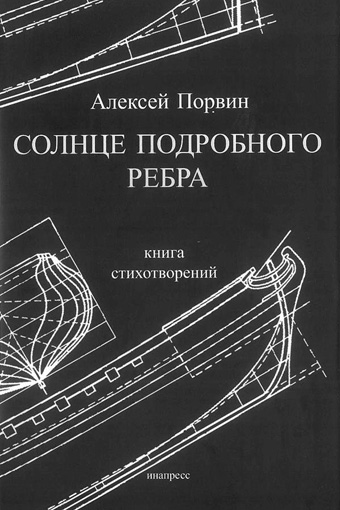
Alexey Porvin. The sun of a detailed rib. - St. Petersburg: Inapress, 2013