
Translated material
Einstein in Wilson's country
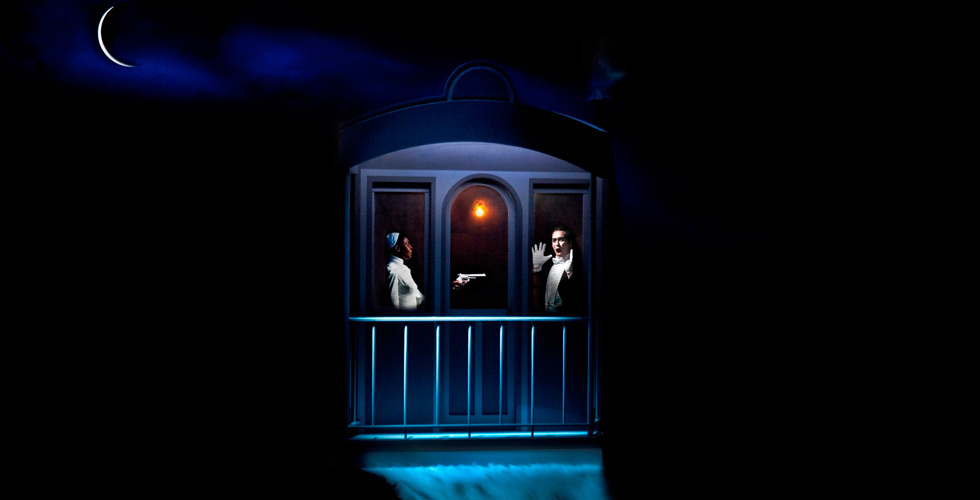
Nothing is obsolete as quickly as the vanguard. Radical techniques are more rapidly becoming a common place, the more radical they seemed.
Since the premiere of Einstein on the Beach at the Avignon festival, almost forty years have passed, but over the years, the masterpiece of Philip Glass and Robert Wilson not only had not reached the circulation-he had already experienced several renewals: in the 80s, in the 90s, in the zero. The next R Evival took place at the beginning of this year in the Parisian Th éâ tre du ch âtelet as part of the autumn festival, and even in its traditionally strong Einstein program, it still looked like the main event - excitement, full -time, standing ovations in the finale. How V.S. Chernomyrdin, there was never this - and here again.
Either Glass and Wilson were very ahead of his time, or more likely-the theater itself, after the avant-garde 60-70s, rushed into conventional backwater, but one way or another, Einstein on the beach looks much more modern than much of what was done in stage art relatively recently. Including, by the way, Wilson himself. At thirty -four years old (for the director, this is not youth even - youth!) He asked the theater a bar, which is not only the rest - it is not easy for him to take it himself.
Reviewing the theater legend, you never know from which side to approach it. Everything seems to be already known about her. Everyone knows that Einstein is going on for many hours in a row, but there is no interval in it. And there is no plot either: Glass composed the music of the opera, putting Wilson's drawings on the piano, they, in fact, became a “plot”. And with the main characters, everything is somehow not very clear. In any case, Einstein even at the moment when the performer, making up a great physicist, sits on the left on the chair and plays the violin, is difficult to call the protagonist of this action.
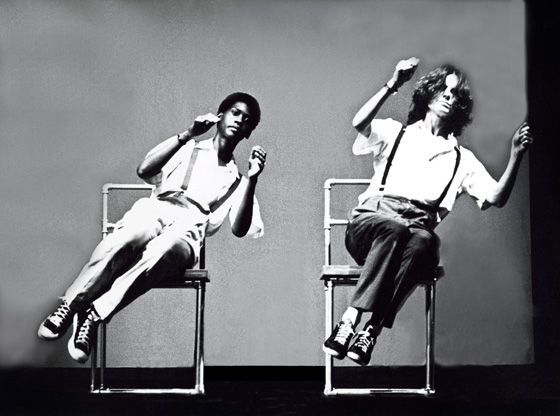 © Richard Landry "Einstein on the Beach", 1976
Everyone remembers that the opus of Glassa -Uilson is a genuine Gesamtkuntwerk : here you have a ballet, and the opera, and short dramatic sketches, and the scenographer theater, and clowning with acrobatics. And at the same time it is a plexus - I would say that the solar plexus is the most important styles of the twentieth century. In the person of Wilson, theatrical art, for which the life of the life has always been a donkey and an irremovable, as it seemed, as if it seemed that everything that the art of the visual was a long time ago. Abstractionism, surrealism, surematism ... It turns out that a black triangle somewhere in the upper right corner of the scene can be no less important than a living artist in the lower left corner-who would have thought!
But all this preliminary knowledge does not allow the magic of the performance and it - oh! - meaning.
I understand that the question "What is the meaning of the work?" And he is stupid in itself, and in relation to Wilson's early Bess -Western works, it sounds even idiotic. And yet I almost always ask myself this question. And if the performance (film, novel) I like, I can almost always answer it. Let it be wrong from the point of view of another viewer and even from the point of view of the artist himself - it does not matter. It is important that some semantic vectors or not arbitrarily whimsical opus are built in my head during the look. In the whirlwind of associations, in a random flickering of images, in the children's memories inspired by the seen, from some almost meditative trance they either appear, as if sympathetic ink on heated paper, or auditory and visual impressions remain Sumbur instead of music, poetry, painting.
In Einstein on the beach they appear.
While the audience is seated in the hall, in the orchestra pit one after another, slowly and pretended-exactly like in the fourth Wilson of the Japanese theater but-there are chorists. And the contrast between the spectator bustle and their inhibited, but verified movements are immediately striking. On this side of the ramp, life flows according to its fussy laws, according to that it is as if in a different aggregate state. This theatrical rapid is generally a Ulson’s signature technique, which the dancer Berd Hoffman was saved in his youth in his youth. The meaning of therapy was in simple movements that had to be done very, very slowly. Since then, the time for Wilson seemed to slow down his run. The stage definitely slowed down.
Look at reality, and you will distinguish between the most difficult - the simplest.
In his performances, he seems to insist: you think the theater is an action, conflict, a clash, an event. But the lack of an event is the most interesting event. You think that the performance needs to be watched, and it must be contemplated. You need to look at the world intently. Stop every moment of it. And then you will understand that it consists of very simple things. From the straight line on the back, from the diagonal, along which the actress walks for a long time, from the circles that the dancers are breaking out of ten digits, who are repeatedly repeated by women sitting on the advance, from the seven notes, who are not words, but notes of “fa”, “si”, “before” - singing the chorists. Look at reality, and you will distinguish between the most difficult - the simplest. The primary elements of being, its bricks. Some things immanent by human consciousness and life as such.
No wonder the Wilson world is very often the world seen by the eyes of the child. With circles, triangles, a fair horse and a house with a pipe. After all, he loves to put fairy tales (recently put Peter Pan), fables (put Lafontaine in Comé Die-Fran çaise ), and even infinitely far from the children's literature “Wojutsek” was in his interpretation as if he was seen through the eyes of a child. Here are the through images of Einstein on the beach-a train, a violin, a boy in a sailor somewhere near the grates-also some kind of children. They are easier to link with Einstein. If the child was told about the great physics, and then they asked to draw something on this topic, he also probably had a steam locomotive, violin ...
What has the gaze of the genius and the gaze of the child, and even with deviations (at the dawn of his career, Wilson often worked with mentally retarded, hard of hearing children; the “gaze of the deaf” - that was the name of one of his first and most important performances)? Only one thing - both there and there the world does not appear the way it is seen by the ordinary consciousness.
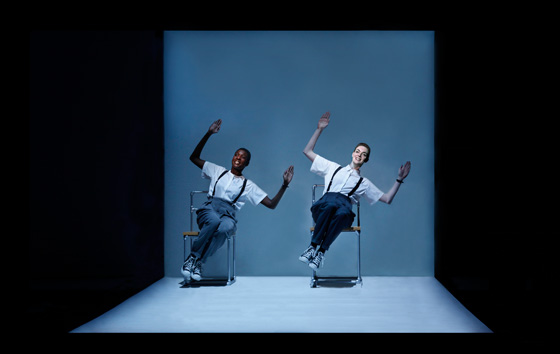 © Lucie Jansch
Wilson's performance is Einstein's universe, seen by the eyes of the child. The discoveries of the great physicist talk about the complexity of the world, the performance of the great director about how simple this difficulty is. The discoveries of the great physicist force human consciousness to break out of the earthly world and its laws. The performance of the great director insists: wherever you break out, from these bricks of being, and at the same time you can’t take from earthly experience.
In the most surreal part of the opera-the scene of the court is not clear who is not clear for what (it reminds Alice in Wonderland, only absurd)-in the foreground, two women carefully make a manicure for themselves. And someone from the extras right there, in the courtroom, talks about baggy pants with such persistence, as if in these pants there is a solution to and unknown crime, and in general all earthly secrets.
The routine breaks into the world of absurdity, but it breaks through the limits of the earth's space.
In the final of the performance, we see a rocket. More precisely, a small application in the form of a rocket. She flies diagonally through the entire portal of the scene. From the Doeinstein world (with a train) - to posteynstein. And then we see how two characters, two actresses, who at the very beginning were selflessly counted on the forefront, crawl out of the hatches on some unwell spaces. We do not know exactly where they were, but clearly somewhere outside our ordinary world. And then the most important thing. What do they meet there, in this non -oral world? They meet a dark-skinned driver sitting at the wheel of a bus and fervently telling some completely melodramatic story, suitable for the dumb films of the early twentieth century. In his story, lovers are sitting on a bench, holding hands, the moon shines, smells of lilac ... Well, something like that.
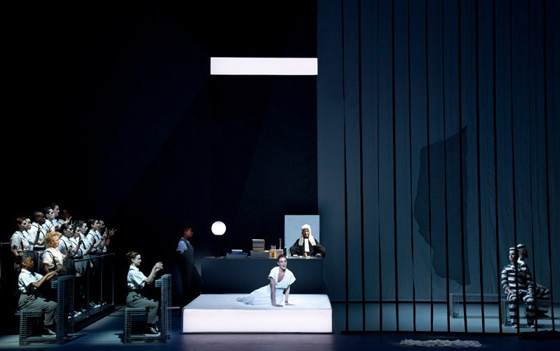 © Lucie Jansch
After four and a half hours of some incredible meditative session, in which all the conventional supports of the theater are destroyed, we suddenly moor on a simple story, to a narrative, to the melodrama, from which Glass and Wilson fled so. After a millimeter turned up to the millimeter, psychology and all earthly, too earthly, we do not fly into the new marvelous world, to unthinkable black holes, but intact to the bus with the melodrama.
And this is such a powerful code that makes the whole performance see in a new way.
Among the disputes about how to properly interpret the famous term Aristotelia “poetics” “Catharsis”, there is a version closest to me. According to her, this word is most correct to translate not as “purification”, but as “clarification”. The clarification of the design of the artist, perhaps at first unknown to himself. I do not want to in vain use the word "catharsis", but after "Einstein on the beach" there is a rare state of exalted clarification. These circles, squares, numbers, notes, letters ... This house with a pipe, in love with the moon, baggy pants, the smell of lilacs ... You will not run away from them anywhere. You are attached to them forever.