
Translated material
Colta.ru
One of the ways for art to oppose yourself to the society in which it exists is to find something dysfunctional, unproductive: art then resists the requirement to be effective. Such a position of resistance to the emegen “to be useful” is one of the important topics of both the texts and the painting of Casimir Malevich. For him, the search for something free outside of any objectivity, outside of labor and the glorification of laziness were associated with ideas about the peasantry and the upcoming utopia. Malevich understood utopia as a way out of history, moving slack labor and the “hardware principle” [1] , - as Malevich called the constant power of economic principles over human being. And in the thoughts of this utopia, Malevich every now and then arises the image of a peasant as a person living a complete life and not striving for progress - a image that is also characteristic of the Russian populist tradition.
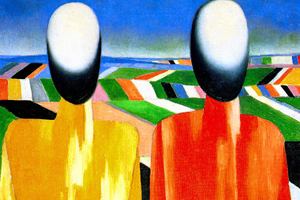
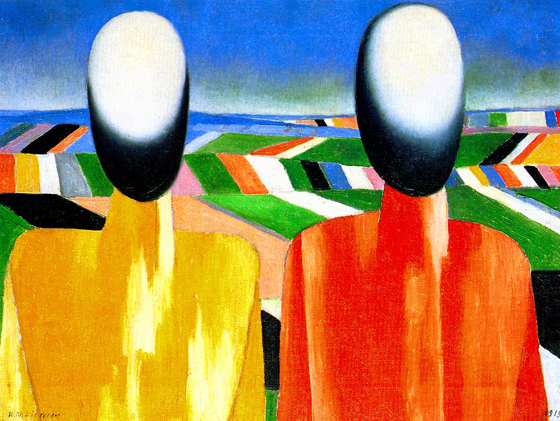 © State Russian Museum Casimir Malevich. Two peasants against the background of the fields. 1930
In the sketches of his autobiography in 1933, during collectivization, Malevich draws the emphasized idyllic picture of the peasantry from his childhood. “The peasants are sleeping all night, and in the morning they go to the fields and work in the air, among the beautiful nature, illuminated by the sun in the morning, half a day and golden evening. Their work flows in songs, especially the song sounds when in large batches the girls and young guys return home. <...> The main thing that I distinguished factory workers from the peasants was drawing. The former did not engage in drawing, did not know how to paint their homes, did not engage in, I would now say, art. Still, peasants - were engaged " [2] . In this pastoral with a typical appeal to folk life for Russian avant -garde (another characteristic example were the calls of Natalia Goncharova artists to draw inspiration in the East, and not in the West [3] ) However, you can see something more: a specific development of labor and idleness.
The peasant is determined through agricultural work on Earth. But the peasant labor for Malevich, unlike the work of the industrial, is intertwined with non-labor, with art, aesthetics. In a similar way in his art inside the peasant being, which seems to be inseparable from labor, Malevich finds grain of lawlessness - one of the important steps in this direction was the “head of the peasant woman” (1913), and the “artistic realism of the peasant woman in two dimensions” (1915) was already a red sandyshot square. Malevich calls the same red square in another text “signal to the revolution” [4] . The Malevich revolution, although he was familiar with the Marxist ideas about the economic basis and the need for his restructuring, also understood as an opportunity to break with the “hard principle”, to break with economism: “Each truth carries the thought of the need for labor>, and <its meaning -> labor as a means of achieving laziness. <...> The whole philosophy of labor is the liberation of laziness " [5] . This idea, like the Malevich antiprogressism, actually does not contradict the spirit of Marx's ideas, and Malevich himself thought of them as co -like revolutionary situations, although his sympathy at the beginning of the Civil War were more likely on the side of the anarchists: in 1918, Malevich published many articles in the newspaper Anarchy. The Bolshevik project of socialism Malevich tried to interpret in the same spirit, for example, erecting the etymology of the word “Lenin” to the word “laziness”: “Laziness, Lenin, he belongs to laziness, he is at peace, i.e. in laziness, in a linen, lazy state " [6] .
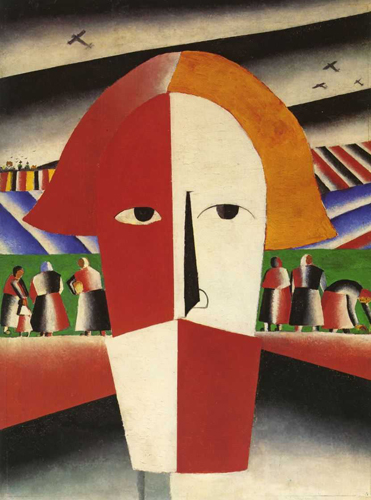 © State Russian Museum Casimir Malevich. The head of the peasant. 1929
Later, in the 1930s, against the background of the Stalinist cult of super-productivity and shock labor, these thoughts already sounded scandalous. In the situation of those years of Malevich’s presentation about utopia, laziness and peasantry, they gained a new meaning - both artistic and political. His so-called second peasant series, unlike the first, created in the first half of the 1910s, almost does not depict labor scenes. The peasants in these paintings usually simply stand in the middle of desert, windy fields with houses on the horizon, often deprived of faces, and sometimes the main tools - hands. But they carry Suprematism, lack of personality in themselves - in the absence of facial features, exponentially tel. This Suprematism in peasant figures and in their nature around Malevich is laziness, freedom, pure art, which he had previously defended and glorified in his Suprematic manifestos. According to the figurative system of Malevich’s texts, the absence of faces denotes the refusal of art to take the temporary appearance of a leader or ideology [7] . The heroes of the second peasant cycle of Malevich are passive - but in their passivity there is stability, there is internal resistance. Malevich, himself completely without articulating, became a lawyer from art for a peasant lifestyle, who was sacrificed to the principles of Stalin's effectiveness and the tasks of industrialization. Despite the intellectual aesthetics of Malevich’s ideas about peasant life, he reflected the specifics of peasant labor, inextricably linked with non-labor, unlike industrial labor. On the connection of labor and leisure in the pre -industrial method of production, where economic activities (hunting, going to the market, plowing) contain elements of communication and leisure, said the British historian Keith Thomas [8] . The transition to industrial production introduces the idea of progress and rationally calculated linear time - as opposed to its former cyclic understanding, tied to specific economic purposes and natural cycles. Nature around which peasant labor is built, thus, acts as something opposing industrial logic. In Malevich, nature is filled with Suprematism, like the peasants inside her.
Malevich told something important not only about peasant, but also about any work in his connection with human being - about the grain of laziness within labor. Suprematism in the circuit of peasants and workers can be perceived as pure color, something psychoanalytically, related to the register of pleasure (inside a lonely body), and not to the register of desire, action, work. And at the same time, in the pleasure of internal Suprematism there is a potential ability to transition to an act, to gesture, to desire, to work. But it is unclear what this work is the work after Suprematism, after leaving the progressist history (and not before, as in the first peasant cycle). The oratorical gestures of the heroes of Malevich in his later paintings (“employee”, “self -portrait”, “portrait of his wife”) denote the potency of speech - speech that the human figure on canvas is able to make, but what kind of speech it is is unknown.
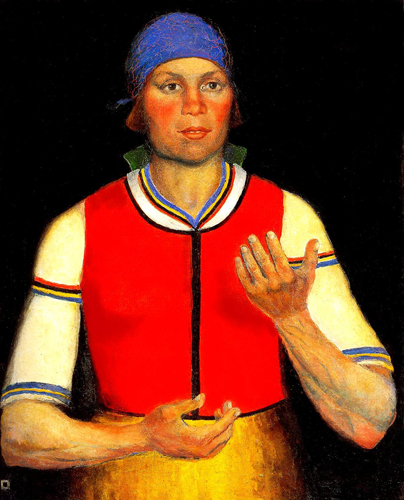 © State Russian Museum Casimir Malevich. Worker. 1933
However, Malevich has a very specific, rooted image of the peasantry to action, the image of the opening of his tightness in Soviet history - the picture of “Lucky” (1930), which depicts a meeting of representatives of the peasantry and the city. Before his death, Malevich worked on sketches for the unfulfilled picture “Sotsgorod” (1935), which can be interpreted as a transformation or even the removal of the opposition city/village. In the "meaning" the space of the meeting, the transition is a typical space of the boundless field for the late Malevich, inheriting the Suprematic space of soaring figures. It is evenly open and equally accessible, as if released by the revolution - the picture “Red Cavalry rides” (1928-1932) is recalled here. As in the “red cavalry”, in the “running peasant” (1933-1934), the hero is captured by this space, the characteristic staticity of the character turns into a swift movement, but this movement is not a functional action that has a goal, it is more likely to correlate the most open space, pleasure. “Licking” is a rare example for Malevich to specify pure potential, the implementation of the pure transition of the Malevich’s heroes and spaces - due to the indication of which act, what kind of labor they can be born. This concretization becomes possible thanks to a meaning with real historical problems. But all the other, “extra -historical” paintings by Malevich get their meaning in a counterpoint with the historical reality that arises in the minds of the viewer.
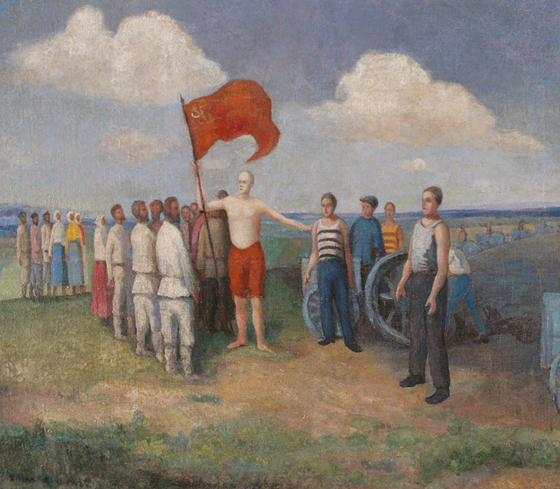 © Private meeting, Germany Casimir Malevich. Lucky. 1930
Today, the second peasant cycle of Malevich can be interpreted as one of the most powerful images of the passive resistance of the peasantry in the 1930s, during forced collectivization. But the images of the peasants of Malevich are not just suffering. They also contain a measurement of utopia, utopia of the outcome from history. Looking at the peasants of Malevich, one cannot distinguish anti -utopia from utopia, the image of violence from the image of freedom. In this tension, the aesthetic force of the peasant cycle consists, based, as always happens with modernism, on internal antinomy. The intonation of the second peasant cycle of Malevich, inseparable from the ambivalence of his content, is the intonation extremely serious and in this limit an exalted and even tragic one. The tension between the figure and the space, between the intensity of the Suprematism inside the painting and the static lack of its potentials, between the picture itself and its historical context, is tragic.
Laziness, idleness, contemplation are not at all frivolity in Malevich, but something very significant that needs to be defended. Malevich does not refuse the problems of labor, on the contrary, it is inside his work that he finds this core of laziness and contemplation. Similarly, Malevich emphasized that his very art is labor, but work associated with laziness and contemplation, "recreation production" [9] , the right to which he defended: Malevich published in 1918 the famous labor “Declaration of the Rights of the Artist” in anarchy. Today, in the post -phorudist (post -industrial) situation, when free time and work for employees of intangible labor are mixed with each other, the problems of laziness and labor in Malevich gains new shades of meaning. No wonder the quote from the text of Malevich “laziness as the real truth of mankind” was located at the entrance to the exhibition “Zero-Permans. The modest charm of the crisis ”of the curator Miriam Varadinis, who took place in 2013 in the New Manege. When we are everywhere required to be pragmatically justified enthusiasm of labor efficiency, the tragedy and utopism of inaction in Malevich can indicate one of the antidotes of this forcible and mundane optimism.
The author thanks Ilya Budraitskis and Catherine Grandvet for the advice when working on the article.
[1] This was written, for example, Boris Groys in Gesamtkunstwerk Stalin (1987).
[2] Kazimir Malevich. "Heads from the autobiography of the artist" (1933).
[3] Natalia Goncharova. Preface to the catalog of the personal exhibition (1913).
[4] Kazimir Malevich. “Suprematism. 34 drawings ”(1920).
[5] Kazimir Malevich. “Lenten as the real truth of mankind” (1921).
[6] Kazimir Malevich. “Man is the most dangerous phenomenon in nature ...” (around 1924).
[7] See, for example, articles “Art” of 1924 or “Painting” of 1927.
[8] Thomas K. “Work and Leisure in Pre-endustrial Society” // Past and Present (1964). These ideas are also retold among Stephen Lovella in the article “Leisure in Russia:“ Free ”time and its use” (2006).
[9] Kazimir Malevich. “Lenten as the real truth of mankind” (1921).