
Translated material
Dialogue with a closed mouth
What remains of the Es-Russia summit
The next Russia -Es summit in Brussels was almost canceled in Brussels, and the program was reduced to a minimum. The New Times looked after diplomatic curtains
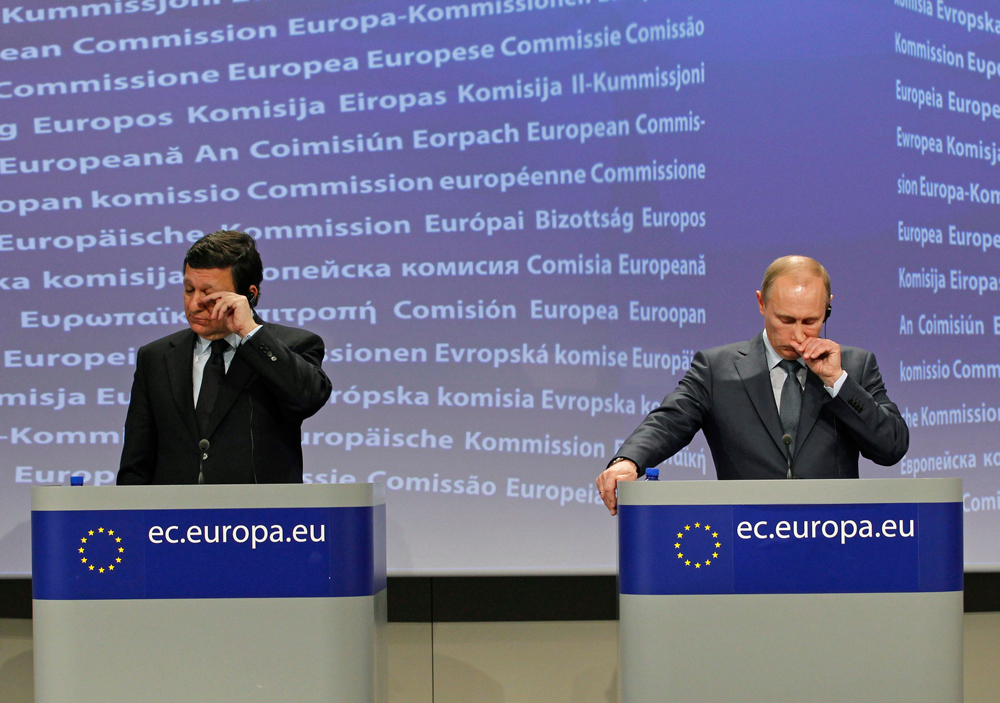
This picture of the head of the European Commission Jose Manuel Barrosa (left) and Vladimir Putin was made in Brussels back in February 2011. Since then, the relations of Russia and the EU have not given a reason for optimism.
The fact that the Russia -Es Summite will be held in a strongly cut -out format, the new European Union ambassador to Russia, Litovets Vigaudas Ushaskas, announced on January 14. Then it became known: the initial program, which included a working dinner with Vladimir Putin in the evening of January 27, negotiations in an expanded composition and a joint press conference on January 28, will be replaced only by negotiations in a narrow composition and press conference. And all-in one day of the 28th. However, according to the diplomatic sources of The New Times, the decision to reduce the program was made before the New Year, all this time between Moscow and Brussels there were negotiations regarding the format of the event. Another interlocutor of the magazine in Brussels generally said that initially Europeans proposed limiting himself to a dinner with Putin, but Moscow reacted hard: the president would not fly anywhere, or we do a normal summit, or do nothing.
Having evaluated the political risks from the abolition of the summit, Brussels agreed to create the appearance of lively negotiations. However, diplomats do not have illusions regarding their results: “This summit will not take place in the format of a regular business meeting,” explained the New Times Vigaudas Ushaskas, “no documents will be signed on it and any specific programs and projects will not be discussed at all. You should not wait for promising statements. ”
Last straw
According to the sources of The New Times, there were several reasons for reducing the program and they accumulated gradually. This is a course in Russia to restrict democracy, violation of human rights and discrimination of minorities, and the free attitude of Moscow to the timing of the obligations adopted within the framework of the WTO, and to the obligations themselves, too: Europeans have always been annoyed by the Kremlin’s habit of using trade as a political impact tool. And Moscow, according to the source, actively applies this tool not only to its CIS neighbors, but also to the EU countries. So, in January 2014, the Rosselkhoznadzor prohibited the supply of dairy and fish products from Estonia, and earlier in October 2013, the Milk War unfolded with Lithuania, which not only preserved at that time in the EU, but also prepared for the Eastern Partnership summit*.
| *At the Vilnius summit on November 28–29, Kyiv refused to sign an association agreement with the European Union, but Chisinau and Tbilisi paraapidized it. ** Yerevan also abandoned the association with the EU and agreed to join the Customs Union. *** cm. The New Times No. 40 of December 3, 2012 |
However, according to all the interlocutors of the magazine, the last straw that overwhelmed the chalk of the patience of Europeans was the unprecedented pressure of Moscow for Moldova, Armenia ** and Ukraine, which led the last to the line of the civil war. “After Viktor Yanukovych failed the Vilnius summit and when everyone became aware of the price of this decision - $ 15 billion promised by Russia to Kyiv, they realized in Brussels: relations with Russia fell to the lowest point, so the discussion of specific projects lost all meaning,” the source of The New Times in one of the European embassies in Moscow said. The pressure on Ukraine was an important (but not the only one) reason in an interview with The New Times and the Ambassador Vigaudas Ushaskas: "It was time to sit down at the negotiating table and decide which way we are moving." In the diplomatic language, this means: the abyss is so great that in general, there is nothing to talk about.
Not to visas
The Russian side was clearly annoyed by the decision of Europeans to squeeze the summit format: one of the main issues on which Moscow was counting on was an agreement on facilitating the visa regime and further progress towards the complete abolition of visas, which Russian politicians talk about at every opportunity. The dream of Moscow was a complete abolition of visas to the Olympic Games in Sochi ***. A similar breakthrough 10 days before the opening of the Olympics would be a wonderful gift to the Kremlin, which is why such hopes were assigned to the summit. The bitterness of disappointment slipped in the words of the Minister of Foreign Affairs of Sergei Lavrov at his press conference on January 21 that Europe uses the issue of visas to achieve political goals: “There is a desire to link further steps along the path of simplifying the visa regime with some problems that are not related to this issue, to break down something from the Russian Federation,” said Lavrov.
The New Times's diplomatic sources in Brussels “refused to understand” the Russian minister: “The roadmap by visas was developed back in 2009, and starting from that time, Russia is very reluctant to take the obligations that itself, constantly shifting the guilt of Europe,” said the interlocutor of the magazine.
"
Moscow reacted harshly: "The president for the sake of lunch alone will not fly anywhere"
"
Russia, at least slowly, but step by step, followed the conditions for the first three blocks of issues to which the road card was divided: the protection of documents from fakes, the fight against illegal migration, including an agreement on the renewal of immigrants from third countries through the territory of Russia, as well as the fight against international crime. But in the fall of 2013 it was the time to discuss measures to fulfill the conditions of the fourth bloc, in the exceptional problem of which no one had doubts from the very beginning, because it concerns the observance of human rights and the fight against discrimination. “In Moscow, it is naively believe that the issue of human rights is pulled out only when you need to scold someone, and then, as soon as relations become friendly, it moves back,” the source of The New Times in European diplomatic circles explained. - However, for us this question lies in a purely practical plane. Russia ranks third in terms of the number of people asking for political asylum in Europe, after Syria and Afghanistan. Yes, there is an agreement on readmissions, but this is not enough, Russia should fight the reasons that encourage its citizens to escape from the country, as if a civil war is in full swing, like in Syria. ”
According to the interlocutor of the magazine, the Russian Foreign Ministry is cunning when he pretends that the conditions of the fourth block of questions arose from nowhere: they were registered in the documents from the very beginning. They reject European diplomats and reproaches by Sergey Lavrov that Europe, they say, approaches Russia with addiction: “To all other countries with which the EU has a visa regime, the approach is exactly the same.” For example, the Ukrainian parliament, despite the fact that he adopted a lot of laws for signing an association agreement that facilitated Kyiv as a visa -free regime, could not vote for the law on the inadmissibility of discrimination at work on the basis of sexual orientation. But in Moldova there is such a law. “This, of course, played a positive role when the EU decided to introduce a visa -free regime with Chisinau in 2015. Russia has to go exactly the same way, ”the interlocutor of The New Times emphasized.
Hungarian irritant
Let it be so. But are there no signs of improving the situation with human rights in Russia, given the liberation of Mikhail Khodorkovsky, Plato Lebedev, who came out under the amnesty of the participants in the “swamp business” and the Pussy Riot group? This argument, judging by the answers of the European diplomats, with whom the New Times spoke, is perceived in Brussels with skepticism. “All this was done on the eve of the Sochi Games,” one of them remarked. -These, of course, are very spectacular steps, but no one in Europe believes that in Russia there was some kind of revolution with human rights and the Kremlin took a new liberal course. Against the backdrop of events in Ukraine, this will all the more have no effect on the course of the Brussels summit. ”
“You need to be an idiot in order to invest more than $ 20 billion in a gas pipeline that may not earn money”
"
But the atmosphere around it is very negative, if you listen to European experts, another decision of the Kremlin affected - to provide Hungary with a loan of $ 14 billion for the construction of two new power units at the PAKSh nuclear power plant, which is 100 km from Budapest, in exchange for assisting the South Stream gas pipeline through the Hungarian territory. “Viktor Orban is a fairly odious politician,” said Michael Emerson, a leading expert at the Center for European Political Studies in Brussels, and a European Commission in Russia, a leading expert at the European Commission, in the past. “Vladimir Putin thinks that, having converged with him (with Orban), he wins something in Europe, but in fact, this causes Moscow’s image only.”
However, according to the diplomatic sources of the magazine, the Credit of Hungary at the summit in Brussels will most likely not be discussed. Another thing is “South Stream”: “At the moment, there are too many legal issues to this project (access to the third supplier gas pipeline, as well as installing tariffs with independent regulators. - The New Times),” explains Michael Emerson. “You need to be an idiot in order to invest more than $ 20 billion in a gas pipeline that may not earn money.” Indeed, even despite the cool disposition of Victor Orban and his ability to resist Brussels, Hungary officially recognized the supremacy of pan-European agreements on national laws, and she will have to observe them, regardless of Moscow loans.
| **** In 2004, the European Court in Luxembourg fined Microsoft at € 497 million, in 2006 the European Commission re-fined the corporation for € 280 million, in 2008 and 2012-additional € 899 million and € 860 million for the refusal to fulfill the decision of the 2004 court |
But Russia, it seems, is worth thinking not only about relations with Europeans, but also about its own money: “Gazprom’s investments can go into the sand if the Kremlin will continue to think that in Europe you can treat the laws as voluntarily as in Russia,” Michael Emerson warns. “Not only South Stream may not earn, but Gazprom may also have to pay millionth fines for violation of antimonopoly legislation.” At the same time, the expert recalls: Europe was not afraid to “offend” its American allies and fined for violation of the antimonopoly laws of Microsoft ****, what can we say about the Russian monopolist. Thus, the expert summarizes, "the Kremlin has no other choice but to learn how to play in Europe according to European rules."
Photo: Yves Hermen/Reuters