
Translated material
Not to the light bulb

The Mikhailovsky Theater continues to rock the opera boat with the help of alien theatrical aesthetics. That is - to experiment with bright dramatic directors that have already formed their style. Last season, Andrei Zholdak, “Eugene Onegin”, set his first opera here. And the performance shot - the other day it is shown in Moscow on the Golden Mask. Now - Andrei's debut of the mighty.
The creator of the Formal Theater has already met a little in his life with the opera genre. In 2003, for example, there was a very large -scale “Boris Godunov” on the Cathedral Square of the Moscow Kremlin (remembered by the pouring rain and the unbending Gergiev near an umbrella). More recently, a very chamber “History of a Soldier” in the Kamennoostrovsky Theater (with bonuses from modern authors). But so, truly, with an opera troupe, in an opera theater-this is the first time for him.
“Tsarist brides” this year the crop: the European version (Berlin -Milan) - at Chernyakov , the home, rich - at the Bolshoi Theater (reconstruction of the historical performance of 1955 with the scenery of Fedorovsky, the premiere very soon, at the end of February). The work of the mighty is a serious addition to this pair of opposites, indicating a certain third path.
The main pretty feature of this work is that the mighty puts the “royal bride”. Which, generally speaking, is completely not obvious to such meetings of the drama and opera - for example, the “Eugene Onegin” by Zholdak, planted in the tough cell of his aesthetics, could be called “Macbet”, “Vozzk” or “Wilhelm TV” with the same success.
 © Stas Levshin / Mikhailovsky Theater
Here the performance does not go across music, the director listens to the singers, gives the listener to be felt during beautiful Aryans (the benefit of the opera is not deprived of them) and applaud after each of the action right in the middle of the action. This does not make him. And at the same time, he does not go into the shadow, Mley from the circus beyond the opera economy (which also happens with his colleagues in the workshop), but fully controls the situation, achieving his goal.
The goal, at first glance, is small. No rethinking of the old plot, new points of view, radicalization of meanings. Also almost nothing about the bloody regime - although it would seem.
In Sama Melodramatic opera of Rimsky-Korsakov, we are talking about love, more precisely, about love-happy, unfortunate, innocent-children, dark-melted, different. And this is the mighty and tells about this.
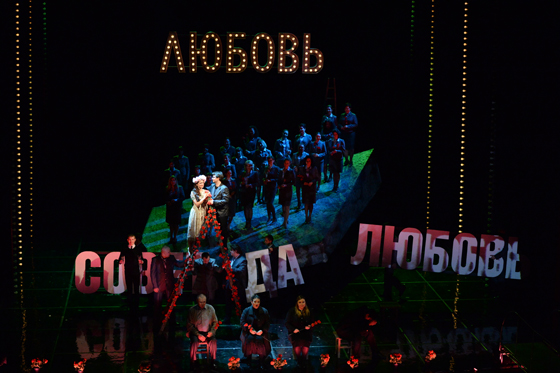
Together with his artist Maxim Isaev, he does not forget to grin the inflation of this concept - this is the word love, folded from large letters, is made onto the stage, light bulbs are burning around, like in a cheap show, and the groom's jacket lights up with electric flashes of the Russian engineering theater “ahe”. But the very possibility of a sincere human feeling is not subject to any doubt.
 © Stas Levshin / Mikhailovsky Theater
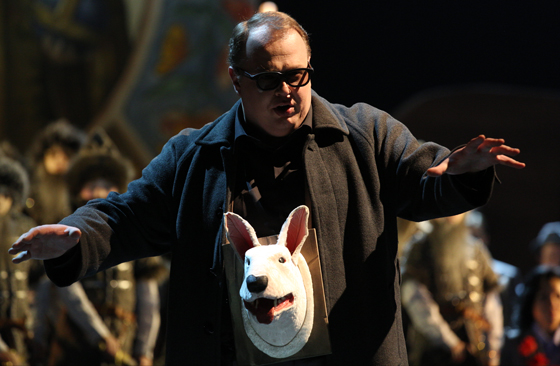
And dirty-the most, of course, beloved by the director-very humanly sinks between two women, this role is perfectly possible by Alexander Kuznetsov. And Martha (Svetlana Monchak) is a touching girl in love. And the defeated Lyubash (Julia Hertseva) cannot refuse sympathy. And the paternal care of Vasily Sobakin (invited from the Mariinsky Theater Mikhail Kit) is a model of comfort and simple -mindedness. And even a ridiculous bespectacled point Lykov (Evgeny Akhmedov) causes a good smile.
The play is generally a lot of humor, and soundless. The king-boy descends from heaven by a fair cloud. There, the word cranes. Downstairs, the words Novgorod, honey, charm, advice and love run down the scene. Yes, there is a lot of things that run, a lot of things can be, as it turns out, so it’s just a simple way to replace with beams and not bother.
And also - and, perhaps, this is the most ingenious idea - you can once and for all solve the problem with boyar beards and brocade caftans. The Great Russian Opera about the oprichnina and Ivan the Terrible, our everything, well, where is it without beards? And they are, these beards, and the caftans are sewn as expected. But wearing children. Like at a children's holiday. The boyars run, frolic, make a terribly pile impression, a tiny king in a hat of Monomakh - in general facial expressions.
 © Stas Levshin / Mikhailovsky Theater
What kind of poorly exprained totalitarianism in the form of a choir of gray women with cloves in their hands or guardsmen with pesh heads in the abdomen are also present, but does not make the weather.
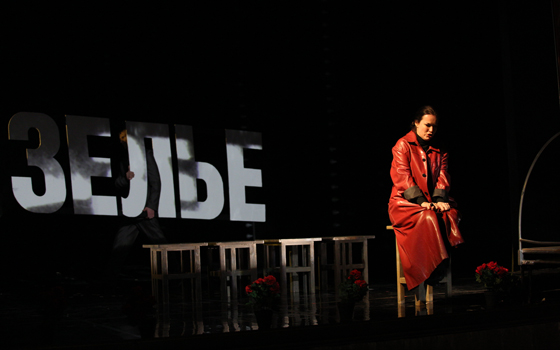
The situation is changing in the last action, when, having had a plenty of amazing the viewer, the directors pull out completely different emotions from him - sadness, longing, anxiety, fear. There is no longer up to light bulbs. A massive, pressing plate hangs over the stage, on which the king’s word pulsates. Heroes climb on stools, as if on a boat. Twelve brides (that was how much was selected for the sovereigns), among which only one real, illustrate Martha's madness. Both the madness of her, and the despair of dirty dirty dirty above her is no longer necessary to sign in large cool letters. The hard, sharp, nervous, not at all Roman-Korsakovsky, and at first the surprising orchestra Mikhail Tatarnikov with screaming shock is completely appropriate. The play, overwhelmed by a mummy children, wooden idols, stools, stairs to the sky and show-off light bulbs, manages to tell about simple human feelings that come out of this bizarre shell completely unmarried.