
Translated material
Dance of death
The first thing you think about, making your way in more than one ten texts about the Gogol Center for the transition of the Kursk station-how familiar this winding path to the beautiful became the usual year. It is hard to believe that at the end of this week, the brainchild of Kirill Serebrennikov, it seems that Kazakova Street was known at least from the beginning of time. The reputation of cultural institutions (not to mention theaters' renom) have been created for years: the experience of the Gogol Center, which has managed to become a symptomatic sign of the Moscow cultural landscape in terms of the shortest possible time, can only be compared with the “garage” with its super-suffering increase in reputation capital.
In the context of the capital's theatrical life, the phenomenon of the Gogol Center is completely unique: the Serebrennikov enterprise, regardless of artistic effectiveness, managed to become a place that could not so much cultural experience as sociocultural identity in a matter of months. There were such theaters for the whole of Moscow one or two at all times and expected: Lyubimov Taganka in its best years is the stronghold of free thought and liberalism and the Bolshoi Theater, which to this day remains an obligatory attribute of the bourgeois savoir-vivre . The smartest software tactics (Trier, Vvedensky, Bunin, Erofeev, Shakespeare, Fassborder), together with an intuitively chopped or thoroughly thought-out image and competent marketing policy, allowed the Gogol Center not only to unite conditional Moscow hipsters around themselves and even more conditional Bohemian bourgeois , but give them an invaluable opportunity to realize themselves as a community.
 © Alex Yocu
Until the past weekend, in a rather diverse assortment of piece cultural products presented in the Gogol Center repertoire-from the Medei, retold by today's stage language to the Broadway musical , was not enough, but a very significant position: a large form of a large form of which in the poster is more than spectacularly spectacular The first year of the Serebrennikov wards summarizes. A staging poem released four years ago at the National Theater of Latvia in the title prose for the Gogol Center, the author was already shown in Moscow at the Net festival, but its current transfer to the metropolitan scene (with insignificant adjustments that did not affect either the strengths or weaknesses of the Riga original) is completely logical-“dead souls” are genetically connected with past work Serebrennikov, either continuing, or in a certain sense, summarizing the “Russian cycle” of the Mkhatov director of the director. The next premiere of the Gogol Center recalled that the Russian classic is not just the territory in which Serebrennikov feels the most confident, but the space that is especially shown by his services.
“Dead Souls”, on the one hand, look like the Mkhatov Triptiha of the beginning of the zero (“bourgeois” - “forest” - “gentlemen Golovlev”), on the other hand, vary and develop the plots of the primitive Serebrennikovsky “Kieze” : it is significant that the main formalist of the modern Russian theater first put Tynyanov and then only turned to Gogol, in which the Leningrad formal formal formal The school, as you know, saw her spiritual father. “Kizhe” and “dead souls” could be a diptych, united not only by a common semantic field, but also with scenographic motives - in both productions of the scene, the chipboard is sheathed. This spatial-visual metaphor can be read differently-we can say that the action of performances telling about Russia as a “country of dead” is happening as if inside a giant coffin, but it would be more logical to assume that a faceless chipboard is a sign of a zero scenographic action, a sign of emptiness: in the “dead souls”, as in “Kizh”, the idea is clearly adjusted that Russia is that Russia is that Russia-Russia- This is the space of metaphysical emptiness, frightening with its absolute irrationality.
The genre of Serebrennikov’s “Dead Souls” is Danse Macabre, the dance of death on the bones of a decayed three bird.
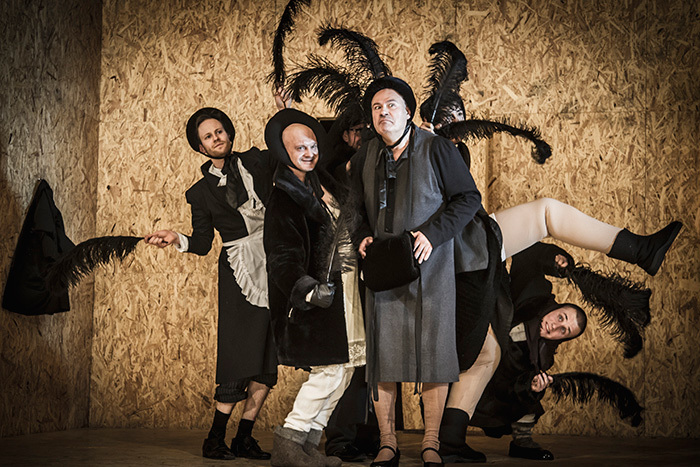
The kinship of two opuses is also interesting in the fact that they are intonationally and genrees, they differ almost diametrically from each other: if Kizhe was one of the most suggestive Serebrennikov’s works (it was precisely the snow -packed snowdrift that was difficult to digested by the capital's audience and decided the fate of this production that was undeservedly quickly removed from the repertoire), then the “dead souls”, the contrast, are opposed. The democratic spectator performance is rare even for the Serebrennikov Game Energy Rabelazian, whose vitality is strengthened by a slight homoerotic fleur (in the Moscow version of the performance, as in the Riga, all Gogol’s heroes-including the box and landlords-are played by male actors). The performance in his premiere condition is definitely shown Oskushka and Utruska: to cope with the pressure of this generously scribbled by the GAGs of the action that does not reduce the speeds for two and a half hours without an interval, so far it is difficult not only to the public, but also to the actors - but even in the presence of fair lengths of “dead souls” are already a perfect spectator hit today. Patuing the addictions of the capital's actors with their eternal craving for beneficence, reprusting and popping (a journey from Riga to Moscow made these qualities of “dead souls” even more obvious), Serebrennikov, meanwhile, manages to enter them into a tough directorial drawing - it seems to work on the territory of the pure mainstream, the director counts in the spectacular (in some places Too) form complex theatrical content.
 © Alex Yocu
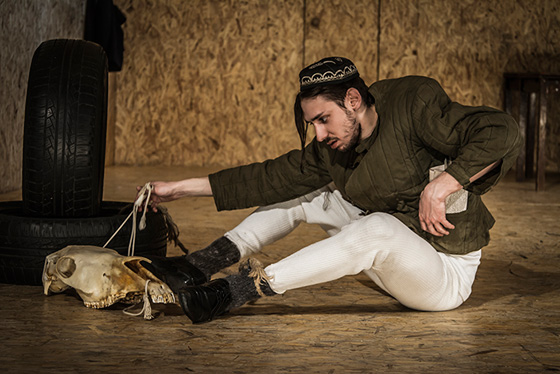
The Genre of the Serebrennikovsky Dead Souls is Danse Macabre , the dance of death on the bones of a decayed three bird, from which only the horse skulls presented to the public remained in the first picture of the performance. The scenes are mounted in such a way that the phantoms step on each other, leaning on Chichikov with stuffy trouble: in the version of the Gogol Center, not the sweetest Pavel Ivanovich circles the lands of the landowners, but they themselves pass by the nightmare parade-alla in front of this after the afterlife stake. The lyrical Motto production is summarized by the great, doomed to Serebrennikov’s independent from the performance, the final zong of Alexander Manotskov “Rus! What do you want from me? ”: Eternal is either the exhaustion, or the sparkling of a Russian person with his restless fatherland.
Everything that happens in the claustrophobic space of conditional Russia is nothing more than imagination, nonsense and absurd: nothing can be sure of anything, everything is actually not at all what it seems at first glance. One of the logical climaxes of the performance is Nozdrev’s checker party, turned into a session of simultaneous game: every game that is running on one sixth sushi, says the director - a game without rules. Or, more precisely, all sorts of rules can be canceled at any time.
 © Alex Yocu
For each of the Gogol’s heroes, his own plastic drawing was invented by directing, everyone was given a careful recognizable social mask - but it is much more important for the dramaturgy of the production that not what Serebrennikovsky Plyushkin from Sobakevich distinguishes, but what unites them into an undeveloped whole. Moving along the route of Dead Souls, the eleven actors of the Gogol Center juggle more than a dozen roles: wherever you throw-everywhere the same digging were the same with their same werewols, such native ghouls. Hence the key plastic image of “Dead Souls”: the road in the performance of Serebrennikov turns into an endless run in a circle. This lapidar-capture metaphor is so obvious that it is even awkward to decipher it: Serebrennikov, if you like, staged a performance about the bad repeatability of the phenomena of Russian life, that life in Russia is a vicious circle from which you can’t jump so easily.