
Translated material
War with "rain"
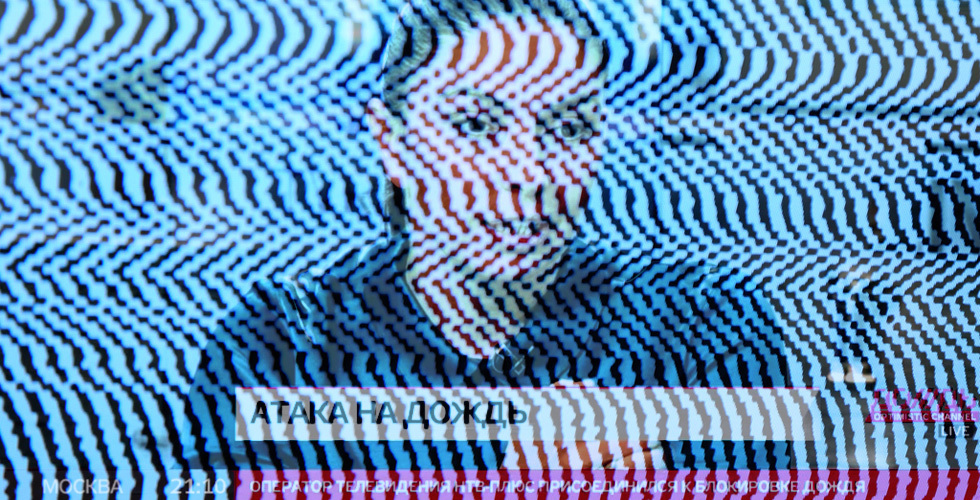
There are several news in history with Rain. For example, the speed of punishment: usually the veins are drawn from the perpetrators, walking through the torment begins-that is, in compliance with the procedures after all, and here everything resembles a psychic attack. Secondly, they usually punish the “owners of the discourse”-and then, as it were, a collective punishment, as in a pioneer camp: no one will go to swim because of Petrov alone. The spectators themselves are punished for a survey at the rain - they are disconnected from the cables and, possibly, they will ban the television channel in general. This collective punishment is not by chance: at first, the question was not so much as a question as the reaction of the audience, and the commentators were indignant at this - that 54% of the audience of rain voted for the fact that the city had to be passed . But this indignation is how you canalize - therefore, everything has come down to an incorrect formulation.
All this has been discussed a thousand times, but I will say again: this voting result is a typical reaction of a modern person. There is no oblivion of memory or contempt for feat-there is simply misunderstanding, and this misunderstanding is to some extent naturally. This is voted by peaceful people, inhabitants, accustomed to the fact that it is always better to negotiate, look for a compromise: they think in the categories of peacetime, and this can be understood and forgiven - but this is exactly the peaceful ethics to them. They are symbolically punished precisely for doubt - for the very attempt to doubt that all the victims were justified. This is already, from the point of view of the state, an attempt on its foundations.
Victims and cruelty are a code of rightness and truth. And this whole story with Rain is actually a story about compassion and cruelty today, and not 70 years ago. Here is the deputy minister Volin says to Kommersant that for such he "would have fired the whole shift at once." So some commander in that war “redeemed the blood” of his own or other people's mistakes-that is, making additional sacrifices (such a case is described by the same Nekrasov in the “trenches of Stalingrad”). Making sacrifices is a mandatory ritual: and this is how the VGTRK behaves in a similar case - it sacrifices a whole editorial office, in full force, nameless. “Rain” here is scolded for the fact that he constantly apologizes, and again, and yet - so that apologies were heard by those who were absent for a good reason in the country. But in the very basis in the behavior of “rain” there is no familiar cruelty to their own - there is no “redemption of blood”. “Rain” does not fire anyone, does not find the switchman, and this is precisely the wrong, abnormal behavior, which is even more enhancing hatred. “Rain” also behaves according to the laws of peacetime, and it is also punished for this - for the lack of proper cruelty to his own.
This whole story with Rain is actually a story about compassion and cruelty today, and not 70 years ago.
All these comparisons may seem blasphemy, but this is the essence of history-that war is still our only common ethics, foundation and moral base. And this case is only a story that we have no other ethics, modern, peaceful, and we all continue to measure the categories of war. Here the conflict is inevitable. And he will always arise. And in this sense, we are all sorry for us all - the deputy minister of Volin, and Podachkin, and cable channels, and those who managed to cut down the “rain” from cable networks in a day and cut it back, and we, arguing about whether it was possible to pass the city 70 years ago; We are all sorry for all of us, because we all continue to live according to the laws of wartime.
The war remains the only ethics, and the illusion arises that if you prohibit thinking or doubt on this topic, if it is fixed in the form of a single textbook or events, it will still be simple: but for each such “war” as a natural reaction, “truthful” appears - precisely as a reaction to the official version. As a result, we all fight for our own versions of the war - for our war against a stranger.
Meanwhile, ethics and memory do not live in direct actions, but in gaps, in chance and reservations: this memory exists on Facebook, where every second post is full of seriousness and pathos and people-the same spectators of “rain”-cut up until 3 nights, looking for all these questions, recalling and experiencing-in a sense this is a correct reaction of society, and everything is natural, until the state does not begin, and does not begin everyone punish.
This intervention instantly destroys the complexity, turns any historical or ethical conflict into political, and everything immediately becomes clear: that it is no longer about the war, but simply the state ran into “rain”-due to the coverage of the Maidan or simply because, in principle, such a phenomenon as rain should no longer be. And I would very much like it because of the war, history, memory-but it is clear that the survey was only a reason, it would not be it-it would be different, and it is pointless to blow on the water. And then it’s still simpler: the political collision with the rain causes natural solidarity, you don’t need to think in the fortress, you need to defend yourself, and there are already no doubts and no controversial moments.
And this simplicity, in fact, is also a very sad thing.
In general, the result has already been achieved: there is no better way to intimidate than to scare, and then let go. And the most natural reaction to this is “but let's not touch this topic from sin away”, self -censorship and psychosis, life in anticipation of reckoning. Let's not go there, let's not get here-the amount of sacred is increasing, and now I write this text, and after each phrase somewhere in a well-known place, fear is born-and suddenly I will insult someone or offend someone's memory of the war. I, wandering the war of the age of 13, knowing the whole story along and across, I, from whom my grandfather passed from Stalingrad to Prague and whose occupation, at the front and partisans died a dozen relatives - this is the first time I am afraid to write about it, and this is the worst.