
Translated material
What is a "memorial"?
Colta.ru continues the heading "Likbez" , in which experts share with us their views on the fundamental concepts and phenomena of culture and history.
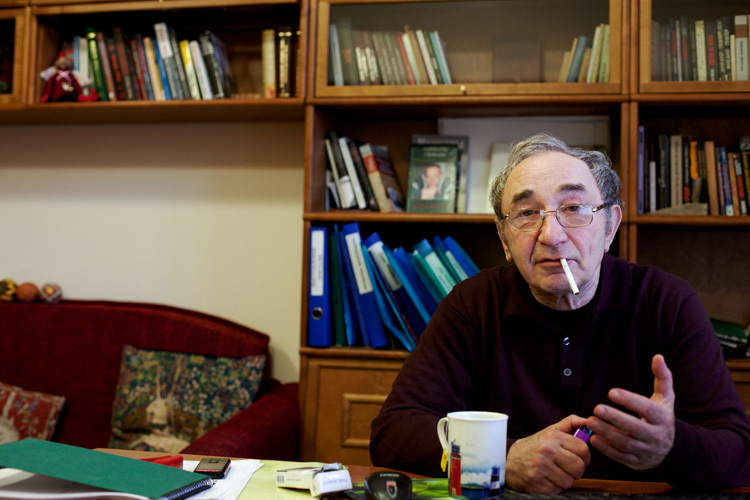
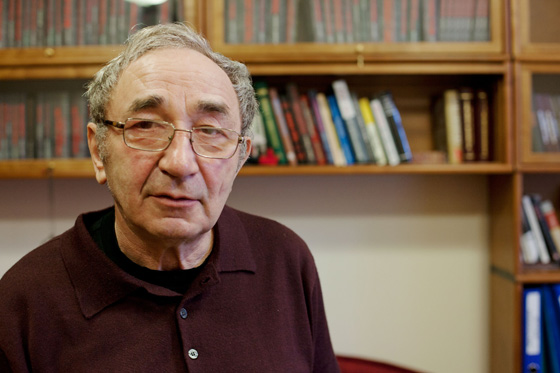
On January 29, the international historical, human rights and charity society “Memorial” turned 25 years old. The Chairman of the Board of the Company Arseniy Borisovich Roginsky told how the Memorial appeared, on what principles it is based, what is its purpose and why it would be worse without it.
Somewhere in the middle of perestroika, year in 1987-1988, the idea of historical truth for a certain period became a kind of national idea.
The fact is that the history of the struggle for rights, freedom and democracy in our country was closely connected with the struggle for historical truth. For many decades, a continuous official lies about the history have been poured into the ears through the reproducers daily, it was crushed through school textbooks and anything. But in parallel there was a family memory that opposed this - implicitly and silently.
And then there was an opportunity to speak. Thousands and thousands of publications began to appear on the topic of the past and on the topic of the truth about the past. In this wave of common interest in Moscow, a small company of young people arose in 1987, calling itself the “Memorial Group”, which formulated its task as “creating a memorial complex of memory of the victims of Soviet terror”. It was about the creation of not only the monument, but also the archive, museum, library, i.e. a center that would be simultaneously a source of recognition and knowledge.
This initiative was immediately picked up in different parts of the Soviet Union: groups began to be created everywhere and signatures to support the creation of the complex. So the Memorial movement arose. At this stage, it was the “Memorial Group” who played an important role in Moscow, it was people like Yuri Samodurov, later the director of the Sakharov Center; Lev Ponomarev, who later became a deputy, now a well -known human rights activist; Nina Braginskaya - now a professor at the RSUSU; Dmitry Leonov; Others ... Two really work from that small group in the Memorial: Oleg Orlov, one of the leaders of our human rights work, and our executive director Elena Zhemkova.
For that era, the Public Council of the Memorial, created according to the results of street polls, played an extremely important role. It was such an anti -Stalinist rating of 1988. There was 20 people, and A.D. played the central role in this council Sakharov, Yu.N. Afanasyev, who then became the rector of the RSU, Ales Adamovich, Yu.F. Karyakin, Evgeny Yevtushenko.
 © Julia Ryzhenko / colta.ru
By the summer of 1988, the movement was already throughout the country, and the idea arose of its institutionalization. After overcoming the many bureaucratic preson in January 1989, representatives from 200 cities of the Soviet Union gathered at the constituent conference. So a public organization appeared under the name "Memorial". Then the task was to register this public organization. It was very difficult, registration took a year. Not only because the authorities resisted. For a long time it was not clear how to register - there was no law on public organizations. Public organizations have been created for many decades by decision of the Central Committee of the CPSU and nothing else.
When Andrei Dmitrievich died in December 1989, Gorbachev approached Elena Georgievna Bonner at the funeral and asked: “What can I do for you?”
“Register the Memorial,” said Elena Georgievna.
This, apparently, was decisive, since within a month it was possible to conspire with the Ministry of Justice, and in January 1990 we were registered - according to the Law on Volunteers (under this law, sports, philatelic, etc.) was recorded). Therefore, our first official name was this: the All-Union Voluntary Historical and Educational Society "Memorial". We began to be called international since 1992, after the Soviet Union was gone.
In general, from 1987 to 1989-it was a kind of “heroic period”, and since 1989, after the creation of a public organization, a long and everyday period of work began, which continues to this day.
Almost immediately, it became clear that it was impossible to engage only in the past without counteracting various kinds of totalitarian, anti -law traditions in the present. Therefore, society very soon transformed into “historical, educational and human rights”, then the word “charitable” was added. Since then, this is how we exist with a more or less changing composition.
When the Memorial was created in 1988, it was a very important outlet - and not only for those who were interested in historical truth or human rights. There were simply politically active people who had nowhere to go - there were no parties - there were no parties, only the CPSU. In the Memorial there were people of various political directions. It was such a society with a certain democratic-free-loving color, but without a clear political narrow line, and there were many, many people. And then 1989 and 1990 came - elections to the Supreme Soviet of the USSR, then elections to the Supreme Council of Russia, a living political life began, and many important activists simply went into real party and/or deputy work.
We want consciousness to be difficult and the identity to be complex, painful.
What do we have in 25 years? About 80 organizations that are part of the Memorial International Society, of which 60 are small in Russia, several in Ukraine and one in a number of other countries.
It is important to understand that we are a fundamentally horizontal organization. The same Ministry of Justice cannot come to terms with this. They believe that the board of such an organization is obliged to control all its members, i.e. All regional organizations included in society, express contentment or dissatisfaction with their activities, organize and direct. And all departments should not be created on the initiative of local activists, but only by decision and instructions of the board. Everything is different with us: there are many “memorials” that arose (many also 25 years ago) on their own, and not by our command. We develop a common line of behavior and offer it, but each individual “memorial” can act as part of the charter at its discretion. This is the most important feature of the Memorial. We also do not provide our organizations financially, they live independently in this regard. De facto is a confederation.
A quarter of a century ago, many saw the future of the "memorial" differently. Some were offered to turn into a research institute, others into the party, but we resolutely evaded both of these capabilities.
Our basic directions-historical, educational and human rights-are interconnected, and what is important-are associated ideologically: we look at history through law and the right with the help of history.
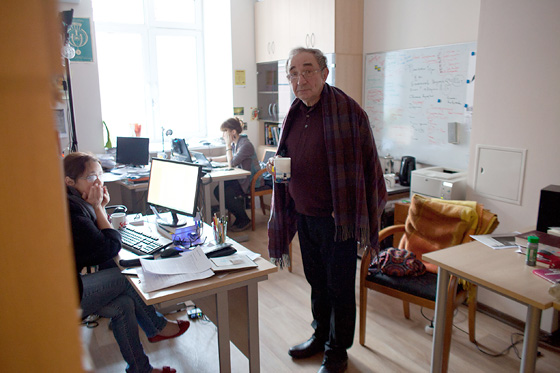
“Memorial” is not a festive, not front, but everyday routine, sometimes rather boring, work: extracting information from a variety of sources, comparing this information, endless checks, correspondence with instances, reports and so on.
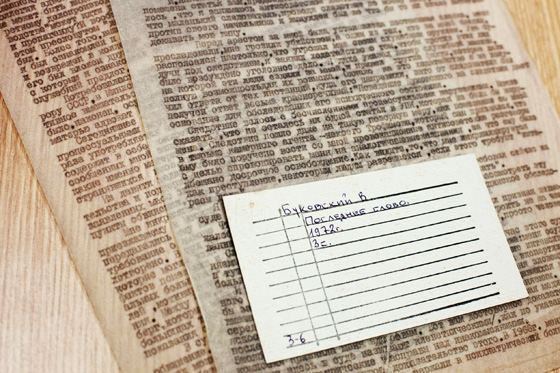 © Yulia Ryzhenko / Colta.ru "Last Word" by V.K. Bukovsky, Samizdat
Here 25 years have passed. Did we defeat or defeated? It is clear that we did not win, because the awareness of this past, which we study as a crime committed precisely by the state in relation to man, did not become mass. People remember the victims, honor their memory, but people are not ready (for the most part) answer the question: whose victims are these? Who is the criminal? If these are victims of the state, then our state was criminal. How to adopt this idea with our eternal sacralization of the state?! Difficult, almost impossible. I repeat, this thought did not.
To do this, at least we would have to achieve a state legal act in which the crimes of the past would be given an accurate legal assessment precisely as crimes. Well, there is a lot of things to do. We did not succeed.
Did we win the main thing, in the transformation of consciousness? Of course not.
Did we get that in our country there were no massive violations of human rights, not political prisoners? Not either. Did they make the life of the victims of the crimes of the communist regime worthy so that, for example, they would receive good compensation? And we did not succeed.
It turns out that the organization worked for 25 years, but this has not been done. How do we evaluate our path?
Nevertheless, there is already an idea of mass repressions, and part of the population thinks why these repressions were possible. To a certain extent, our efforts contributed to the archives to open, so that these facts were well known. And most importantly, it is a rehabilitation law. The only act in which some assessment received the past. The very fact of the existence of this law is an important factor in influence on public consciousness. Yes, we did not win at all, but without us it would be worse.
Not fault, but civil liability.
We are all unhappy with us. “For whom? Are you for those or others? " And all the time it turns out that not for those and not for others. The picture that we are trying to draw both in our activities in the field of history and in human rights work is often more complicated than the schemes imposed on society. Whoever they are imposed.
The last fifteen years is the time of the return and planting of black and white perception of history, black and white consciousness in general. This is an excuse for all crimes - collectivization, “great terror”, others - a victory in the Great Patriotic War. This is the revival of the old stereotypes: “We are good, the West is bad”, “Inside the fifth column, outside the enemies” and all this rubbish.
We directly say about rubbish that this is rubbish, but we have to say about a lot that it is difficult. Well, how with the Maidan, you know? What can we tell us? Of course, we are all our hearts on the side of civic activity, happy by the readiness of society to defend our rights and interests - but Molotov cocktail does not inspire us at all.
In history, almost everything is really difficult, and therefore the very idea of a single textbook of history and a single look is a harmful absurdity. The whole thing is what consciousness we educate. If you remember, our president at a meeting with teachers in 2003 said: “We need to educate our youth with examples from our glorious history” - and this has gone to “our glorious history” that it has only continuous victories. Before the Victory revolution, after the Victory revolution, Dniepers, great construction projects, etc. But it is impossible even to reduce the war to the victory alone and even more so to Victory Day.
Black and white consciousness is again vaccinated: "This homeland, which has always been wonderful, we must love." How can this design include political terror, how to include massive human rights violations throughout the history of our Fatherland, which are not random phenomena, but one of the ways of governing the country? We want consciousness to be difficult and the identity to be complex, painful. This is in the normal Russian tradition, and no great Russian literature, if it was true, was built on the idea of the great and glorious past. It is both great and shameful. And the shameful in it weighs no less.
 © Julia Ryzhenko / colta.ru
Although our victory does not have to talk about, nevertheless there are a number of very successful and demanded memorial projects adopted by the Society. For example, an all -Russian history competition for high school students has existed for more than ten years, which in total have come over the years 35 thousand works. Of these, there are many deep, truly research. They show what schoolchildren were and are, how memory changes, what teachers. We see beautiful teachers, most in small towns and villages. So, from the village of New Kurlak, we received 30-40 works of the first level over the years - simply because there is a wonderful teacher. It is amazing to what extent memory, independence, in general, “independence of man” are held on these local teachers, museum workers, librarians; It turns out that there are a lot of them in Russia - this is the school competition and our other projects convince us.
An important project is associated with the creation of a single database about victims of repression - it includes information from the books of memory published (and sometimes also not published) in different (unfortunately, not in all) regions of the former union by the efforts of different public organizations and government agencies. Now there are more than two and a half million people in the database. This is less than a quarter of the total number of victims - so there are still many work.
Also remarkable projects of our human rights activists to observe the situation in the North Caucasus, their regular reports, reports. They are one of the most important sources of knowledge of Russian people and people in the world about what is happening there from the point of view of not political transformations, but a person and his rights. These projects are already about 20 years old - and the need for them has not been reduced in any way.
And a network of legal consultations for migrants throughout Russia - here the relevance of everyone is obvious.
Our lawyers work with the European Court of Human Rights, and more than a hundred of these cases have been won in the ECHR. These are all important projects, and this is all our everyday life, not very attractive externally and time -consuming.
We did not win anywhere, but without us it would be worse.
Our achievement is also our collections. What is in our archives? These are documents and letters transmitted by the families of former prisoners or former participants in the dissident movement. These are diaries, hundreds of unpublished memoir texts around terror topics. Documents of resistance, samizdat. Many thousands of different photos. These are all documents about a person. The unit of measurement of the "memorial" is a person, a unit of interest of the "memorial" is a person and documents around a person.
All this is sometimes transformed into publications, into the work of researchers who actively use our materials. In films, where our collections are used.
Around human fate, our unique museum collection is built. This is the works of artists created in camps and links, and various objects from camp everyday life. Based on this collection, different exhibitions are created both in Russia and abroad. In Germany, an exhibition “Traces of the Gulag” has been working for a year, prepared by us together with the Museum of Buchenwald. This is a very important exhibition, the first Gulag exhibition in Germany over the years, it has already visited Berlin and Weimar, and ahead of several more cities.
The main value declared from the first day of the “Memorial” is the general accessibility of the archive, the museum, the library. This general accessibility is at the base.
Our most important work, generally speaking, is a reception of people. There are constantly calls, visitors, constant searches. Relatives are looking for relatives, researchers - information about specific people or on repressions against certain social groups. A mass of people is looking for graves, since we have very bad things with information about the burial places of the victims of terror. Alas, the state is almost not doing this. And such people go constantly, daily.
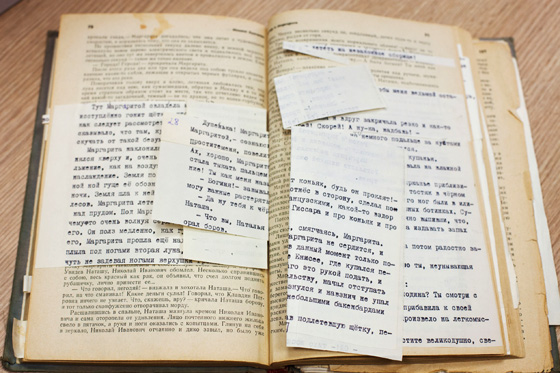 © Yulia Ryzhenko / Colta.ru "Master and Margarita", 1966 with pasted episodes, remote censorship
This human stream is a source of replenishment and acquisition of our archive. People go with questions, and then it turns out that they have preserved the letters of this person from the camp or something else at home. Or we tell them where to turn for information, and then they bring us the results of their searches, answers from different departments.
The question of the fault of the country, the fault of the people. They say to us: "You are to blame." We answer: “We are not to blame. We are not to blame for the fact that our conditional grandfathers shot your conditional grandfathers in Katyn. But we are responsible for this. ”
This is a completely different thing - not guilt, but civil liability. Civil liability is one of the central ideas of the Memorial. If the wine turns only into repentance and you can’t turn it anymore, then civil liability for the past turns into a set of specific cases, into an active life position today - so that the mistakes and crimes of the past are not repeated.
It all is related to today. Everything that the human rights center does is in a motive and is also based on the problem of responsibility for what is happening.
All the time I tried to talk about what was moving from the very beginning "Memorial." This is a desire for historical truth and a sense of civic responsibility. The words “civil liability” are some kind of not very clever, because high, pathos, but in itself this concept is well translated into the language of simple matters.
Our past is both great and shameful. And the shameful in it weighs no less.
We have existed for 25 years and have not achieved the country to think about the past as we think. They did not achieve that human rights would not be violated in the country. I’m not talking about freedom and democracy. Part of the responsibility is precisely on us, and it is obvious that we did something wrong or not actively enough, did not concentrate our forces at each individual moment. Хотя представить себе, что одна общественная организация может преобразовать жизнь страны, — это смешно, наивно, и у нас этой мании величия, слава богу, нет и не было.
Тут надо подчеркнуть еще одну важную вещь: мы, конечно же, не одни. Мы не одни, потому что существует великое множество разных сообществ, которые занимаются тем же самым делом, каждое по-своему. Существуют какие-то журналы и газеты и такие медиа, как ваше, общественные организации и отдельные люди, сообщества музейщиков и учителей по всей России, отдельные исследователи, журналисты. И все работают более-менее в одном направлении.
Я сказал самонадеянную фразу «мы нигде не победили, но без нас было бы хуже», так вот под словом «мы» я подразумеваю, с вашего позволения, и вас, и всех, кого только что упомянул. «Мемориал» — это только один из таких островков независимости и ответственного гражданского действия. Мы одни из многих, вот это надо понимать.
Вот закон об иностранных агентах. Штука не в том, что власть издала очередной дурацкий репрессивный закон, а в том, что ни одна организация не пошла регистрироваться! Они же не сговаривались, а действовали сами по себе. Значит, «мы» есть! А чем мы одушевлены? Мы же не договаривались никогда, что у нас общие идеалы и что мы достигаем каких-то одних общих целей. Это мы знаем по умолчанию, как русская интеллигенция всегда знала по умолчанию. Не сговариваясь, многие и многие действуют более или менее в общую сторону. Глупо (хоть и естественно), что при этом очень многие раздражают друг друга, но это все мелочи и частности.
Да, власть нас недолюбливает и подчас называет нас всяко. Это так. Но все же они вынуждены терпеть нас, принимать к сведению и в некоторых случаях считаться — это тоже результат, и не такой уж маленький, нашей работы.
В наших отношениях с властью главное не то, любит она нас или не любит, любим или не любим ее мы. Это все ерунда. А вопрос в том, можем ли мы хотя бы чего-то добиться от нее. От власти как системы.
Кажется, это сюжет для отдельного — и не короткого — разговора.
Записала Юлия Рыженко