
Translated material
Dorokhov remains
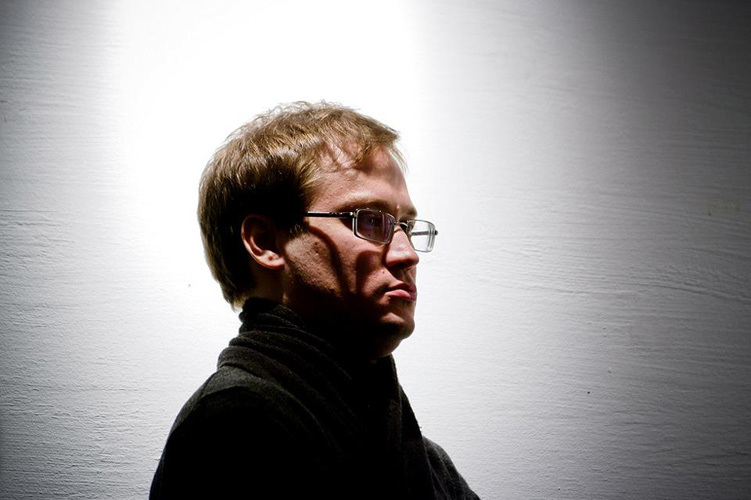
On the night of February 1 to February 2, 2013, the composer-activist Georgy Dorokhov, who was 28 years old, died of a stroke. He was not at all smooth and not calm, but very important and noticeable hero in the young generation of Russian composers. Today on the platform - the evening dedicated to him : the Moscow ensemble of modern music performs the play by Alexei Sysoev “Quiet hour” specially written for this day . And the senior colleague Sergei Nevsky for readers COLTA .ru analyzes the meaning of Dorokhov’s work and reflects how much it was soldered with his difficult life.
I first met the music of Gosha Dorokhov in 2007. It was “ Under Construction ” , a short and filigree creampic play, developing the poetics of Shpalinger and Khuber: an extremely subjective statement, in which fragmentation was compensated by the ultimate honeness of each gesture. Then I heard things for the chamber ensemble: “Elementary particles” and “ Adagio Molto ” . There, the detail of the recording was still preserved, but the syntax has changed, the sounds have become more independent, and their sequence is more monotonous, uniform.
The farther, the more in Dorokhov’s work there was a process that could be designated as overcoming the main convention of traditional composer writing , which is - the interaction of the elements and their influence on each other. Following the evolution of his style, the new scores were increasingly turning into To Do List , into the sequence of instructions for the performers and a description of the order of their actions. And the further, the more often the parties of individual performers were independent of each other.
Nevertheless, all Dorokhov’s things retained structural harmony. Moreover, it was not only about a temporary organization, the verification of which Gosha always carefully cared. Often, the shares of the performers were differentiated by the game method, forming a classic timbre series, a scale (“ La Primavera ” ), or the whole essay borrowed structures taken from the classics (“ Concertino ” ).
In the latter case, it was like the use of simple “song” forms in late quarters and baguator of Beethoven: it seems to be the form of elementary, material in the palm of your hand, and the general action of music seems very strange, distance, a kind of second -order observation, the artist’s look, rising both over the material and over the structure. With schematics, clarity of form, the material could either be emphasized by neutral, either extremely expressive, or both, as, for example, in the “Russian poor” for drums and voices written to open the Museum of Modern Art in Perm, one of my favorite works.
Dorokhov’s critics often indicated at the time of the destruction inherent in many of his scores. For visitors to online forums and many colleagues at the Conservatory of Dorokhov, he was a man who breaks violins and crumbles polystyrene on stage. I myself watched how the Paris premiere of “ Concertino ” , in which the destruction of the violin was clothed in the form of a baroque concert (refrain - intermedia - refrain), the audience reacted with bewilderment - in the end, June Payk was engaged in the same way, the same forty years earlier, and Yani Christ - thirty years earlier.
Nevertheless, protecting his music in numerous discussions, Gosha insisted on the uniqueness of his approach and, perhaps, we will have to agree with him.
The point is not only that returning to the radicalism of the 60s, Dorokhov re-questioned the concert situation, invading the comfort zone of the performer and the listener, deliberately violating the distance, invading personal space. And, invading, he made us understand that all the questions posed by the art of the 60s are still open. In the end, if some things still cause pain, then they are still relevant.
But, I think that the originality of Goshi and the capabilities of his music are just that they have no claims to be “well made”, “in a detailed” art. Their strength, oddly enough, is not exactly, the verification of the gesture, carried out at the only right moment, but in its inflation, replaceability. In his “destructive” things, written somewhere since 2009-2010, there is no uniqueness of the situation, but there is a list, an endless sequence of elements; The shape and duration of the work is determined rather than the wear of the material of the objects used.
While the destruction of the violin in the solder is a perfectly built samurai gesture, a swing of the sword in slow -off shooting, and the scores of Christ have all the signs of a classic form - a tie, climax (in which the tools are usually broken) and catharsis, Dorokhov’s gesture, if not blurry, but intentionally unique. When in the posthumously executed composition of Rondo, the destruction of a variety of objects on stage lasts about an hour, then this is not an articulated break with a philharmonic tradition (like a solder) and not about the riot metaphor (like Christ), but rather about meditative practice.
The most interesting thing is that listening to the late Dorokhov, you listen to the form, recognizing the elements, rejoicing in the return of the sound layers all in new combinations. And in general, in paradoxically, this hearing is quite comfortable today, it does not carry an internal conflict, rather we can already talk about the established convention. And today it is difficult to understand whether this is the merit of Dorokhov (because we are accustomed to his dictionary) or we are talking about a new phase of his work, to which he consistently went through conflicts, through overcoming traditional practices and situations. And only the blood on the hands of the musicians (and the execution of some works of this period requires careful compliance with the precautions) sometimes recalls that the late Dorokhov is still often used “dilated techniques”.
A well -known joke about Schlenberg, who, while in the military service, answered the officer’s question, whether he is Scheanberg, with the phrase: “ Einer Hat Es Sein M üssen , Keiner Hat Es Sein Wollen . So habe Ich Mich Dazu Hergegeben ” (“ Someone had to become them, no one wanted to be, so I had to devote myself to this ”), and is fully applicable to Dorokhov. The severity and radicality of the questions posed inevitably inevitably caused an aggressive reaction of the so -called music lovers, polemicizing with which Gosha only strengthened the uncompromising of his own position.
I often asked myself whether it was really necessary to be in endless conflicts, spending time to clarify relations with Internet trolls and semi -craft visitors to music forums, participate in each promotion of an irreconcilable opposition, in order to steal an evening in a car gut, or to explain to the teachers of the department of the composition of the Moscow Conservatory, in which they are wrong. I myself, a sinful thing, continuously argued with Dorokhov, because it seemed to me that excessive reduction, simplification in some approaches to the detriment of art itself and reduces its capabilities, and the halo of the hero -Autsider, which was formed during his biography conflicts, distracts Gosha from the composition, from creative evolution and calm, lonely lonely, lonely, lonely Questions about the meaning of what we all do (in fact, perhaps it was conflicts that catalyzed the intensity of this questioning).
It also seemed to me that the endless fixation of the discussions about Dorokhov on the external aspects of his music (how many violins suffered during the next performance, can the play for tuning forces last twenty minutes and what the pianist does under the royal) also led to the conversation about its essence, that Gosha is most likely not a hero and not an outsider, that he was painfully trying to formulate a new new one The approach to musical art, but the modus of his life and continuous involvement in the fate of others prevents this final formulation of the new.
Perhaps, in the very recent works ( “ Primavera ” and especially “ Cantata ” ), he came close to this new language, and the detached, absolutely static nature of this music indirectly indicates a certain new support point he found.
Today I understand that a person is not always able to determine the presence or absence of conflicts in his fate, that increased sensitivity and heightened sense of justice (and both of these qualities were fully present at Goshi) inevitably generated them, and Gosh was not in power over their number and intensity. Moreover, I realized that the biography model “everyone’s beloved beginner author is an outcast - a radical - classic (posthumously)”, unfortunately, archetypal, especially in our country. The only question that continued to worry me is how the general condition of the last two years of Goshi’s life, his constant stay in tension and internal discomfort interacted with his work, and would it be possible (summing up all of the above) some other development of events, less tragic and more favorable for him, his music and all of us.
I received the answer to these questions from Goshi himself, during a completely unexpected spiritualistic session that happened in the Moscow Metro carriage a few weeks ago, when I considered this very text. Just at the moment when I was thinking about whether there is an interaction between a tendency to destroy, intentional blurry, gesture inflation in the late Goshik things and his general emotional and mental state - at this very moment the man brought the phone to the ear and said one single phrase into it: “Gosha is normal. Absolutely normal. " Then he hung up. This was uttered with completely Dorokhov intonation and peremptory. The word "was" in the sentence was absent. Okay, I thought. It is better not to discuss with the other world. This is not the classic forum for you. And, mentally thanking the deceased friend for the news, he continued to move.