
Translated material
Blockade: event and meaning
Mikhail Yampolsky - About hunger as a political instrument
Soviet propaganda silent the true tragedy of the surrounded Leningrad. But today, many try to replace historical memory and compassion with pseudopatriotic reasoning
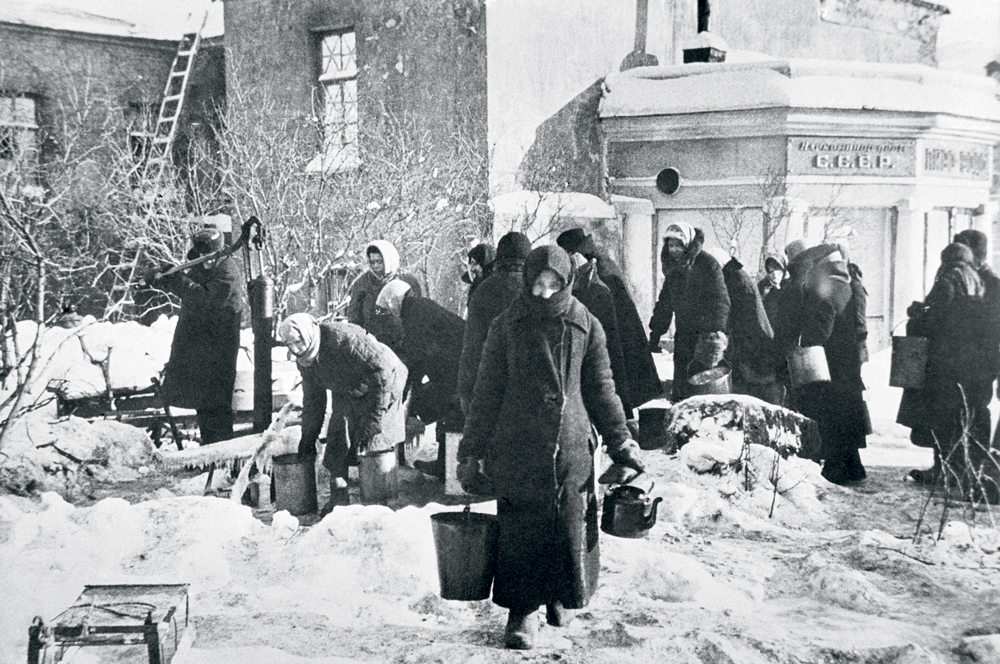
Leningrad, 1941 at the water column installed on the corner of Dzerzhinsky and Zagorodny Prospekt Street
Few people doubt that the question of the Leningrad blockade was cynically used by today's authorities in order to destroy or at least restore the Rain TV channel. But it is interesting that it was the blockade that turned out to be the reason for the outbreak of bullying.
Hunger as a political instrument
It seems to me that the blockade should be placed in the context of the mass destruction of the population, begun Stalin since the 1930s. The experience of the Holodomor in Ukraine showed that the destruction of people with a simple seizure of food is the most effective of all methods. It does not require the organization of camps, transport, specially mobilized executioners. The Holodomor responded to Stalin’s policy, which aimed at destroying fists as a class. Traditional ways of deportation and imprisonment in the camps were not effective enough. In the first four months of 1930, 113 thousand people were deported from Ukraine. For the end of 1930 and the beginning of 1931-32 thousand families. At such a pace, the mass destruction of the Ukrainian peasantry would stretch for years. In 1932, all products were seized from the peasants, and the rural regions of Ukraine were taken into the blockade ring, which excluded salvation. As a result, for 1932-1933, Stalin managed to destroy, according to the most realistic estimates, 3.3 million people.
"
The place of patriotic heroism is occupied by the unbending of the individual. And this begins to read as an anti -state line
"
Hitler used the Stalinist experience of mass destruction of people with the help of hunger and initially applied it to Soviet prisoners of war, which were not fed. By the end of 1941, three million Soviet prisoners of war were in the hands of the Nazis, and most of them were destroyed by violent hunger. Hitler intended to apply the mass execution of hunger and to Leningrad, which was intended for destruction, and the territory occupied by the city was to partially move to the Finns participating in the blockade. The Finns did not want to have a big city on their border. Hitler believed that it was irrational to preserve the population of the city because he would have to feed it. It was decided not to take the surrender of the city, if one is proposed, and apply the Holodomor methodology to Leningrad.
How is the mass execution of hunger different from other forms of execution? The fact that the victim gradually loses its human appearance, although, of course, degradation was not struck by everyone. This was well demonstrated by the Holodomor. In 1932-1933, 2505 people received a term for cannibalism, which became relatively mass phenomenon. In the black market, human was the only type of meat. The police arrested people when she saw smoke over the pipe of their house, which was often a sign of Cannibal Pires. At the same time, the first people who kept the human appearance were the first to die, those who refused to steal, prostitute themselves, those who shared food or were not able to eat human. It is known that in the blockade Leningrad the same depressing picture was repeated, in which no one has to be accused. Cannibalism always accompanies mass and extreme forms of hunger. Such forms of hunger introduce victims into the existential “borderline situation”, as the German philosopher Karl Yaspers called it. The meaning of such a situation is the loss of social norms and the detection of the deep human basis of the individual.
The wrong museum
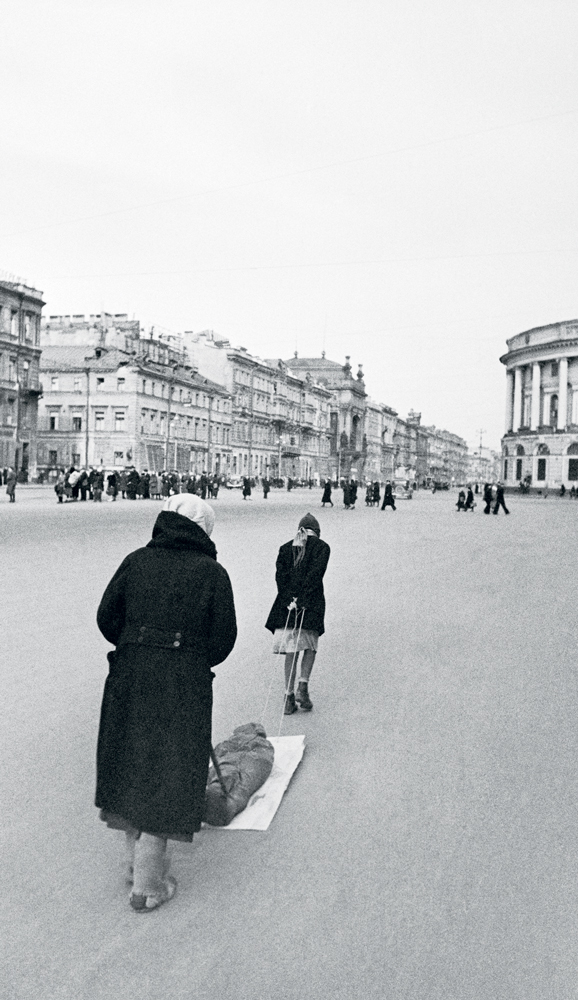 |
| Leningrad, April 1, 1942 Nevsky Prospekt |
All this bloody nightmare, however, got a very special meaning in the context of Soviet propaganda, which, hiding the terrible truth about the blockade, turned Leningraders into a model of heroic patriotism. Leningraders were systematically portrayed as people who are ready for extreme forms of suffering in order not to give in to the enemy. The emblem was Shostakovich, composing the seventh symphony without food and warmth. The task of this propaganda was to, on the one hand, to hide the dehumanization, to tear the Soviet man out of the existential confrontation with himself and to pervert the meaning of the heroism of many blockade, presenting the extreme form of suffering by the practice of achieving the highest form of social and patriotic maturity. (This tradition is still alive when, in some domestic films, holiness is shown as a result of a monstrous dehumanizing experience - “Island”, “Orda”.)
"
The true panorama of Russian history unfolds between the total dehumanization and the tragic struggle of a person for dignity
"
The propaganda transformation of reality was not without problems. In February 1949, Malenkov came to the city on the Neva and immediately visited the Leningrad Protection Museum, which arose on the basis of a temporary exhibition opened back in April 1944. Malenkov was furious and accused the administration of the museum of the anti -party line, the creation of an exposition that emphasized the special role of the blockade in the war and did not take the proper place to Stalin. The museum was temporarily closed and finally liquidated in 1953, and its exhibits were partially destroyed. At the same time, the construction of memorials was suspended. Indeed, the blockade gave little grounds for the exaltation of Stalin, as it involuntarily focused on the individual heroism of Leningraders.
History and interpretation
The scandal with insufficient representation of Stalin is not accidental. Stalin was a source of the meaning of Soviet life. The heroism of the blockade acquired the “correct” meaning only in the context of the general semantic field of Soviet reality. Stalin disappears - the official meaning of heroism disappears, which does not arise from an individual desire to survive and preserve human dignity. The place of patriotic heroism is occupied by the unbending of the individual, the will to maintain independence, the reluctance of slavery. And all this, in the end, begins to read as an anti -party, anti -state line.
It is significant that even today the current Zhdanovs and Malenkovs are just as intensely observing the interpretation of the blockade epic. It is worth disappearing from it to the leader and the state, as in this historical nightmare there is a genuine panorama of Russian history, which unfolds between total dehumanization, atrocities and the tragic struggle of a person for his dignity. The question of the justification of the blockade victims, which sounded on the "rain", is addressed precisely to such an understanding of history. But it is precisely such a vision of Russian history that today's “Politburo” is afraid.
Photos: ITAR-TASS, Mikhail Trahman/RIA Novosti