
Translated material
Along along the "Tunnel of Truth"
How Britain guarded the 2012 Olympics
How Britain defended the 2012 Olympics
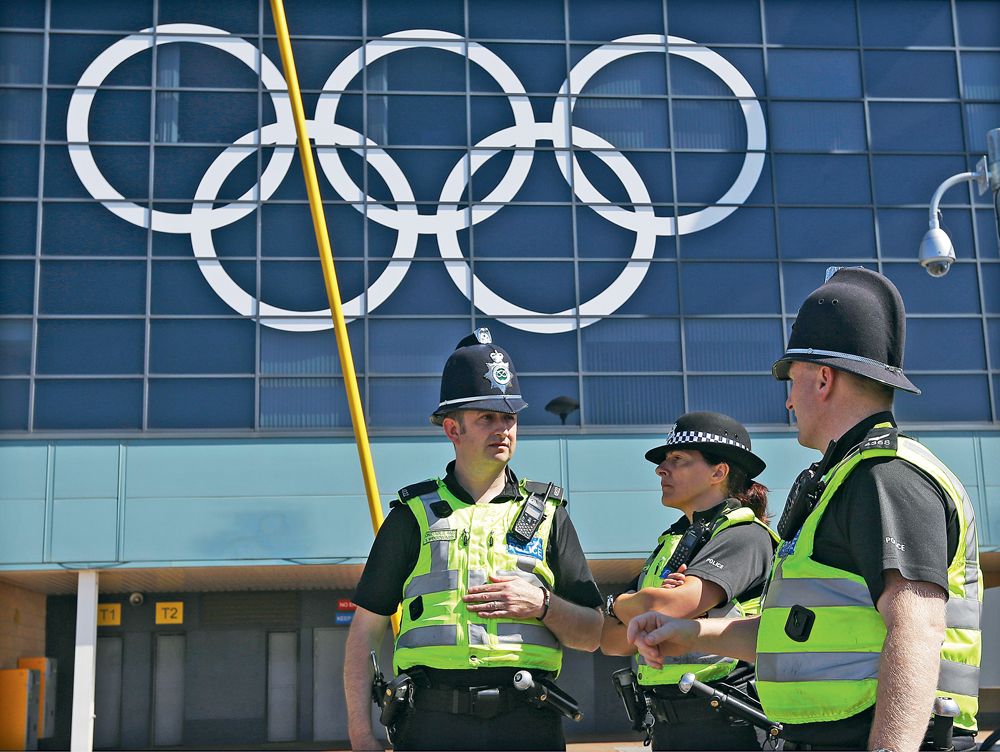
The British police are on duty during the Olympics at the entrance to the stadium in Coventry. July 2012
On the approach to London, the plane that flew out of one of the Middle Eastern capitals suddenly changed the course and began to decline sharply, heading towards the Olympic Arena, filled with spectators. The crew did not answer the needs of dispatchers. The ground services came to the conclusion that the aircraft with a hundred or more passengers on board, including a bunch of children, was seized by terrorists.
Around London, Typhoon fighters were based, a pilot was on duty in the cabin of each day. They could be lifted into the air in a matter of minutes. On the "Iron Ring" around the British capital, the Rapier anti-aircraft missile systems are located, as well as Starstreak launcher. All of them were also in a state of full combat readiness. The first thing you could try to do was to make a suspicious plane with the help of Typhons at a nearby military airfield. But what if there is no time left for this? Or will the plane refuse to land? Then he will have to knock him down. After all, passengers are most likely doomed to death in any case. But if you allow the passenger liner to fall to the stadium, then a great many innocent people will die, and the holiday of the Olympics will be completely crossed out. But who should make a fateful decision? Air Force generals? Heads of special services? No, only the Prime Minister personally.
Such a terrible script among many others seriously considered the British government on the eve of the 2012 Olympic Games, considering it quite real. Indeed, when planning the operation to ensure the safety of games, it was necessary to provide any turn of events. The scale of the operation itself was simply unprecedented: the power structures, the police and the army of Great Britain, still did not know anything like this. According to the British Security Service of the Mi-5, the volume of only one information work-tracking the activity of potential sources of a terrorist threat-increased four times in the Olympic Games compared to “peaceful” time.
"
The volume of information and analytical work of special services increased by the Olympiad time four times
"
To great happiness, no terrorist acts during the Olympics happened, although there were probably many who wanted to commit them. The report prepared by the British counterintelligence said that we should have expected attacks, explosions, shelling and so on from several sides. First of all, al-Qaeda or other radical Islamic organizations, and secondly, North Irish schismatic groups that reject the peace process in Olster. Thirdly, God knows from what anarchist or Suprematist groups (the United States had sad experience).
With the first two, British intelligence agencies have long and relatively successfully waged a systematic struggle, although the explosions arranged by Islamists in London in July 2005 led to the death of 52 people. But since then, all attempts by serious terrorist attacks were able to prevent - and there were hundreds of attempts! Nevertheless, not everyone was sure that the festival of sports in London would take place without a bitch and a bitch.
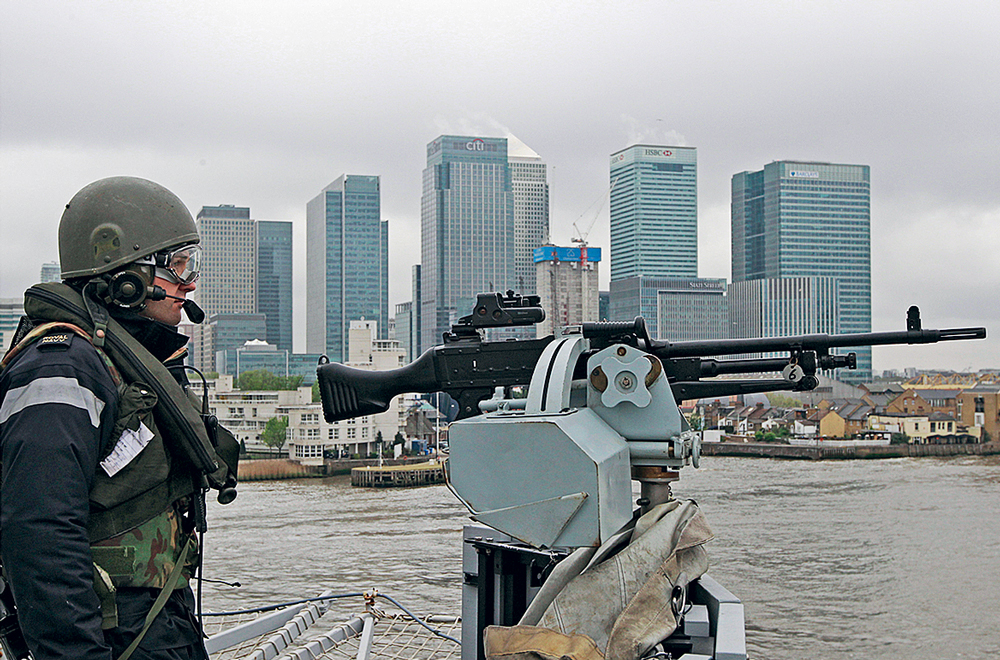
The safety of London games was also provided by snipers. In the picture: during military exercises on the eve of the Olympics. London, May 2012
Waiting for the worst
Many subjects of Her Majesty, if not the majority, did not expect anything good from London games - neither a beautiful sight, nor the sports success of their team. Before the Olympics, it was considered a good tone to grumble: this meaningless undertaking will all cause us countless inconvenience. And how much money will go away, as if in a black hole. And, of course, they expected a wide variety of troubles. The Times newspaper reflected an opinion that widespread among the British when she wrote: “The upcoming Olympic Games will become a catalog of disasters.”
Ten days before the opening of the games, the largest and world famous international security company G4S (more than 650 thousand employees in 125 countries) admitted that she could not fulfill its obligations to ensure security at stadiums and other sports facilities: it suddenly turned out that the proper number of guards (over 10 thousand) is not able to prepare. Initially, Cameron’s government hoped to get by with only 2 thousand guards (as so much pledged to provide G4S), but at the end of 2011, partly under the pressure of American experts, this figure was radically increased - more than five times. G4S promised to cope with an increase in the order, but it turned out that there was simply nowhere to take additional employees. Mostly chronic unemployed, long-worn from any creative activity, as well as recent immigrants, responded to advertisements. Many of them were practically impossible to teach. “Such people cannot be entrusted with a garbage bucket,” wrote Daily Mail about these recruits. Other newspapers painted a terrifying picture: potential security officers who could hardly explain in English, falling asleep in the classroom, unable to distinguish between weapons and explosives on the screen of the X-ray apparatus ... At one of the exercises, the “viewer” was freely dragged to the stadium, a 9-mm pistol hidden in sock ... As a result, about half of the students had to be deducted from the courses.
It seemed that the worst fears began to come true and the disaster was approaching. But the government, we must pay tribute to him, immediately mobilized an additional several thousand soldiers and police officers, and they perfectly coped with security functions. True, the total costs of safety had to be increased almost twice - from £ 282 million to 553 million. The benefit of other articles has formed a small underword in the approved budget.
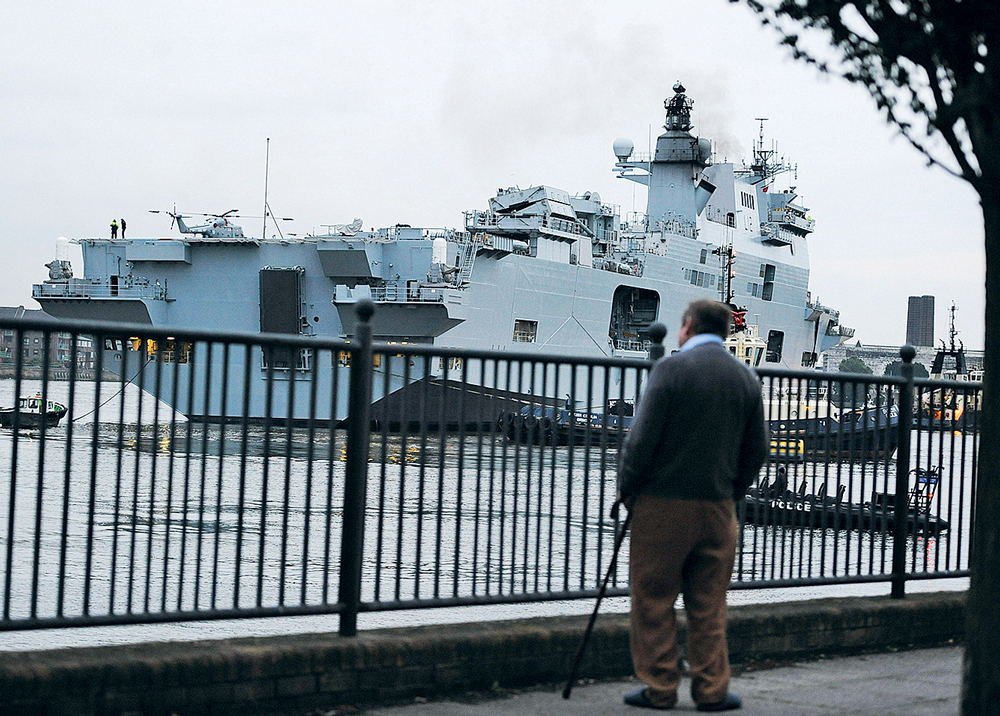
The ship of the British Navy "Ocean"-on guard of the 2012 games. London, July 2012
Both sensor and eye
The opening of the Olympics was so wonderful that it immediately broke the public mood. As a result, everything turned out to be in order with sports achievements, and the weather turned out to be extremely excellent, and nothing terrible happened in the field of security. She was provided with 13 thousand police officers and 17 thousand military personnel. The actions of the army and the police did not particularly annoy anyone, because it was clearly visible: they try to do their job as efficiently as possible, but tactfully, so as to minimize the inconvenience caused to the public. However, not everyone was satisfied.
From the air, the Olympic village and sports facilities covered the air defense systems, and some missile systems had to be placed on the roofs of residential apartment buildings. Which, of course, could not please their inhabitants - they tried to get rid of uninvited “guests”, filed claims, but did not receive support from the judges, had to be tolerated. The warships were on duty at the mouth of the Thames and in the places of sea competitions. The Olympic park was surrounded by high - almost five meters - a fence. Above it was installed an electron-signal fence with more than a meter. Visual control cameras were placed around the perimeter, which allowed to monitor what was happening around the clock. 200 thousand people who visited the park daily passed through four checkpoints, nicknamed the “Tunnels of Truth” equipped with the framework of metal detectors and highly sensitive sensors made by Smiths Detection - they are considered one of the most perfect in the world and are able to detect weapons, explosives and dangerous biological materials. In addition, bags and portfolios for reliability were inspected in a good old way - a human eye.
"
The safety of London Games was provided by 13 thousand police officers and 17 thousand military personnel
"
Finally, volunteers also made their contribution. Safety was not included in their basic duties, but the vigilance shown by these disinterested enthusiasts has simplified the task of security forces many times.
The fight against hackers
The invisible but real threat turned out to be cyber attacks. British Telecom, which acted in close coordination with a specially created information and technological service, was responsible for ensuring the electronic security of the games. “Throughout the Olympics, I had to repel at least one massive hacker attack per day,” says one of the leaders of BT Mark Hughes. - 212 million attempts to enter the system with suspicious goals were made. The most formidable turned out to be the day of Super Subtot on August 4 - then I had to repel 128 attacks. ” It seemed that it was impossible to cope with such an unprecedented volume. But they coped! When asked what the main lesson of the Olympiad in terms of electronic security, Mark Hughes answered: “The correct selection of people and the organization of all processes are no less important than the correct technologies and computer systems.”
According to Jerry Pennela, the head of the IT service of the Olympics, "at least one cyber attack posed a really great threat," but it was also possible to reflect it thanks to the "accurate planning and energy of employees." In general, according to Pennel, the team gathered an "unprecedented number of talented people full of enthusiasm and energy." "And what, there was not one among them who would come to you by patronage?" “This is the wrong case,” Pennel laughs. “We could not take this risk.”
Photo: Ki Price/Reuters, Hussein Malla/Associated Press, Luke Macgregor/Reuters