
Translated material
Art. Made in a test tube
Artists program in Labs has been working in Switzerland since 2003 and offers scientists and artists to look at modern science as a grandiose art object. Thus, Hina Striver and Matti Sweeter, reflecting on the consequences of creating genetically modified organisms and the development of genetic engineering, in 2007 came up with a performance with the metaphorical name of REGROWING Eden at Lucid Field . They interviewed scientists in Switzerland, Vietnam and Brazil, and then with the help of visual means they told how the discussion of genetic engineering in these three countries develops. Before starting work on the performance, the artists spent several months at the Zurich Institute of Integrative Biology. Alexander Jolie in his work Sacred PEANUTS And Fish Skin investigated how the natural sound is born. In Chinese research laboratories, he recorded sounds with which amphibians communicate, and came up with visual support for them. Another Swiss, Christian Gonzenbach, in 2010 presented the installation of Quarc, created during his work at the University of Geneva. This is a design of fluorescent lamps connected by an hour and a half cable, in the center of which is the motherboard, which allows to turn on the lamps in a random sequence. The installation develops the artist’s idea that any unpredictability is predetermined by one or another predictable mechanism. ARTISTS manager in Labs Irene Hediger told Olga Mamaeva what’s in common with science and art.
- Please tell us about Artists program in la b s . How was not the most banal idea - to unite art and science in one project?
- The ARTIS in Labs program began in 2003 at the University of Arts (Z H DK) as a training experiment and gradually began to expand. This program is focused on the study of connections between art and science. Moreover, it is on the example of research laboratories. We help artists in various fields to plunge into the scientific process and become part of it - we place them in residences, organize work in laboratories, arrange joint seminars with scientists. We are just intermediaries, our goal is to establish cooperation between artists, scientists and engineers, they will do everything else themselves. So, artists work in research groups in various disciplines - from biology and psychology to physics and nanotechnology. The impressions obtained in laboratories are then rethought in works of art.
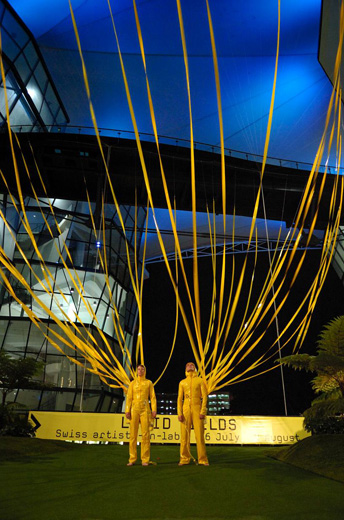 © Institute für integrative biologie (IBZ), ETH Zürich REGROWING Eden at Lucid Field Hina Striver and Matti Sobrich
- Do you work only with Swiss artists and scientists?
- It all started with this, but since 2009 we have expanded the program, now we have made it international. Moreover, we began to expand east. The first country to join Artists in Labs , became China, in 2012 we started working with India. Now our views are fixed on Russia. The access to the international level is interesting primarily by the fact that artists are immersed in completely different cultural contexts. They begin to engage in things that used to seem completely incomprehensible to them. Of course, scientific research seems to be engaged in global problems, united for everyone. But in reality, in different countries, in different spaces, they are closely connected with the local cultural and social landscape. And then it should be studied by artists, not scientists. So, about Russia. We expect that in the very near future, one of the Russian artists will come to Switzerland in order to develop their art projects related to science here. And his Swiss colleague, in turn, will begin to work with Russian scientists. The results of this cooperation - paintings, videos, installations - will then be shown at exhibitions in Russia and Switzerland.
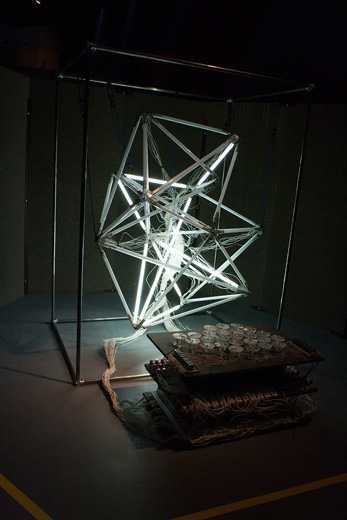 © Université de Genève - Cern Quarc Christian Gonzenbach
- Already this year?
- No, this year there are no plans for now, the project is under development. Most likely, the program will begin to work in Russia in 2015.
- And what are the central topics, reference points of work?
- Of course, it is not surprising that the main topic for them is the ecology, the destructive impact of man on the environment. The contemporary artist today is the conductor of new ideas, so it is important that it is precisely the people of art to talk about an alternative look at the solution of environmental problems, so that in an artistic environment to begin and then conduct a public discussion with those means that are available to artists.
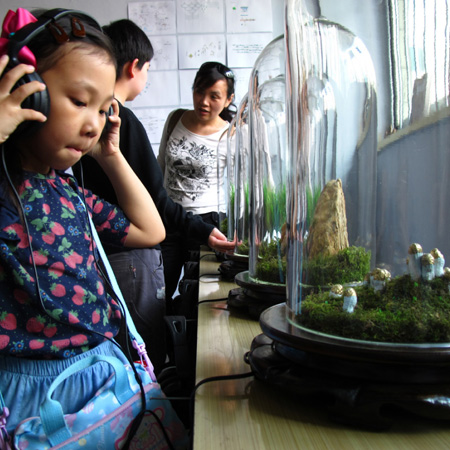 © Chengdu Institute of Biology, China Sacred Peanuts Alexander Jolie
-And yet: what is the main thing for you? Do you just create a new environment for people who are engaged in art?
- If you reason globally, then the meaning is in the development of education, interdisciplinary research and innovative processes at the junction of art, science and technology. Moreover, in the context of a separate laboratory. In Switzerland, there are a lot of different research laboratories that are scattered throughout the country. This is what created ideal conditions for us to launch the Artists program in Labs here. But, of course, the process of artistic and scientific cooperation of artists and scientists does not begin and does not end in the territory of the laboratory, it goes much further. Its goal is the development of critical thinking. Art should wake people. If we can achieve this, it means that we do everything right.
Details here .