
Translated material
King of the North
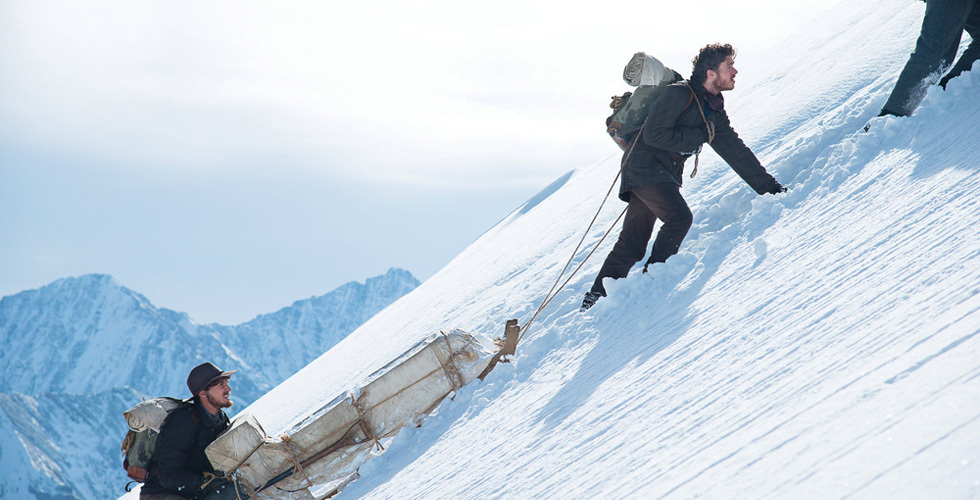
The end of the XIX century, America is sick with a gold fever for the last time. Tens of thousands of prospectors flows to the place where Klondike flows into Yukon to make a fortune - at the cost of marginal efforts, but quickly. This race for gold is one of the most severe in the history of the continent. Instead of the barren drought of the death valley, along which the California prospectors walked, the ice ridges of Alaska. Instead of a freemen, there is a vague threat that the days of single scouts are numbered: officials, railway workers, newspapers and large mining companies are on the heels. So it is necessary to bring to life an American dream quickly-a year or two hard labor in the town of Dawson. Here people die every day - from typhoid, the hands of the Indians, the machinations of competitors, hunger and cold.
The main characters are the New Yorkers Bill Haskel (Richard Madden, Robb Stark from the Game of Thrones) and Byron Epstein (August Prue), romance with empty pockets and heads, full of hope. The first series "Klondaika" promises a dozen conflicts. In New York, the heroes remained debts to the Chinese mafia. In Dawson, they owed the local priest who saved life first, and then the other. Bill became interested in a girl who is looking for a shorter path to wealth than he is. And they were carried away by a local forest princess - a young and tough mistress of the pilrams (Abby Cornish). Byron, not having time to come, made enemies: some will hate him for the fact that he is a Jew, others - for love. In the middle of the episode, a fateful shot will sound, which will quarrel with migrants with local Indians. And then a brutal buyer of real estate (Tim Roth) and Canadian superintendent (Marton Chokash), forced to rush between his own ideas about honor and corrupt authorities, will enter the stage. The heroes will have to take up revolvers. There are still three more hours before the denouement.
Today, only TV shows can afford to play such intellectual games.
At some point, Jack London will be one of the random drinking companions, and Bill inadvertently tell him the name for the novel- “ Burning Daylight " (" Time-no-will "in the translation of the faith of tooper). After that, a curious viewer will go to Wikipedia to make sure that this is not a joke, and will subside: the tragedy described in the series, despite its mythological scope, really took place. None of the key heroes have been invented. In the small town of Dawson, there really was his Pontius Pilate - Superintendant Sam Still, who decided to execute or mercy on the innocent Indians for fun and to please the authorities. Other heroes also have prototypes in history, books and cinema. Along the way, it becomes clear that today only TV shows can afford to play such intellectual games.
The show on Discovery , of course, imposes certain obligations on the show: there are erotica, but there is no sex (one of the main ones, which is already there, the competitive advantages of TV before the cinema), and “interesting facts” are invaded into the dialogs. In between, they will tell us how many times the gold is heavier than water, which staff was the first to allow women to vote and what Russian weapons traders did in Alaska. All this, however, is only ennobled by the series: it has no bodily bottom that competitors are so obsessed with, and saturation with knowledge and historical details relieves the viewer from guilt for aimlessly five hours. The only thing you can regret when you watch Klondike is that something similar was not removed from us. In 1912, on the banks of Lena, the tsarist police, by order of the managers of the Russian-British company, Lenzoloto shot from 150 to 270 Siberian prospectors who staged a strike due to unbearable working conditions. These events are displayed in detail in the book "Gloomy River" and not in such detail-in the series of the same name. But he is already 45 years old.
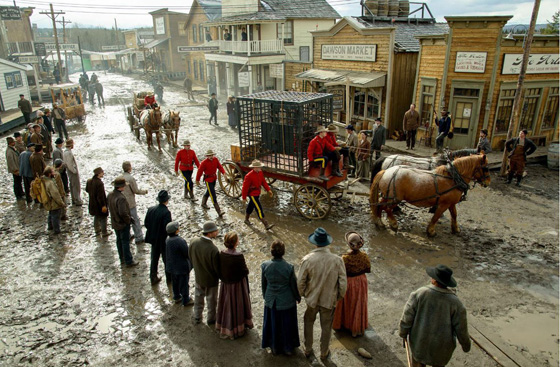 © Scott Free Productions/Discovery Entertainment One/Nomadic Pictures
Klondike produced by the master of the big cinema Ridley Scott, and was shot by television prisoner Simon Sellan Jones, the director of the Underground Empire, Borgia and Generations of the killers. Three one and a half hour episodes allow a mini-series to take the best at a wide screen and TV. All relatively successful films of recent years have been quick and dead - energetic and spectacular, but not very deep. Any delay for them was like death - see the box office of the "Appaluza", "Offers" and even the "Lone Ranger". The television tests - “Dedwood”, “Hell on wheels”, “Hatfield and McCoi” - were the exact opposite of the movie: slow, but alive. “Dedwood” at the same time closed due to high cost, but more dynamic “Hell on wheels” still brings the AMC channel Good ratings, and Kevin Kevin’s mini-series “Hatfield and McCoi” even became the most successful premiere of cable TV in the history of the United States, collecting for History Channel 14 million spectators.
Klondike did not overtake Hatfield and McCoev, but definitely found a gold mine on the border of the cinema and TV shows. He is fast as films, but at the same time alive as a television show. Any modern vertical series is divided into two parts: the one in which the guns are slowly hung on the walls, and the one in which they shoot. The first is usually boring, but in Klondike around this weapon ritual a great cinematic sacrament is organized. The series made his way to the holy of the Holy of the Great Cinema and, taking advantage of his free time, testified to everyone - from Chaplin to Eastwood, from Leon to Jarmush. The film, if it does not go for three hours, can simply not afford such shakes. A well-organized serial scenario, on the contrary, should: this is the same duty as humanizing secondary functions-functions and a convincing reconstruction of the era.
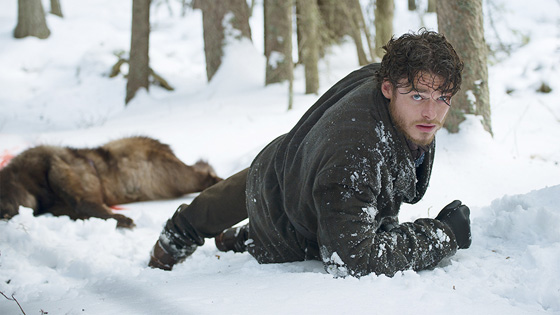 © Scott Free Productions/Discovery Entertainment One/Nomadic Pictures
It is in the Wild West - the original territory of the big cinema - television agricultural Jones seeks to breathe deeply: after all, it is not known what "cops" will have to be shot next time. The viewer from this freemen is continuous joy: instead of one story, he receives four at once (or five, if you count the anti -hero Tim Roth), completely different, but united by a general intonation. In this sense, Klondike looks like a collection of stories by Jack London - who only does what he drinks and talks to the dog. Historical personalities in big cinema as heroes are, by the way, are useless. In costume series without them, nowhere.
When it is time to shoot for hung rifles, Klondike finally turns into something epic: one denouement follows another, the scriptwriters-snipers from point blows go to the canonade.
The first episode has a frontal, but spectacular metaphor. The hero rises to the mountain to celebrate the need, but forgets about the case, because he sees the northern lights. In the same way, you can describe the relationship of viewers and TV shows: you turn it on sometimes to turn off the brain, and you come across a miracle like a “clness”.