
Translated material
Indifference to truth
"Swamp prisoners" in anticipation of a sentence
In the Zamoskvoretsky Court of Moscow, the “Mass Mass Massacities on May 6, 2012” is completed. In the coming days, Judge Natalya Nikishina will go to write a sentence. The prosecution requested tough terms for eight defendants - from five to six years in prison.
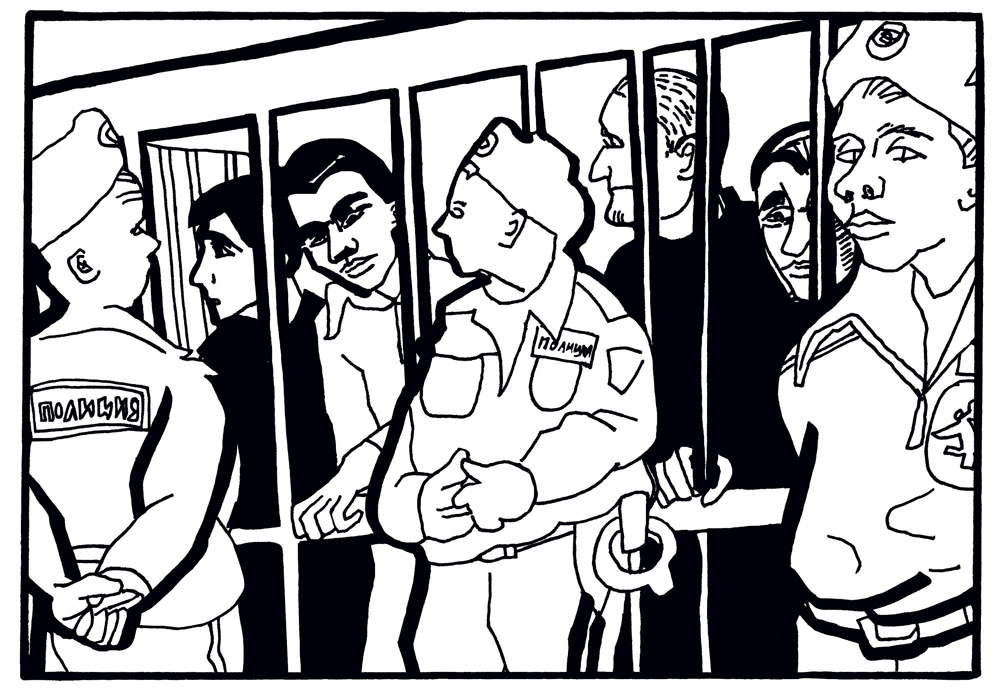
"Swamp process." Zamoskvoretsky District Court of Moscow. January 27, 2014
“The only possible decision of the court in this process can only be an acquittal for all the defendants,” the lawyer Dmitry Dubrovin, who defends Alexander Dukhanin (Naumov) and Denis Lutkevich, finished speech. All lawyers in this process were unanimous: they did not ask for condescension to the defendants, they demanded a complete excuse.
The speeches of most defenders were written in the best traditions of human rights advocacy. And the “swamp process” itself, especially in the last month, when the hearing was transferred to the Malyusky hall of the Zamoskvoretsky district court of Moscow, reminded the political processes of the late 70s-early 80s of the last century.
Only for their own
| *The case of demonstration on August 25, 1968 against the commissioning of Soviet troops into Czechoslovakia. ** A similar situation was in the Hamovnichesky Court in August 2012, when they sentenced the persons to Pussy Riot. |
Forty -five years ago, on October 9, 1968, the People’s Court of the Proletarian District of Moscow listened to the case “On Violation of Public Order and the Slander of the Soviet State and Public Origin”.* As the famous lawyer Dina Kaminskaya recalls in his book, several dozen sympathetic and foreign correspondents gathered near the court building. During this process, the court stopped his work - no other cases obeyed **.
Only relatives were allowed to the process, explaining to the rest that "there are no places in the hall." Meanwhile, it was known that specially selected people - KGB officers and especially trusted students of law universities - were carried out into the hall through the back door. On the first day, the chairman of the Moscow City Court, the ranks from the KGB and the chairman of the Moscow Bar Association arrived at the process.
In January 2014, the story repeated in the Zamoskvoretsky District Court: no one except relatives and lawyers, bailiffs were allowed into the hall; After the hot bickering and calls of journalists to the Supreme Court and the Moscow City Court, only two or three correspondents were allowed to go inside. Why it was impossible to transfer the hearing to the Moscow Court during the debate and the sentence, as was done at the very beginning of the “Swamp process”, it is unclear. The only explanation - the departments supervising this political process, tried as much as possible to limit the publicity of the court hearings and bring down interest in the “swamp case”.
"
On the first day, the Chairman of the Moscow City Court, ranks from the KGB and the chairman of the Moscow Bar Association arrived at the process
"
"Question of moral hygiene"
In the lobby of the first floor, a TV and several rows of chairs were installed - 50-60 people hardly fit on this patch. It is heard badly: the doors are opening every now and then, visitors participating in other meetings enter the court building. But dozens of people stand for hours and watch video broadcasting. What brought them here?
To the question of the correspondent of The New Times, why he came to court, if it is impossible even to get into the hall, 20-year-old Dmitry, a student of the Mehmat MSU, replied: “Not for political reasons. I just empathize with the guys who are here - in the cage. I vividly imagine myself in their place. This whole story is similar to 1937, absolutely Russian roulette. For me to come here is a matter of moral hygiene. ” Pensioner Larisa Sergeevna goes to the "swamp process" seven months. She says that she supports the defendants and wants to "so that investigators and prosecutors know that they are wrong." The children's psychologist Vladimir says that he was on Bolotnaya Square on May 6 and came from solidarity to those who are unfairly judged here.
When a break is announced in the process, all these people go outside, become under the windows of the court and chant: “Freedom! Freedom! " In the hall No. 410, these exclamations are well heard, and eight defendants, who in seven months are already pretty tired of daily trips in auto -zats, humiliating searches and dry rations instead of lunch, smile and look at each other, rejoicing in support.
"The suppressed attempt to storm the Kremlin"
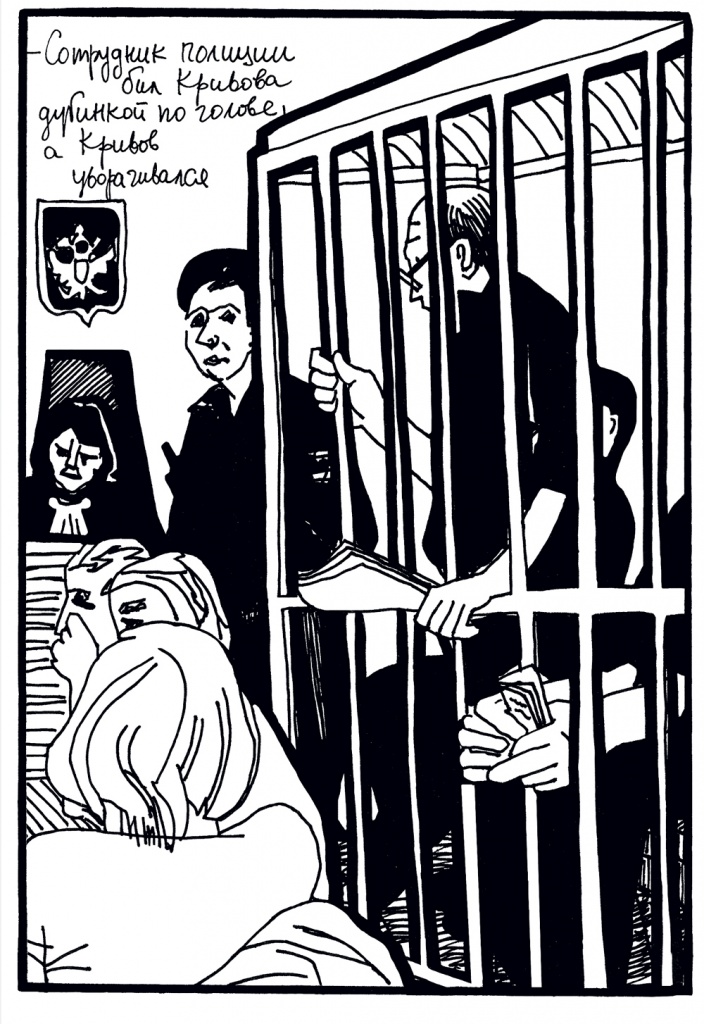 |
| Speakes Sergey Krivov. Zamoskvoretsky District Court of Moscow. January 27, 2014 |
Initially, there were 12 defendants in the “Swamp process”, four of them were freed according to the December amnesty. Seven remained behind bars, Alexander Dukhanin (Naumova) - under house arrest. All of them are accused of two articles of the Criminal Code of the Russian Federation - Art. 212 hours 2 (“Participation in the riots”) and Art. 318 h. 1 ("The use of violence that is not dangerous to life and health in relation to a representative of the authorities").
On Monday, on the first day of the defense, Denis Lutskievich said. He spoke calmly, with self -esteem. He told how, after a night search, on June 9, 2012 he was brought to the insulator on Petrovka, 38, and the operatives forced him to testify to the persons unknown to him. Lutskevich refused. He says that there is no evidence in the case file-neither video, nor testimonies of witnesses that would confirm that he had caused any harm to the police officer Troin, and this employee himself admitted in an interview with Esquire, that he had not seen any of the attackers.
“There are many videos in this matter,” said another accused Alexei Polikhovich. - Prosecutors can argue as much as they like that they see criminal intent, arson, pogroms, mass riots on these records. The prosecutors do not see that it was impossible to go towards the Oktyabrskaya Square until a certain point, they do not see the violence of riot police, broken from the blows of batons of heads, arrogant detentions, beatings. The impudence and lies of the prosecutors Strekalova and Kostyuk struck me. But the most important thing is indifference to truth. The prosecutor’s office is trying very hard to imagine everything that was May 6 on Bolotnaya, almost as a suppressed attempt to storm the Kremlin. The only bottle of incendiary mixture, extinguished after a few seconds, turns into arson in the plural, the trampled on the stupidity turn into pogroms. The Hamsk, illegal action of the police is called the following job descriptions and the provision of law and order. ”
The only bottle of incendiary mixture, extinguished after a few seconds, turns into arson in the plural
"
A woman sitting next to me in a blue booklated suit applauds Polikhovich’s performance. Judge Nikishin asks the bailiffs to take her out of the hall. Passing by the cage, the woman turns to the defendants: “Guys, hold on! Tens of thousands of people support you! " - "Come out of the hall, your tribune on the street!" - the judge literally shouts.
The word takes Sergey Krivov. Next to me is his wife Kira - a middle -aged woman with lush blond hair. She does not look at her husband, squeezes a small black mobile phone in her hands and periodically closes her eyes. Krivov is almost four hours. He talks a lot about the political significance of the demonstration on Bolotnaya, explains why people went to the square, why this was so offended by President Putin, who saw a threat to his legitimacy in many thousands. Krivov recalls provocations of the police, the Main Directorate of Moscow and the Moscow City Hall, which deceived the organizers of the rally. And his wife Kira sighs: "No matter how he damaged himself ... and why talk for so long?"
Deja vu
The lawyer Aleksey Miroshnichenko, who spoke on Tuesday, defending Alexei Polikhovich, stopped at concrete accusations against his client: “Let me remind you that specifically Polykhovich is charged with a mask, I tried to free the detainees, pushing the police hands, grabbed the police officer’s hand, causing him physical pain, tried to push off the metal pain in the group of citizens. The barriers of the police chain ... In court, Tarasov said that he did not experience physical pain from the actions of the protesters. And allegedly for this, my client threatens 5 years 6 months in prison. ”
The lawyer Miroshnichenko stopped on the topic of "riots." In his opinion, there were no mass riots in the area of Bolotnaya Square on May 6, 2012. “Mass unrest is a single -object crime and it is directed against public security,” the lawyer recalled. -The materials of the criminal case and the circumstances established during the court session do not contain actual data that during the events in the area of Bolotnaya Square on May 6, 2012, public security was somehow undergoing criminal encroachments. There was no disorganization in the activities of government bodies, and public order was injured exclusively as a result of actions or inaction of the authorities and their representatives. ”
It is clear that forty -five years ago, a demonstration on Red Square was not recognized as mass riots, but the level of tendentity of the prosecution was almost the same as now. So, the KGB officers who were conducting the case believed that the content of the slogans “for ours and your freedom”, which were held by the participants in the demonstration, could be considered as a violation of public order. And then, protecting Pavel Litvinova, Dina Kaminskaya’s lawyer said: “The very fact of the appearance of demonstrators on Red Square and raising posters does not form a crime. What actions can be qualified as a violation of public order? This, firstly, is the imprisonment of the authorities, and secondly, interference with the movement of transport and interference with the work of state and public institutions. The materials of this case do not contain evidence that Pavel Litvinov provided disobedience to the legal requirements of representatives of the authorities. ” Similar arguments were set out in their speeches by the lawyers of the “Prisoners of Bolotnaya” when they talked about the absence of a crime in the actions of their clients.
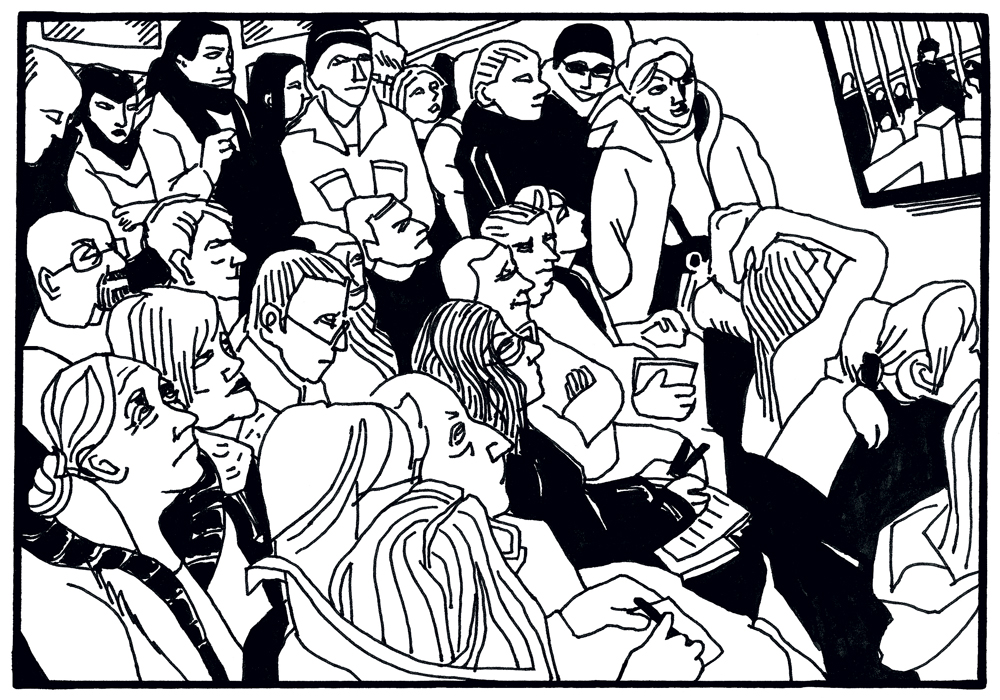
The sympathetic audience in the "Press Plot". Zamoskvoretsky District Court of Moscow. January 27, 2014
Imaginary damage
On Wednesday, on the last day of the debate, the lawyer Dmitry Agranovsky, who defending Yaroslav Belousov, was the first to act. He said that according to the law, "no one can bear criminal liability twice for the same crime." And in the decision to attract as the accused twice, as two different crimes, the same actions of Belousov are described. As a result, he, like the other defendants, was brought to criminal liability under two different articles.
But the lawyer Olga Grigorenko, who defends Alexei Polikhovich, dwelled in detail on the issue of damage, which, according to the indictment, as a result of the riots, the Ministry of Internal Affairs and the Directorate of the Customer of the Housing and Communal Services and the improvement of the Central Administrative District suffered. The amount of damage was 28 228 227.25 rubles. The point that during the demonstration on May 6, police missed helmets, body armor, rubber sticks, and radio stations. In addition, asphalt was damaged in Bolotnaya Square.
Such a significant damage was needed to justify the presence in the actions of the defendants of the crime - participation in the riots. Lawyers did not agree with the prosecution during the process. The consolidated position of protection during the debate was expressed by lawyer Olga Grigorenko. “It is not mentioned about any destruction of property, there is a deliberate substitution and a mixture of concepts from representatives of the state prosecution,” she said. - Instead of the “destruction” of property, “loss” or “damage” appears, which is clearly and obviously not the same thing. In the criminal code, the objective side of the corpus delicti under Part 2 of Art. 212 of the Criminal Code, is precisely the "destruction of property." I believe that the requirements of prosecutors for compensation for property damage are not subject to satisfaction, since no property damage has been established during the trial. ”
Judge Natalya Nikishina must bear the verdict within two to three weeks. Or even earlier
"
Crime crowd
Lawyer Svetlana Sidorkina, who defended Andrei Barabanov, quoted an excerpt from the speech of lawyer Fedor Povleko, which he said in 1897 in the case of riots at the Konshinsky factory: “In this case, a crowd was a criminal, but they did not judge a crowd, but several dozen people seen in the crowd. The crowd was formed by mass instincts, and the crowd of defendants formed investigators and prosecutors. ”
The audience, following the process in the "Press Plot" on the ground floor, applauded to all the acting lawyers. Those, sitting in the hall on the fourth floor, did not hear either these applause or the screams of “bravo”. Having dissuaded, they sat in their place, passing the word to the next defender. In the hall No. 410 it was unbearably stuffy, the defendants read or slept. A large red-haired sheepskin shepherd was breathing heavily, Judge Natalya Nikishina looked out the window or wrote something in a notebook or on a sheet of paper.
When all the lawyers ended their speeches and public defender Alexandra Dmitry Borko, asked the judge to “let the girl to study at the veterinarian,” Judge Nikishin suddenly remembered that there was no lawyer Dmitry Dinze, who should defend Denis Luetkevich in the hall. In this regard, to the great surprise of all those present, she announced that she was postponing the process for a week. And then very quickly she left the audience, without even asking the defendant if he wants a lawyer Dinze to make a speech in his defense - after all, other lawyers in his speeches about Lutskuevich already spoke.
“The judge grabbed the formal reason to postpone the process,” said the lawyer Agravsky. “But she does not have much time to write a sentence.” To date, the term of detention of all the defendants is set until February 24, 2014. And by this time, if literally read the CPC, or the verdict must enter into legal force - and this will no longer be a preventive measure, but a measure of punishment, for example, of real imprisonment, either the judge must re -return to the stage of the judicial investigation, which is extremely rare. There is another way out of this situation. We consider all of our clients innocent, but as an intermediate option we allow the conditional measure of punishment. If the court appoints one, then the term of detention will not be of any meaning. ”
It’s not long to wait for the denouement: the judge Natalya Nikishina must bear the verdict within two to three weeks. Or even earlier.
“We leave after the sentence through the main entrance of the court into the lane ... and we are presented with large bouquets of flowers. Someone hastily apologizes that they are not so big and not so beautiful, and explains that they stole much the best bouquets. Flowers for lawyers were stolen by representatives of the “indignant people”-workers from some of the nearest factories ... /... /They did not stop even before that the doors of the passenger machine in which these flowers were stored in anticipation of our appearance in front of the police. Somehow, a description of the scene remained especially clearly in the memory, when with fierce satisfaction they trampled these flowers thrown onto the asphalt so that not a single living flower is left .../ .../ A few days later, the chairman of the Moscow Bar Association, Apraksin, specially called me: “I asked you to not go through the main entrance. And now your photos with flowers will appear in bourgeois newspapers and there will be trouble again. ”
(Dina Kaminskaya. "Notes of a lawyer")
Illustrations: Victoria Lomasco