
Translated material
Theater as an obsession
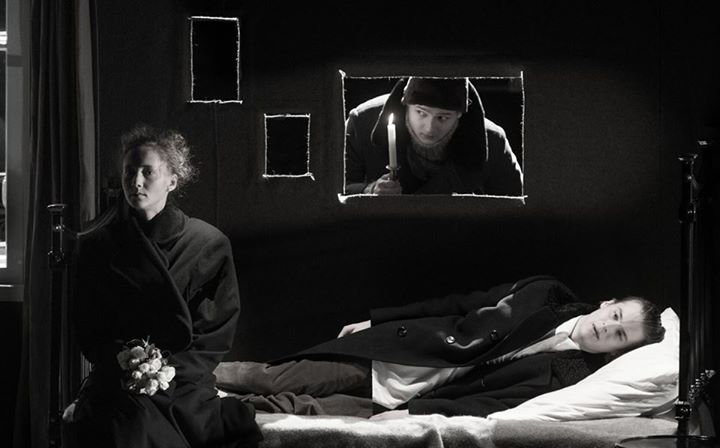
Having cut off his book in the midst, Mikhail Bulgakov never came up with what to call it. The reader is a complete will: if you want, call it with a “theatrical novel” (under such a title, the book was first printed in 1965), you want - “Notes of the deceased”, as indicated in the Bulgakov manuscript. Sergei Zhenovach preferred a less running and more gloomy option, as if deliberately contrasting his stage version of the cheerful performance “Theater Roman”, published in the “Peter Fomenko workshop” two years ago.
The “Fomen” with the main character was the theater himself, and the wife’s only living character was the same dead man, on behalf of which the book was written, while other characters are ephemeral and exist exclusively in the imagination of the writer Maksudov.
 © Studio of Theater Arts
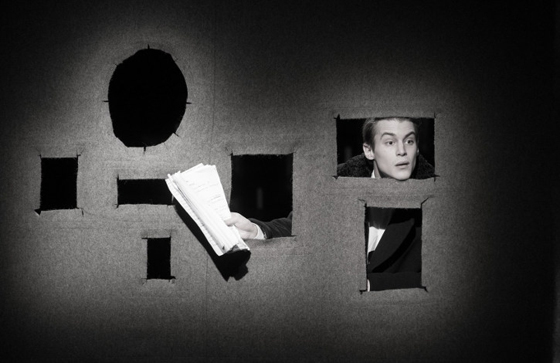
There is no frightened Kyiv in the world where the action of the Roman “White Guard” and the play “Days of the Turbins”, nor the arrogant Moscow, ridiculed in the “Theater Roman” unfolded. All this is only the obsession that are Maksudova in nightmares. You will open the door to the balcony-and the poor fellow-Jew, planted on the Petliur bayonet, will put forward a drawer of the desk-from there with a snake smile, the head of the colleague’s head of the colleague is already stretching into your room. How can I not shoot yourself?
Unlike most directors who tried to stage the “theater novel” before, Zhenovach managed to answer the fundamental question “Why did the Maksudov?” If you follow the plot, then Bulgakov gives answers seemingly completely ridiculous. Because you wrote a bad romance? Because you composed a bad play? Nonsense, in fact, Maksudov’s suicide has a completely different background: you can shoot and should be shot any of us, because life makes no sense. The surrounding reality in Bulgakov’s novels is always low, the scabies and gives it with deadly, and the right to life is given to his heroes only until they dream of high dreams, offering them over the Consumer world. So it was in Master and Margarita, so it was in the Run (play in eight dreams), so the notes of the deceased were built.
The Zhenovach, following Bulgakov, the Stanislavsky and his system, but the in vain and eternal attempts of the artists to win the Drama Theater Rutin and the dead man, hisses.
The novice actor Ivan Yankovsky plays the novice writer Maksudov in the performance of the theatrical art studio, who, on the one hand, is ordered to portray something like a monoscope, and on the other, it was dumbfounded to talk with all demonic obsessions that storm his consciousness. “Demons” is said not for a red word: Maksudov in the performance of Zhenovach is equated with Faust, who concluded an agreement with Mephistopheles (the role of an infernal temptor was entrusted to the publisher Rudolfi performed by Gregory of the Servant, and after that the departed administrator of the independent theater, Gavriil Stepanovich, performed by Alexander Suvorov).
A few years ago, Zhenovach put the White Guard in the Chekhov Moscow Ring Road, where the Turbinsky living room was the focus of all the storms of the Civil War, through which the hordes of junkers marched. In the “Notes of the Dead”, Zhenovach came to the final victory of solipsism. Maksudov - Yankovsky does not leave the room, does not make a mistake, but flopes his leg around the bed in slippers, attracting more and more characters to this center of the universe. Once - and a whole theater was primagnetized, which was immediately located in his room with cream curtains (artist Alexander Borovsky). Two - and suddenly another dreamer, suspiciously brushing at Stanislavsky, was entered on the Maksudov’s bed. This is where a completely different performance begins.
 © Studio of Theater Arts
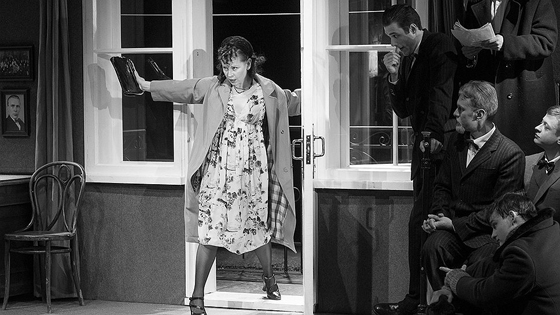
The initiative is hopelessly lost. Maksudov with anxiety realizes that the heroes are no longer subject to the author, but by the protagonist of the performance (now we are no longer “notes of the deceased”, but really the “theater novel”) suddenly came the co -director of the independent theater Ivan Vasilievich in the surprisingly ridiculous and accurate performance of Sergey Kachanov. “I don’t believe,” he spreads his hands upset in front of the artists who repeat several phrases from Maksudov’s play in every way, demonstrating the amazing wealth of false intonations. Having complemented the Bulgakov book with fragments from the “actor’s work on yourself” and the recordings of rehearsals in the art theater, Zhenovach encroached on the most sacred - on the Stanislavsky system. “I doubted the theory of Ivan Vasilievich,” Maksudov tells us in a whisper, watching how the actors blow out of exaggerated emotions. However, Zhenovach, following Bulgakov, is not so much furious of Stanislavsky and his system as in vain and eternal attempts by artists to win the Drama Theater Rutin and Dead. The essence of the Stanislavsky system is to help the actor be alive, but sometimes he suffered a fiasco. “Dry the theory, my friend, but the tree is turning green”-this way, after Mephistopheles, the newly-minted Faust Maksudes could say in the play of Sergei Zhenovach, and then shoot himself. However, Ivan Vasilievich, as you know, does not like shots, and, it seems, the hero will still have to stab.