
Translated material
Visiting Kafka
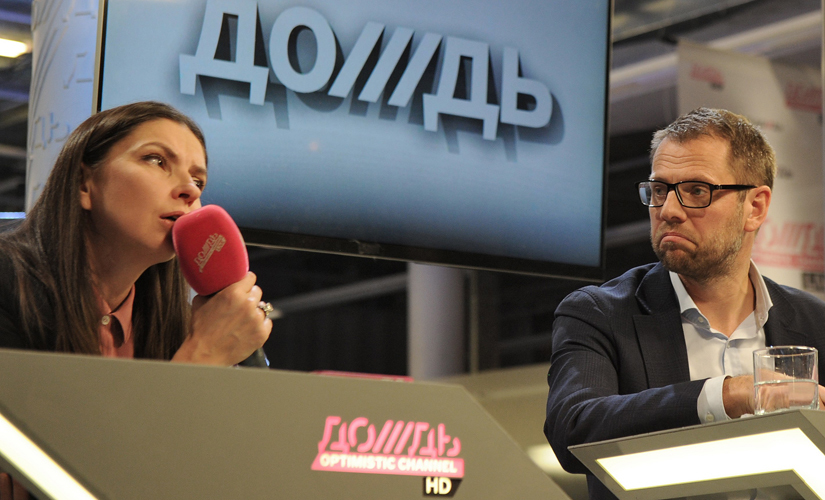
The press conference at the rain was very good-approximately like the first protests in Moscow in 2011-2012. The ones who came here had different motives: to show solidarity, to support colleagues in the “border situation”. And it really was a historical press conference.
True, there is nothing to ask in such cases, the main thing and so it was clear after the statement of Natalia Sindeeva and Alexander Vinokurov (General Director and Chief Investor of the Canal. - Ed. ).
But you can always ask about something else. For example, how many cable operators are left with the rain, and how much it took - and immediately transfer this figure at percent; will there be claims; whether the channel paid off; What the operators say now. The fifth or sixth in a row is a foreign journalist and says that he is surprised why no one asks the question of the most important thing - about the role of Vladimir Putin in this conflict.
There are five more questions from Russian journalists - about the same, but otherwise formulated. Then again the question of a foreign journalist, and so on. Natalya Sindeeva admits that the television channel began to be tested since the fall of last year, when the plots appeared about the summer cottage of Pine. Something was felt, some kind of tension. There are generally many different factors converged, says Sindeeva. Most likely, in general, that there is such a television channel - where you can’t call and prohibit, which cannot be “pressed”.
By the way (this was somehow forgotten), the problem with the survey arose precisely because of the direct broadcast technology-which, in fact, has long been no longer on other channels. The question was formulated in a hurry precisely because there is no internal editing on the TV channel - that is, no one clarifies the boss with what is possible and what is impossible. If the live broadcast was the norm in Russia, then errors would be the norm, and everyone would be used to them, and they would be understood by society as inevitable. But the norm is completely different.
Irina Sandomirskaya says that the main art under the Soviet regime was not cinema, not literature, but an editing, which all led to a single standard. The possibility of editing, retouching, pre -examination is the code of power, any authoritarian power in general. And the violation of this practice is really an attempt on the foundations, on the holy.
That is, the problem of “rain” is not that he says or does something, but that by his existence he erodes a homogeneous palette and reminds the rest of the TV of his professional secondaryness.
And another uncontrolled effect. “Rain” involuntarily began to form a line of alternative stars - by analogy with the “second culture” (the term Dm. Likhachev). The channel creates an alternative fashion for alternative heroes - on those that, by definition, cannot be on other channels. This is also an attempt on the foundations - an attempt to create another, own world.
The rain still has the opportunity to atone for the guilt and correct the reputation - but no one explains what to do for this.
The Kafkian sensation arises when you listen to the comments of the participants in this drama. Cable operators initially claim that their feelings are stuck, holy - and then they speak completely different. Now their explanations look emphasized rationally: no hints of feelings - but "in connection with the inconsistency of the editorial policy of the TV channel, the principles of forming these packages."
At the same time, the authorities seem to send signs in different ways - that the “rain” still has the opportunity to atone for the guilt and correct the reputation; But no one explains what to do for this. For example, during the conference a statement by Rostelecom comes that it does not exclude the return of Rain to a package - if only the TV channel returns its reputation (I retell close to the text, but this is the essence). Alexander Vinokurov, as it were, rhetorically asks - but how can we “return the reputation”?
Indeed, this is a question from another area, these are the problems of the “castle”.
But the rain itself gives tribute to this logic. Vinokurov says: “In no case do we blame cable networks - because we know that they are not out of their own free will; And we hope that we have a long and happy cooperation ahead. ”
That is, Vinokursov is directly - which is not common in the practice of Russian media - emphasizes that the conflict is not economic, but political. But at the same time, he immediately expresses the hope that “economic arguments will prevail over political”, and notes that he continues to believe in the “market rationality”.
This is the main, in my opinion, error.
The actions of both the authorities and large business in Russia have long been irrational, and it is precisely that feeling is intolerance to other forms of existence, professional, ethical and other things. And the more irrationally the motives, the more rational the explanations will look. In fact, everything, including this press conference, can only be understood in the logic of the irrational-there is also logic inside the novel of Kafka or Beckett, but this is the logic of the absurd. In order not to go crazy with this performance, to the participants of which you experience completely sincere human sympathy, you must be a little crazy yourself.