
Translated material
Museums on barricades
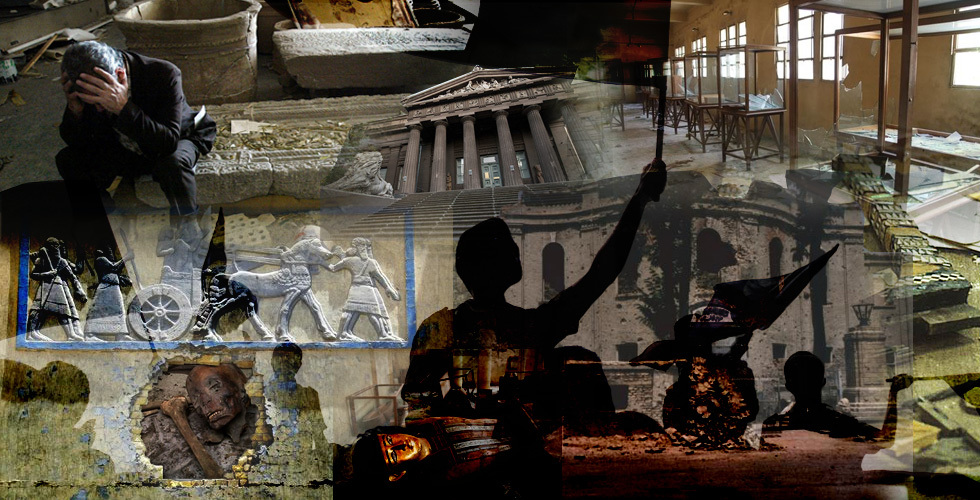
On January 24, the leadership of the National Art Museum of Ukraine (NHMU), whose funds stored over 40 thousand works of art, published an appeal to the authorities and citizens of the country with a request to protect the monument of culture from the destructive actions of all participants in the civil confrontation and recognize its neutral territory. The main art museum of Ukraine is located on Grushevsky Street, which has become the main place of clashes between the protesters and the Berkut. The situation in Kyiv and Ukraine as a whole is constantly changing, but so far there is a threat to NHMU. If the authorities and the opposition do not be able to protect the museum in time, its employees are sure, he can repeat the sad experience of other world treasures, who were in the center of military and revolutionary events. Whether such situations are always dangerous for museums, Olga Mamaeva finds out.
Iraq
The main damage caused to the cultural heritage of Iraq during the American operation of 2003 was carried by the National Museum in Baghdad. Then tens of thousands of exhibits were injured at the hands of the looters, many have not yet been found. The American Archaeological Institute appealed to the US authorities with a request to protect Iraq cultural heritage, but later the plunder of Baghdad museums continued: for example, about a thousand exhibits disappeared from the historical museum. Later, the general director of UNESCO Koitiro Matsuura made the same requirement. A few months later, the American intelligence agencies discovered 700 works of art and 40 thousand ancient manuscripts stolen from the National Archaeological Museum on the territory of Baghdad - including the famous gypsum sculpture “Sumerian Mona Lisa” (3500 BC); Museum employees buried them in the ground to save from death. A significant part of the items was returned by local residents in exchange for amnesty or monetary reward. In July 2003, the American administration arranged an indicative exhibition of Nimroda treasures in Baghdad - after numerous scandals, this gesture was called upon to demonstrate that the United States cares about the preservation of Iraq's cultural heritage.
Afghanistan
In 2001, the building of the National Museum in Kabul, already severely damaged back in the 1990s, was fired by the Taliban city: out of 100 thousand exhibits, no more than thirty survived, a unique collection of statues of Buddha was completely destroyed. In 2003, work on the restoration of the building began at the expense of international funds and private investors from around the world, a year 2004 a year, a year, on September 29, 2004, an updated museum opened. Among the main exhibits is the wooden statue of the Buddha of the 5th century, as well as the gypsum and clay heads of the Buddha. A significant part of the collection is the ancient Greek sculpture, jewelry, documents and ancient manuscripts - all this managed to hide the museum before the arrival of the Taliban.
Egypt
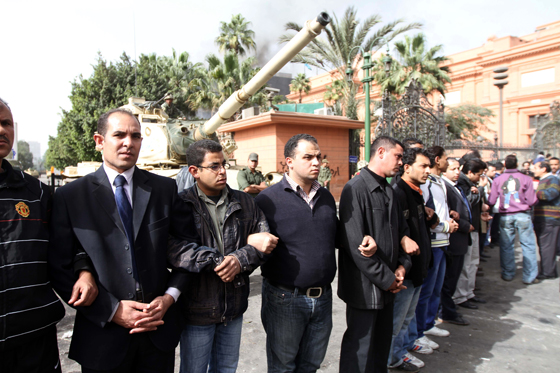 © AFP / EAST News Live wall of activists protecting the Cairo Museum from plunder
During the Arab Spring, which began in 2010, more than two thousand ancient exhibits disappeared from the Egyptian museums. The greatest damage was caused by the Egyptian Museum in Cairo (like NHMU in Kyiv, he found himself in the very center of clashes - on Tahrir Square), when in 2011 mass protests led to the fall of the Mubarak regime. Then dozens of most valuable monuments disappeared from the funds, many were significantly damaged. Civil activists tried to protect the building from looters, building a live shield, but it was not possible to avoid losses: two statues of Egyptian pharaohs were completely destroyed, a rare collection of Egyptian antiquities and a collection of glass lamps of the XI-XI centuries underwent partial destruction, dozens of exhibits were stolen, including a series of silver products. It has not been possible to completely return the losses so far. UNESCO allocated 100 thousand dollars for the restoration of the Egyptian Museum, but private funds are needed for complete restoration. Other treasury also suffered damage: so, the looters stole part of the exhibits of the Roman and Byzantine eras from the vault of antiquities in Kuantar, raided the Coptic Museum, the Royal Jewelry Museum and the National Museum in Alexandria. The building of the National Library in Cairo was seriously injured, where books and documents of the ancient world, the Middle Ages were stored. In the summer of 2013, more than 500 objects of art of antiquity disappeared from the National Museum of Malawi in the city of El-Miny. Search is to this day.
Syria
The plunder of Syrian museums, libraries, cultural monuments and temples located in the territory of the hostilities continues today. Last year, UNESCO included 40 monuments that are facing the threat of destruction in the list of world historical and cultural heritage. The media report that about a third of the Syrian museums are looted and destroyed, but no one can name the exact figure - it changes daily. The chances of returning lost artifacts are close to zero - those that survived fall into the black market. In addition to museums, 11 necropolises of the Roman Empire and the Arab Caliphate were destroyed in the country. The ruins of the royal city of Ebla, the monastery of St. Simeon Stolpnik, a number of cities in the north of the country were partially plundered and destroyed.
Ukraine
The “Orange Revolution” of 2004, in fact, became a peaceful protest of the middle class and to destruction similar to what happened in the Arab countries, did not lead. For the most part, artists and the museum community were on the side of the Maidan and were prone to the famous poetization of what was happening. So, in 2004, an apologetic exhibition “Yes!” Opened in the Kiev house of the artist in the Kiev house of the artist. Orange Revolution ” - a collection of photographs, paintings, sketches and cartoons made by participants in the protest movement right at the scene. Then the idea came up to create in the Ukrainian capital the Orange Revolution Museum (its author was the rector of the Kiev-Mogilyansk Academy Vyacheslav Bryukhovetsky), supported by a number of artists and public activists. However, things did not advance beyond words. However, the events of 2004 have repeatedly rethought in the works of Ukrainian authors. In 2005, a large documentary exhibition “Orange Revolution was opened in Kyiv. One year later, ”organized by the Smoloskip Publishing House and the Ukrainian Samizdat museum-archival. And in the Moscow Gallery of Marat Helmann in the same year, they showed an exhibition of paintings by Kiev artist Vasily Tsagolov “Ukrainian X-Files ”-an ironically-integrated look at the Maidan chronicle.
OCCUPY WALL STRET
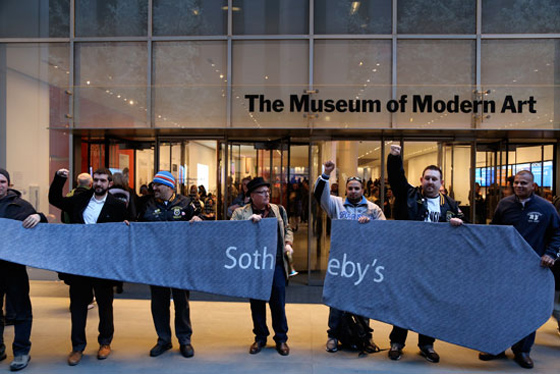 © OCCUPY MUSEUMS
The most bloodless and unification was the series of protests by OCCUPY WALL STREET , which appeared in 2011 in New York in disagreement with the economic policy of the US authorities and the hegemony of large corporations. His activists quickly enlisted the support of the museum community and artists around the world. Famous writers, musicians, directors, actors: Salman Rushdi, Elis Walker, Pete Ciger, Radiohead group, Michael Moore, Alec Baldwin, Sasha Gray and many others joined the actions. The artist Yoko, expressing solidarity with the protesters, recreated her 1981 project “Dirva of desires” (it was originally conceived as a rally of John Lennon’s memory and was a tree decorated with notes from his fans) - 10 thousand cards with words of support that were distributed throughout the country. In October 2013, the MOMA New York Museum of Modern Art acquired three dozen posters of local artists created in support of the OCCUPY Wall Street protest promotion. The posters, which in 2011 held thousands of protesters in 2012, were collected by the Brooklyn alliance of artists in the OCCUPRINT PORTFOLIO project. With the growth of the popularity of OCCUPY WALL STREET, he has an independent branch of OCCUPY MUSEUM - a movement opposing corruption, a hard hierarchy, inequality of labor conditions in traditional cultural institutions and advocating their total and violent change (with the OCCPUPY MUSEUM manifesto, you can get acquainted with here or here ). Activists of the movement raised these issues, in particular, at the VII Berlin Biennale of Modern Art . Potentially, the OCCUPY MUSEUM movement could more radically affect the future of museums than sporadic, albeit destructive, cases of robbery or vandalism.