
Translated material
Praise of all smallness
In the Moscow metro, they are very fond of giving annoying instructions to passengers. Only advertising sounds more often, sometimes completely indistinguishable due to the worthless quality of the speakers. It’s even a pity for advertisers - in vain money flew away. So, among the instructions, warnings regarding spontaneous advertising, which are pasted with various kinds of suspicious well done with running eyes, just prevail. Being out, as a rule, a crowded wagon, they almost glue home -made pieces of paper with offers on your forehead, for example, get a loan in just 30 minutes or purchase fake talons of inspection or sick leave of the character equally unrighteous.
The warnings that such an advertisement “may contain deliberately false information” does not act on anyone, although any normal passenger should have been elementary to annoy the walls of wagons, sloppyly covered with finely trembling multi -colored leaves. However, this is not surprising. The city dweller, traveling in the subway, feels like a temporary passenger here. He does not want to admit to himself that he is actually registered here, and forever, and was sentenced to spend only a little less time allotted for sleep. Therefore, he perceives everything that is happening around as something spontaneous.
Outstanding German-American Protestant Paul Johannes Tillich (Paul Johannes Tillich) in his speech “On the Future of Religion” (“über die zukunft der religion”) noted that “the average layman, even if in his profession it reaches the famous ranks and acquires a reputation, has a reputation, has the usual Decisions that determine the life of the society to which it belongs, as a kind of turn of fate, on which it has no influence. ” All this describes the philosophy reigning in today's Moscow. And this applies not only to ugly pieces of paper on the walls of wagons. The president can reign at least thirty years in a row - it does not concern me. The same thing in the field of its own history. Recently, the townsfolk has been more and more often glued paper on the foreheads, which “can contain obviously false information”, but this ultimately does not care.
Many say: “And what about the story? This is always four in the exact sciences twice, but in history there is no such thing. Everyone can bend her at their discretion. ” I object decisively. Galileo was persecuted precisely twice two, that is, for the assertion that the Earth rotates around the Sun. So in the exact and in the natural sciences there were battles, and what else. On the other hand, I would like to send immediately to the two great Germans - Leopold Ranke and Max Weber. The first laid the foundations of a strict empirical study of the mass of historical facts, indicating, for example, that it was impossible to explain what happened before, from the point of view of what was later. For example, one cannot say that the Holodomor was an “action” exclusively against the people of Ukraine. Comrade Stalin nevertheless surpassed his German colleague and managed to kill millions of Ukrainians, Russians, Belarusians, and all who could not be saved in peacetime. Because he was really a very “effective manager”. Then plants and factories were built on the bones of these people of various nationalities, which produced weapons for the worldwide dictatorship of the proletariat.
The whole world is shaking the crisis, and in Switzerland it is practically not felt. Cause? 99% of enterprises belong to the category of small and medium.
And Leopold Ranke said that not only persons, but also documents are important for history. He taught to carefully collect documents and critically analyze - like this (and here we go to Max Weber), as the crime man at the crime scene does. Let us recall the wonderful series “C Si” and all these investigators with brushes, laying out dust and vills in bags. The historian does the same, observing no less stringent rules. If we return to the same holodomor, then Moscow, in which all historical traces are stored, must be the first, without looking at the false sense of “national pride”, to lay out all the documents in order to create a field that does not allow various kinds of incorrect, primarily from a purely scientific point of view, interpretations of events. And even more so not to destroy and not hide the documents, because the destruction of historical documents is equivalent to the elimination of evidence, and who is engaged in this matter, as a rule, who? .. Exactly!
The courage of the historian is to follow the laws of science. Any historical situation should be excluded initially. And most importantly, the state should be interested in the fact that historical studies are primarily true from the point of view of elementary craft. Because true patriotism is not hasty inventing of new holidays of fictitious folk unity, but in giving an accurate diagnosis. An example here is the great German historian Hans-Ulrich Wehler , who, having recently completed his “history of German society” (he worked on it for a quarter of a century), came to the conclusion that, for example, the energy of the post-war revival of Germany was only an energy redirected into a peaceful course, which led to Nazma in due time. In other words, the Germans are in Nazism, that in capitalism, still where, follow with the same care and sequence. Offensive conclusion? It is possible, you can argue, but you can be sure that, at least, the “craft” is executed at the highest level, all dust particles are laid out in bags.
Switzerland, by the way, is very similar to Russia. Until 1990, before the famous speech of Fr. Dürrenmatt about the Swiss, playing the rooks and prisoners at once, in the country everyone was sure that the history of the Confederation is one even movement from the meadow Rutley to the present under the banner of the only faithful teaching. See, by the way, old photos are at leisure. Street campaigning in Switzerland and the USSR of about 1939 almost does not differ either in form or in pathetic content. These were still societies of the same type-closed (K. Popper). In Switzerland, however, food has always been in abundance.
But in 2006, in Canton Zurich, a school “Reading Book” called “Hinschauen und Nachfragen” was released - Die Schweiz und Die de NationalSozialismus Im Licht Aktueller Fragen ” Switzerland and the time of national socialism in the light of relevant issues ”). There are no, of course, statements equal to allegations about Stalin and his “effective management”. However, it is directly stated that the confederation, speaking in today's language, laundered money for Hitler Germany. Of course, screams began about the overwhelming national honor, but in the end he outweighed common sense. After all, an honest attitude to your own history in the long run is always much more profitable. And most importantly - documents. They must be available. So that forensic historians can come and do what they are obliged to do, namely, to bear the verdict. Unlike the investigator, the historian can do this. And even obliged. In Germany, this happened, in Switzerland - happens. And I'm very happy for them.
In Russia, merchants do not compete for the market, but for access to the body of a ruler who personifies both power and property at once.
And now a little about something else, although in fact about the same. My grandfather was a railway worker, and he received a plot for the country in the 1950s. In the immediate vicinity of the railway canvas. All my childhood passed in a situation of permanent earthquakes-there is a train, and the world is feverish with a capacity of three or four points on the Richter scale. From the worst, I constantly asked myself the question: why is the embankment along which the rails pass - by and large a bunch of stones is not rolled out in different directions after a powerful product? The story of Switzerland all the time was a history of crushing, unification and again a section on small pebbles-kantons. But no matter how rummaged through these pebbles a rink of history, they did not roll anywhere, preserving some almost mystical connection among themselves.
There is only one exception - a single and indivisible, strictly vertically constructed Helweitical Republic, which lasted from 1798 to1803 and the entire history of this monolith was marked with continuous ... state coups, a unique phenomenon for Switzerland. Not that before or after this period in Switzerland there were no conflicts. But just for the “monolithic” Helvetius there were enough several cracks - and it was canceled by history as a project that did not justify itself.
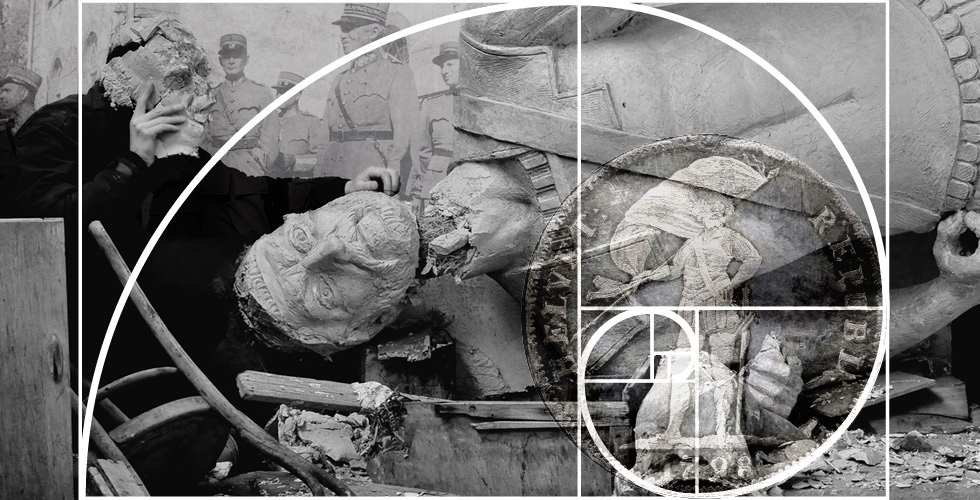
Again, the change of milestones: the whole world shakes the crisis, and in Switzerland it is practically not felt. Cause? 99% of Swiss enterprises belong to the category of private small and medium. A slide of stones. The crisis will hit the hill - and it only regroups and settles back. Hammer with a hammer on a monolithic statue - and it will be scattered with ugly fragments, from which the statue can not be created back. A slide of stones is always relevant, although not glamorous. The statues are beautiful, but they, as a rule, are found in the end without arms and noses deep underground, in layers that have been preserving a long time. Why did the crisis hit Russia in such a way that it showed the worst results in the world on an economic decline?
Because the main employer in Russia is the state. Because they are going to carry out modernization in Russia with the help of huge state corporations with giant financing, which is so pleasant to distribute. The crisis hits - and these blocks fly in different directions, like kelings in bowling. And such small companies as one Berne company, which recently invented, without any clues, a publicly available technology for editing sites, are able to dodge any strokes. In Russia, an innovative economy is absent due to the fact that innovation is not there an argument in the competition. Merchants compete not for the market, but for access to the body of a ruler who personifies both power and property at once. And while the state in Russia will try to control everything and everything, nothing will change. And a pile of stones ... This is sand. And the valley, in which suddenly a lot of such stones gathered, begins to be called Siliconova by itself. In Switzerland, this happened today.