
Translated material
Colta.ru
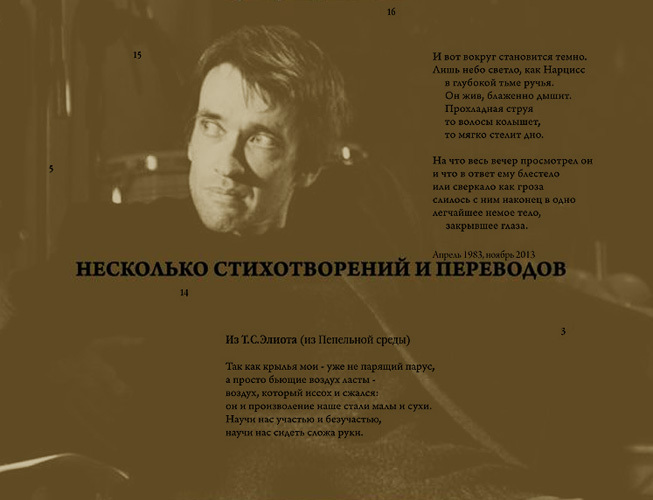
The publishing house "Caspar Hauser" published a new book by Grigory Dashevsky: posthumously. The author selected the poems included in it, in the last months of life. The whole book was fit in twelve poems, in each of them it comes to the very limit, behind which the impossibility of speech and thought remains.
This limit is drawn so strictly and clearly in one of the poems of the collection that the rest form a cloud of signs around it, which are clearly manifested from the position of the limit. This is the poem "Narcissus", more precisely, its second edition. Thirty years have passed since the first edition, in which almost the whole life of Dashevsky as a poet fit. The poem written in 1983, according to the author, talks about a walk in the cemetery. In a letter of February 3, 2009, he writes:
I would like to talk about the “dream” in more detail and ask. I only re -read it now - and did not reread it for many years. This was the first story of Kafka, which I read in German-in the summer of 1982-and did not understand half of the phrases, only brightly saw this picture itself: grave, plate, letters. Now I recalled this picture, I remembered this picture - and only now I understand that I probably remembered from the story this combination of uncertainty is whether you yourself are alive (actually the content of sleep - “you thought that you were alive, but in fact you died” - that's why he is crying (returning to science: I correctly realized that in all your examples [1] Sleep uncertainty/Yav correlates with uncertainty alive/died?)), And the inscriptions on the grave plate - when in six months he composed a long poem - which, however, describes a real walk in the rain in the Don cemetery (it is not in the book [2] , but there are halftones at the very end, if you have not seen. There is a very weak beginning, but still there is some kind of rhythm and some kind of feeling, because of which I decided to completely eliminate this verse, well, in general, it is clear.
But in your phrase that while the “dream” is awake, Joseph K. does not die, there is something terribly comforting, I will remember it.
The author of this walk and rewrites the second edition. The beginning of the poem remains the same, and the last two stanzas change:
And the sky is pale, like a daffodil He is exactly the fish | And then it becomes dark around. What the whole evening he looked at |
“He does not breathe”, imagined by a daffodil at the bottom of the stream, the vision of his own death turns into “blissfully breathing”, into the breath of the narcissus, looking into bright reflection on the water surface. The speaker is now looking not deep into the stream, but at the most looking at the reflection in the water. The imagination of one’s own death as a source of ongoing reflection (this reflection cannot stop, because you can not look at your own death retroactively, it can be experienced only once) is replaced by observation of your own reflection, gradually dying out in the thickening twilight until it disappears in the dark. The darkness is indistinguishable from what is visible inside closed eyes, when external vision merges with the darkness of the body. This advancing darkness, which can be realized and described, replaces in the second edition of the poem the impossibility of awareness of death.
Approaching the limit, and not an attempt to comprehend the limit - the inner moment around which the verses of the new book of Dashevsky rotate. Oblivion, darkness is approaching the understanding of the limit that life ends, but still it does not replace them and does not replace the speech about their own death. The border between life and death in approaching death is perceived as the border between consciousness and unconscious, and thoughts about it take different forms in the new book of Dashevsky. One of these forms is expressed at the thematic level in poems about the border between reality and sleep: “Alien Bayuccal”, translations from Swinburn, Hopkins, Frost. In the translation of the "garden of prisifiers" Swinburn, death merges with sleep in the line "that the dead will not wake up" (and not "resurrect", as in the original: "That Dead Men Rise Up Never" ).
Approaching the limit, and not an attempt to comprehend the limit - the inner moment around which the verses of the new book of Dashevsky rotate.
The status of translations in this collection must be said separately. Dashevsky had previously translated poetry so that they became part of his own books (in the “Duma of Ivan-Lei”, “Henry and Semen”) [3] . In the new collection, translations differ from the previous ones in that, with great semantic proximity to the originals, they turn freely with the boundaries of translated texts: translation from the "Garden of Proserpin" is limited to one (penultimate) stanza, from Eliot's "ash" - just a few lines. The translation as if gropes the limits within someone else's poem, which he can reach, and separates what is beyond these borders. Dashevsky once explained his principle as a translator of poetry (namely poetry) as follows:
And the principle of “translation” is like this - if I see, “where” someone else's poem is taken from, that is, I see a three -dimensional body, the projection of which is this Latin text [4] , then I can build my projection of the same body on my plane-my language, time, situation, etc. I do not put here the reservations of “it seems to me” or “in my opinion”, because such an operation is possible only with complete confidence (Descartine obviousness) is another matter that this confidence can be self-deception [5] .
 © Caspar Hauser Publishing House
The integrity of the design of the original, which Dashevsky here surprisingly calls the “body” (alive? Platonic? Heavenly? Perhaps their combination), which is necessary before the translation, in his new book is enclosed in fragments, as if the author identified something finished during the speech of the original. The projection in a separate language here can be compared with the transfer of the area to the map. During the original speech, he first distinguishes that island or the bay, which he then transfers to the drawing of his own thought and his own text. How important it is for these translations the allocation of limits and the need for silence in them, Nikolai Epple noted:
Dashevsky did not translate the last two lines from the fragment of Eliot-and this is probably the most piercing of his translations, some completely prohibitive gesture of volitional indefinite, turning someone else's word into action.
Pray for US Sinners Now and at the Hour of Oour Death.
Pray for us Now and at the Hour of Oour Death. [6]
Perhaps it is worth adding to this reading that the matter is not only and not so much in indifference, but that the words of Eliot about the “hour of death” outline the limit to which it is precisely that the idea of dying cannot reach, without changing himself. In the lines from the “ash environment” the translator's eyes grab the integrity of this thought, the thought of the limb of thought, stumbled upon death as an extreme limit. Having highlighted this thought, the poet projects, transfers and carries it into integrity of his own translating, which remains entirely on this side of the mortal hour.
The fact that death as a limit was the end point to which Dashevsky’s thought was pushed and from which was repulsed (like a photograph from negativity) and in its very last poem. He did not include this poem in the collection:
Thank you wide winged eagles.
Rushing to the deepest heavenly corners,
you break the feathers of the wings,
You will die for the squadron of the squadron,
breaking out of indestructible heavenly honeycombs
ice at least grain to a person in a mouth -
And he lives another moment [7] .
According to Mikhail Gronas, Dashevsky attributed the last line later, and he showed this poem without her, to Gronus, a powerful reader. Whereas all the poems collected in the book speak of approaching the last limit, this separate text comes from the movement in the opposite direction, denoting and holding the last little that separates death from life and cannot be overcome without jump. The poem itself, the continuation of speech, and not only the continuation of speech metaphorically described in it, increases to life - the life of man and the life of the poet - a few more words.
This poem in combination with the book is formed as if in the image and its display, in which, according to the rule of mirror symmetry, the parties repeat each other, but change places. Their correspondence comes from the existence of the limit itself. As the water surface necessary for the dumb reflection of the narcissist and the story about this reflection, we need to talk about dying about the extension of life to contemplate the limit between them. In 2011, Dashevsky wrote a commentary on Alexander Blok’s poem “Buried, Goy Deep”, in which he speaks of the symmetry of images that reflect life and death. The poem was built on the figure of silence, writes Dashevsky: on the silence of the Last Judgment, which could separate the eternal suffering from eternal life. This silence is the key to the continuation of existence, which cannot be divided into only flour or only life:
Here, perhaps, we will decide that under the life of the dissent and Putno, human minds were understanding - finally, directly (even with epithets, weakened to maximum insignificance: instead of righteous, unrequited instead of sinful), what only the time was discussed all this time, two versions of life are called that could lead to two variants of eternity - if the court would lead to a trial, an incorrect life. Eternal flour, waist - in eternal life; But there will be no eternal punishment and an eternal reward, a self -forces for a dissolved and impedent life - just an invention of human minds , to understand in life, that is, until delight and longing, love and flour, there was no time and hunting .
Doubt in the Last Judgment becomes the limit that allows the block to divide the epithets (albeit weakened) into symmetrical and spraying. The limit is not so arranged in the late verses and translations of Dashevsky, although they also rely on the existence of mirror images. This limit does not exist as a moral category in the poem of the Bloc, but rather as an ethical obligation of a translator in relation to languages exists: translations must correspond to the original, but should neither imitate it, nor, conversely, deny it [8] . The translation and the original should take shape together so that the very difference between language situations, special and separate for the author and for the translator, becomes tangible in them, and this is often achieved by minimal means.
An example of such a discovery of the difference between languages is the translation of the dying poem of Emperor Adrian. Unlike other translations of the collection, this text gives the name (more precisely, the first line of a fragment that has no name) in the Latin original, “ Animula vagula blandula ” . This inclusion of the original in the translation is not accidental and not arbitrarily, but is due to the fact that the translation follows the original, focusing on its phonetic figure: “frozen, naked” reflect a diminutive suffix “- ula ” with sound, not grammar. Answering the reader’s question about what happened to reducing suffixes in the translation, Dashevsky replied that the Russian language in relation to Latin and already diminutive. This comment can also be understood as a description of the formal principle (transmitting a diminutive suffix by direct phonetic transfer), and as a remark about the historical status of modern poetry in comparison with ancient (today's poetry is perceived as something insignificantly small in relation to the colosses of the classics). The formal move in this translation solution is the figure of a large shift that occurred in the paradigm of poetry since the time of antiquity. The fact that is achieved by the seizure of lines in translations from Swinburn and Eliot is achieved here by the application and partial coincidence in the phonetics of two languages. Without violating the ethical principle of accuracy, these translations transfer someone else's experience to their own. And it is this transfer that allows Dashevsky to get closer to an almost impenetrable feature: a line that separates reflection from his own character, a limit that does not allow a person to see himself entirely, but only, as a daffodil, in the reflection of reflection.
In this dying collection, fixing the decrease, a person’s speech is almost close to that integrity of life that all fits into the difference between speech in general and his own speech, and the closer to this limit, all the more distinctly and isolated this speech sounds.
Grigory Dashevsky. Several poems and translations. - M., Caspar Hauser, 2014. 20 p.
[1] It was about my report in which I am talking about the story “Sleep” by Franz Kafka.
[2] This refers to the "Duma of Ivan-Lei".
[3] I wrote about these poems-translates, especially the role of Katull, in the article “Own History” in the journal “Air”.
[4] Elegy 4.7 Property.
[5] http://partr.livejournal.com/147038.html (May 14, 2007)
[6] “Pray for us sinners, now at the hour of our death. / Pray for us now and at the hour of our death. ” "Memory of Dashevsky" (December 20, 2013).
[8] Igor Gulin also speaks about this - the consent of the translation with the original in the note about the new collection of Dashevsky: “This, of course, is the etymological - joint sound, and ethical - speaking“ yes ”( “ clarity of loss ” ).