
Translated material
Games of patriots
An interesting survey was conducted by VTsIOM on the eve of the Olympics in Sochi. It follows that the vast majority of Russians know about the upcoming holding of the Olympic Games in Sochi (98%) and more than half believe that such megasis benefits the country, its cities and regions. But the most curious further: knowing well about such large events as the APEC summit in Vladivostok, a student universiade in Kazan, Sochi-2014 or the 2018 Football World Cup, not one of the respondents personally was present at the already held events and does not plan to go to the coming ones. And 1,600 people were interviewed in 130 settlements in 42 regions of Russia (statistical error no more than 3.4%). In the summary table of the survey in the column “Personally present /plan to attend” there are four egregious zeros, including in the column “Olympics in Sochi”.
Such a sofa patriotism: we know about the Olympics, we approve, but we ourselves will not go anywhere. There may be several reasons. Firstly, just laziness, and there is no need, because there is a TV. In addition, the Olympiad was overfeeding for all the years of preparation for it. It’s like a dinner party: the guests are gobbling, and you seem to have grown up while cooking, and there is already reluctance. It is also possible that terrorist attacks in Volgograd were reflected in public well -being: people in the province admit that they are afraid of the troubled south, and unprecedented security measures can ruin the high from the sports holiday.
Secondly, even if you really want to go, a simple Russian is unlikely to find three to four thousand dollars to get to Sochi, settle with relative comfort and see the competitions that I would like. Assessments of the average costs associated with a trip to the games range from 60 to 160 thousand rubles. There are organized Olympic tours and half a million (through travel agencies). The prices for the opening ceremony are simply scared away: there are 50,000 and 30,000 rubles each remained (our people, as you know, do not drive a bakery in a taxi), although tickets of 6,000 and 20,000 rubles each are sold out. At the closure ceremony, the official ticket site offers only the most expensive places for 37,000 rubles.
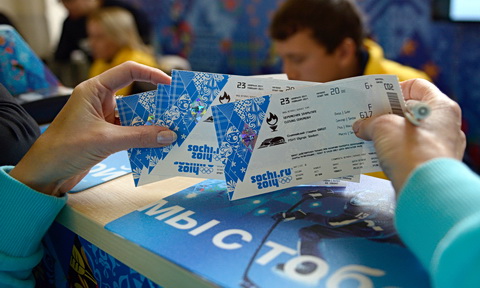
The fact that the Sochi Olympiad for the money would be unbearable for most Russians was clear a year ago , when tickets went on sale. These games are one of the most expensive for a fan: in the Winge-2010 winter Vancouver-2010, half of all tickets cost less than $ 100, and in Sochi there are 40 percent. Nevertheless, by mid-January, 70 percent of tickets were sold for games in Sochi. Who bought them?
Suppose there are Russians who have long been saved on a trip to the 2014 Olympics. Suppose that many places in the stands will be filled with Sochi residents, who do not need to spend money on the road and accommodation. But, it turns out, large Russian state -owned companies are buying tickets for the Olympics for tens of millions of rubles. These tickets are awarded the best workers and veterans. Tickets are also purchased for foreign colleagues and partners, whom state corporations are invited to the games "in order to strengthen the image of Russia and the development of business ties." Rosneft intended to spend about 65 million rubles on a ransom - by agreement with the organizers - places in several lodges of the Olympic stadiums. The same source (Prosedra website) reports that Rostelecom received tickets in exchange for sponsorship of the Olympic Games. The delegation of Gazprom will visit the final of the hockey tournament and the closing ceremony, that is, the most expensive and rating events. And if, as reported, the Organizing Committee of the Olympiad plans to earn at least $ 250 million on tickets, then a significant part of the revenue will obviously help to make state -owned companies that will sell a little oil and gas for this and slightly increase the article “Representative costs”.
According to the Minister of Sports, Vitaly Mutko, in Sochi, over 1 million spectators will observe the Olympic Games. The sales structure - how many expensive tickets were sold, how many cheap ones and what competitions - can be evaluated later (if such information is available at all). But, judging by the dynamics of sales, if Evgeny Plushenko was John Lennon, then he, like Lennon, could say: "You, on the gallery, applaud, and you, in the forefront, shake with diamonds." Because the Russians are primarily buying the cheapest tickets for the farthest stands. For example, as of February 3: for figure skating competitions (men and women, team competitions) on the sales website there were no tickets for 1,500 rubles each, but there were 4000, 6000 and 15,000 rubles each. Foam skating, short program: there are tickets of 9000 and 18,000 rubles, and 2000 and 4,500 rubles. not anymore. The arbitrary dance (on February 17)-there are no tickets of 3000 and 6000, there are only 12,000 and 20,000. The group stage of the group stage on ice hockey (women, USA-Switzerland): there are no tickets of 500 rubles each, there are 1000 and 2000. Imagine a panorama: a completed galer and a void place in the Parater. Poor television picture.
To prevent this from happening, the smart government came up with the so -called quotas, which are distributed by the regions. This is an obligation such as “who takes the package of tickets, he will receive a water pump”, which was lowered into places (this phrase, as you remember, has a continuation: “And if they don’t take it, we’ll turn off the gas”). This became known when the Ulyanovsk governor Sergei Morozov ordered to buy off tickets provided by the region on quota (in the amount of 224 pieces), and then give them to the "best people." Tickets were supposed to receive ordinary residents of the region, not officials, and this was emphasized. Here the question immediately arises: what other quota, if tickets can still be bought freely via the Internet? On the other hand, if you can expel the crowds of state employees to organized glee on the streets of the Olympic fire relay, then why not give the order to visit the games with fans?
It turns out that the idea of such a quota belongs to the federal government. “The purpose of this order of the Government of the Russian Federation is to support Russian teams at the Olympic Games,” explained the acting The head of the regional department of physical education and sports Alla Nikitin. - We understand that all countries of the world will direct their representatives to support their teams. So that as many Russian citizens can be as possible among fans, so that as many spectators as possible come to the Olympics from the regions, quotas were determined for subjects of the Federation. Therefore, 224 tickets for the Ulyanovsk region at least die, but will be provided. Our people will go and support Russian teams. ” In other words, officials are invited to ensure the patriotic presence of fans in the stands.
But at the expense of the regional budget, as promised, it was not possible to buy tickets - there was no article. The profile minister received on this occasion from the governor. Therefore, the quota began to pour out the municipalities and organizations, to persuade wealthy people to visit the Olympic Sochi. “Best people” were those who themselves found money for tickets, travel and accommodation. The last reference of the governor’s press service sounds victorious: the distinguishing ones will go to the Olympics in Sochi. “Among the representatives from our region are workers, pensioners, students, teachers, trainers, deserved and honorary citizens of the Ulyanovsk region. In total, the delegation included 109 people, 54 of them provided financial assistance from the municipal and regional budgets: tickets for competitions were purchased, and some paid for accommodation and travel, ”Alla Nikitina said.
Foreign media call the Sochi Olympiad Square Putin. Olympic facilities were built mainly for budget money, multibillion -dollar loans were taken from banks with state control, tickets for competitions are redeemed by state corporations, now the “best people” are equipped with fans with budget support. On such a patriotic background, the ruble simply cannot but fall.
Photo by ITAR-TASS