
Translated material
Cool "rain" hit on TV
Why did the operators disable the popular channel
The largest paid television operator Tricolor TV promised to disconnect the Rain TV channel on February 10, as already done by Akado, NTV+ and others. Was the operators thought well - the New Times found out
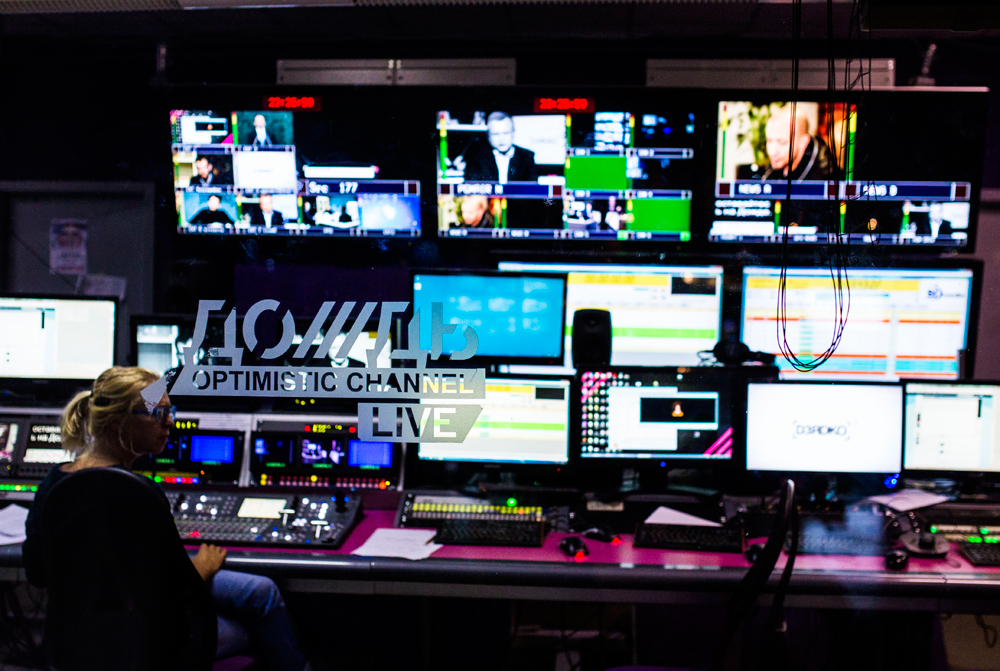
After the Tricolor will turn off the rain, the audience of the TV channel will be only 2 million households. This is almost 9 times less than the rain had before the scandal with the blocking poll
“I am the same consumer who signed up three times on Tricolor TV (at home, in the country and again in the country) solely to watch Rain - in the place where I am and where the bad Internet. Now, for my money, I will watch a "hole from the bagel." "Tricolor" three times unilaterally violated my consumer rights. I will write a leisure time, and then-in my world court at the place of residence, ”-the user of Sekam left such a comment on The New Times under the story of the owners of the Rain television channel on February 4. It was announced: the channel will continue to work, despite the fact that after disconnecting the largest operators will lose 80% of the technical coverage of the audience.
| *“The consumer, when detecting deficiencies in the work performed (rendered), has the right to demand at his choice: freely eliminating the deficiencies of the work performed (the service rendered); appropriate reduction in the price of the work performed (the service provided); reimbursement of the costs of the costs of the work performed by him (the service rendered) on their own or third parties " |
The New Times correspondent contacted Sekam - he is actually the name of Andrey, 54 years old, lives in Moscow, works in the construction of infrastructure facilities of federal significance. Reigned decisively. Refers to paragraph 1 of Article 29 of the Law "On Protection of Consumer Rights"*. Andrei does not refuse his intentions: if from the 10th “Tricolor TV” he will really turn off “Rain”, then in accordance with the law he will first write a written claim, and if there is no response, he will sue. Another reader of The New Times - Vera Kuritsyna from Kazan - said that she and her husband Ilgiz wrote an indignant message to their operator, and even sent the answer received by e -mail - from Svetlana Mirzayanova, a specialist in the support group of subscribers. “Tricolor TV,” is said in a letter, unequivocally condemns “violation of public morality by channel staff (“ rain ”).” In this connection, “... Rain Channel (LLC“ Telecal Channel Rain ”) was sent an official written warning about the possibility of terminating the cooperation agreement unilaterally if the channel’s incorrect content policy in the next 30 days was maintained. Such termination is provided for by the agreement between CJSC National Satellite Company and LLC “Television Channel Rain”.
And then - surprisingly optimistic postscript: “Attention! For all subscribers “Tricolor TV”, the “second receiver to the house” is valid - a second receiver and a kit for its connection at a special price! ”
Alas, Ilgiz and Vera are not that the second receiver now does not want, but I would be happy to refuse the first ...
“True, there is little hope for other operators now,” says Vera. - After this story, we realized that there are no independent companies among them. Well, if someone made a collective lawsuit under which you can subscribe. ”
"
“Tricolor TV”, the letter says, condemns “violation of public morality by channel staff”
"
How they conspired
Such a lawsuit decided to prepare the Memorial human rights center - now its employees are consulting with lawyers. The Foundation for the Combation of Corruption of Alexei Navalny is also preparing to file claims “in defense of the indefinite circle of consumers”, whose rights are violated by the actions of cable television operators. “We urge everyone to join this action. In the near future we will tell you how to do this and what complaints you will need, ”Navalny wrote in his living magazine.
However, this kind of claim is far from the worst thing that threatens operators. The Human Rights Council (HRC) under the President of the Russian Federation appealed to the prosecutor's office, Roskomnadzor, the Federal Antimonopoly Service (FAS) and the Ministry of Internal Affairs. The first two departments, according to the HRCs, must conduct an audit for a violation of consumer rights and the law on the media, and the other two - to see if the operators were “cartel conspiracy”.
The Chairman of the HRC Mikhail Fedotov told The New Times that he himself, as a NTV+ subscriber, also lost the opportunity to watch “rain”: “In my agreement it is said that NTV+ has the right to change the composition of the package, but he must warn about it in 30 days. This was not done. And this violation is not individual, but a massive character. And the prosecutor's office and Roskomnadzor should do this! - Fyodotov was burning. And he added sadly: “But they have not answered us anything yet.”
As for the violation of the antimonopoly legislation, the chairman of the HRC is suspected by the fact that the telecom operators turned off the rain almost simultaneously.
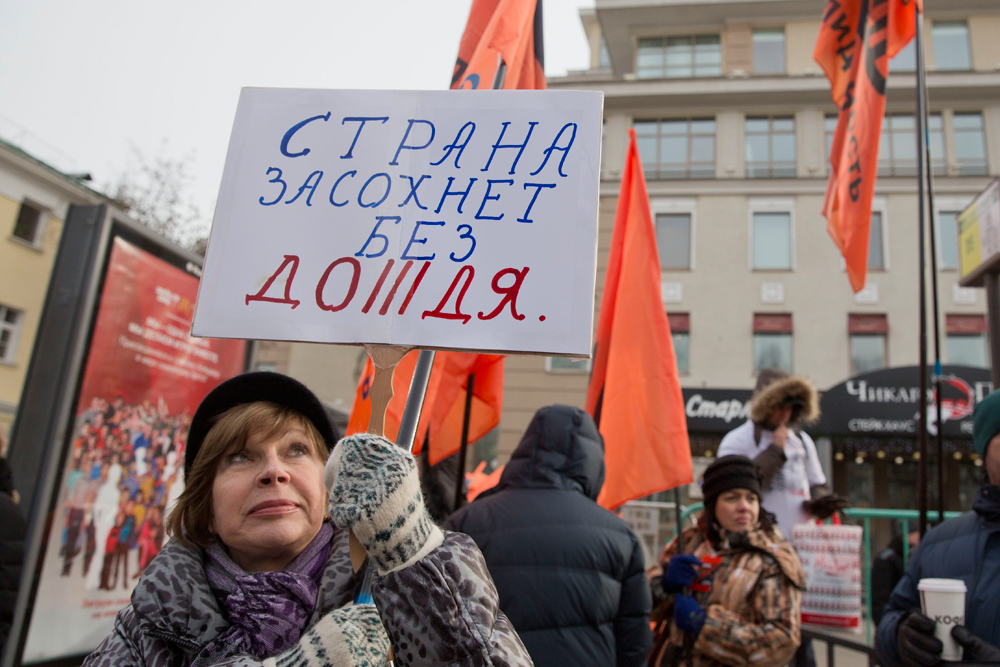
The march in support of political prisoners. Moscow, February 2, 2014
Million fines
The New Times sent a number of requests to the operators disabled “rain”. There were no answers. Only in Akado they said: "No comment." So it is unclear how much these companies themselves are afraid of claims.
However, the lawyers interviewed claim: although operators are obliged to notify subscribers in advance about changes in the package of services, there are few prospects for civil lawsuits. “It is not very clear what exactly the subscriber can demand in such cases,” says Yuri Vorobyov, head of the practice of resolving disputes and mediation “Pepelayev Group”. - Did the consumer incur losses? It is difficult to prove. Moral damage? But you still need to prove the fact of moral suffering. True, the subscriber may demand: since you have not noticed me in 30 days and did not give me time to find another operator to view the rain, then let's broadcast this channel for 30 days. ”
Things are completely different with a violation of antimonopoly laws.
The Chairman of the Board of the International Confederation of Consumer Societies Dmitry Yanin (he also oversees the road map approved by the Government to develop competition and improve antimonopoly policy) in a conversation with The New Times recognized that the case of the rain is unprecedented. Nevertheless, the FAS has every reason to start a criminal case of a cartel conspiracy: “The Broadcasting of the Rain was originally proposed by the President of the Cable Television Association Yuri Podachkin, then the cascade was followed by the refusal of the operators. That is, the business of another company was killed by coordinated actions. ”
Yaroslav Kulik, lawyer for Antimonopoly law from Art de Lex, explained the procedure for FAS in a conversation with the magazine: within 30 days, the department must consider the application, then decide whether to initiate a criminal case. If the case is opened, then it will be disassembled for nine months. And if in the end a conspiracy is established, the FAS will impose sanctions. The conspiracy participants face imprisonment for up to 6 years. But this is an extreme measure. There are also material sanctions, the so -called “working fines” - up to 15% of the annual revenue of each of the companies - participants in the conspiracy. Plus, the victim may require compensation for losses.
For example, the revenue of the national satellite company, which owns Tricolor TV, in 2013 amounted to 8.1 billion rubles. The company may lose up to 1.2 billion rubles from FAS penalties. According to the Akado group, there is data only in 2012 - revenue 11.227 billion rubles. That is, the maximum loss could amount to 1.6 billion. For comparison: the same “rain” revenue in 2013 amounted to only 362 million rubles.
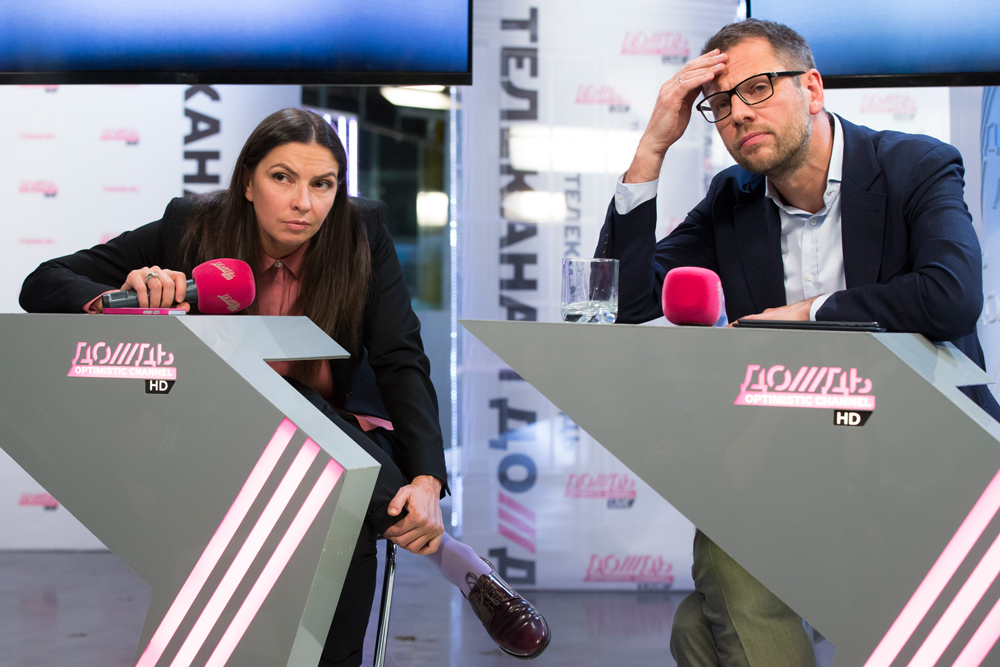
At a press conference on February 4, Channel General Natalya Sindeeva and Rain Investor Alexander Vinokurov announced that they did not even consider the option of closing the channel
Losses from leaving
How much did the operators have lost subscribers who terminated the contract with them? There are no official numbers. The vice-president of the Cable Television Association Mikhail Silin said that he knew how many subscribers were disconnected from Akado-"almost not at all." The sources of The New Times in the operators respond in about the same way. “We have a multimillion-dollar audience, and people are disconnected daily for a variety of reasons, we do not fix those who specifically left due to“ rain, ”the interlocutor explains in the“ Tricolor ”. “But, according to my estimates, maybe several thousand subscribers together.” Outraged by the disconnection of the rain, of course, much more, the source admits. But, “firstly, often there is simply nothing to choose from people-either we, or other operators who turned off the rain. And secondly, the change of operator is a troublesome event. Not everyone will spend time on this. ”
Mediaxpert Vasily Gatov agrees with this: “Given that the annual ARPU (revenue from one subscriber) for most networks is on average about 600 rubles ... Well, they lost several million rubles for all, turning off the rain.
According to the information on the Akado website, in early December 2013, the share of the audience of Rain of the total number of subscribers was about 2%. In the first quarter of 2013, this operator had about 1.15 million subscribers, which means that there are approximately 23 thousand subscribers. On average, the price per package included in the channel was 300 rubles per month. Thus, if all the spectators of the rain left Akado in general, the operator would have lost 83 million rubles per year - less than 1% of annual revenue.
But at the "rain", which already next year planned to go for self -sufficiency - there are big problems. According to the rain investor Alexander Vinokurov, in 2014 the channel was going to earn 20–25% on the sale of content to paid operators and by subscription to the site. The rest was expected to receive from the sale of advertising. The operators “Akado”, NTV+, “Er-Telecom”, “Beeline” and “Rostelecom” gave “rain” up to 35% of the technical coverage of the audience, and Tricolor gave about 50%. After they all turned off the channel, it only had 15% of 17.4 million audiences - that is, 2 million households.
According to Vasily Gatov, the rain will not receive about 30 million rubles from large operators who paid for content. But these losses can be compensated by subscribers on the site. Another thing is possible losses from reducing advertising or reducing its value as a result of reducing the audience of the channel. “Selling advertising in a publication with a circulation of 500 thousand and 100 thousand are a little different things,” says Gatov. And he explains: - It is difficult to imagine an advertiser who would withdraw his advertisement in the current situation. But for the next contract period - let's say, the next quarter - he simply will not receive the scale of the audience for which he pays. So the rain has no problems right now, but a month or two. ”
In order not to completely disappear from the TV, the rain leadership announced a public offer: until the end of 2014, the channel is ready to give content to operators for free. Rostelecom has already said that he was allowing the possibility of returning to cooperation.
The scandal with a survey about the blockade coincided with the negotiations of the rain and operators on changing the broadcast conditions
"
Business interests
Of course, the question arises: did the operators turn off the channel for political reasons?
A remarkable detail: a scandal with a survey about the blockade of Leningrad in time coincided with the negotiations of the rain and operators on a change in the conditions of translating content. According to Vinokurov, it was about changing the strategy for working with cable and satellite networks. “Akado”, for example, paid the “rain” a symbolic thousand rubles a month, and the channel, according to the co -owner of Akado, Yuri Podachkin, demanded to increase this amount 500 times. And Mikhail Silin said that the rain put the operators in unequal conditions: the same “Tricolor”, which covers almost the entire territory of the country, he himself paid for distribution, while other operators, on the contrary, had to pay “rain”.
“A lot of things came together at one point,” said Vera Krichevskaya, the owner of a 5% stake in the TV channel and the former creative producer of Rain. - In addition to political reasons, there are also a workshop hostility - after all, no one, even the most liberal, like Vladimir Pozner, can afford the information agenda that the rain has. There were commercial reasons. “Rain” tried to change the rules of the game in the market: communications operators in Russia traditionally do not want to pay for content, but the channel decided to develop according to generally accepted world standards, as well as develop, for example, MSNBC and Fox News. ”
According to Krichevskaya, “rain” at the expense of the unique, “within the framework of the existing regime”, content gave operators a new audience, and therefore, in the end, some operators accepted its conditions.
But there is another version: in April 2011, then President Dmitry Medvedev came to the “rain” and gave an interview. And soon the channel began to quickly enter cable networks. Krichevskaya refutes this. According to her, the rain back in 2010 concluded an agreement with NTV+ and a number of other operators, including in the regions.
In 2013, Rain began to take money from operators, which is why the channel’s broadcasting was stopped by mobile television systems (MTS). In addition, a paid subscription to the site was introduced that many operators, especially large, were perceived as an “insult”. “The TV channel“ violates the Convention ”, in which they are operators - are“ tribulations of tribute ”from the audience,” says Vasily Gatov. In Russia, the expert observes, everything is so interestingly arranged that in almost any conflict, political, economic and moral aspects are intertwined: “And in the case of“ rain ”, it seems to me, we intertwined again.”
Mikhail Shekhovtsov, Managing Director of Media Projects J`son & Partners Consulting:
It is difficult to compare Russian television companies with international directly. When the Fox News and CNN channels appeared (in 1996 and 1980, respectively), the television market was different technologically and other competition: if CNN was the first news channel in the United States, then Fox News Renews from one of the 4 federal ether television networks. But even at the beginning of his development he had to pay for access to a paid TV network in order to quickly increase the subscriber base.
As for the modern Russian market, in general, the subscriber base of paid television is about 35 million households, which corresponds to approximately 65% of the penetration. But about 50% of these subscribers receive a TV signal through analog cable networks, which can technically skip up to 70 channels (in many cases there are much less), while in Russia there are more than 350 main cable television channels. This indicates high competition for access to a paid TV network.
The remaining networks of paid TV (satellite, IPTV and digital cable) do not have such severe restrictions on the number of channels, but they have a division into various services with different amounts and range of channels and, accordingly, with different prices, which also limits the possibility of including this or that channel in each specific package.
Therefore, many channels in Russia have to pay for access to a paid TV network, some of them are broadcasting for free, while they earn on advertising and additional income, including from television stores and SMS services.
Photos: Evgeny Feldman/New Gazeta, Alexander Zemlianichenko/AP