
Translated material
North American gambit Diego Rivera
In the spring of 1933, in the Rockefeller Center on Manhattan, the illustrious Mexican murawist Diego River creates one of the most famous and contradictory murals of the twentieth century. The artist’s monumental work was not destined to meet with the audience in the luxury of the luxurious New York skyscraper. Due to the conflict with the customer, Mural was not completed, for nine months she was hidden from the public behind a dense screen, after which the fresco was finally destroyed and prayed on the night of February 9 to 10, 1934. The discussions around this incident have not been faded for 80 years. What is the secret of the work of the Rivera and why is it still important to remember this story?
"All artists are propagandists, otherwise they are not artists."
Diego River
Mexican invasion
To create an art socially responsible, understandable and accessible to the wide masses, which tells about the history of the Mexican people and the universal issues of the world order, is the creative declaration of the artist Diego Rivera, which he adhered to throughout his life. Reviewing the language of monumental art, Mexican muralists created the first modernist movement that arose in the twentieth century outside Europe - in America. Mexican muralism is an example of “alternative modernism”, exclusively an American phenomenon, included “on equal terms” in the world art process at the beginning of the last century.
In the United States of America, interest in Mexican monumental art appeared almost immediately, already in the late 1920s, when the first brilliant frescoes of the Rivera were created in the National Palace and the Ministry of Education in Mexico Code, the Cortes Palace in Kuernavak. Young American artists sought Mexico to see the work of monumentalists and learn skill. In the 1930s, Mexicans begin to travel to the United States, exhibitions are organized (one of the first major mobile exhibitions “Mexican arts” was organized by Rene d'ARNOKUR in the Metro-Museum in 1930), such masters as Jose Klente Orosko, Diego River, David Alfaro Sikereros, receive orders for the creation of monumental paintings in San Francisco, Los Angeles, Detroit, New York and other cities. The representative office of Mexican artists in America in those years became so wide that it received the unofficial name "Mexican invasion."
In the USA, Mexicans owe their success to rich patrons, writers, critics, museum curators, gallerists, collectors and, of course, to their private clients - for example, Anita Brener, Alme Rebby Rockefeller, Karl Sigroser, Walter Patchi, Lewis Mamford.
However, the US interest in the southern neighbor also had a selfish economic basis. The post -revolutionary Mexico was a profitable platform for North American investments. The resources of the mining industry are only part of a large catch. Cultural contacts and communications strengthened business speculation.
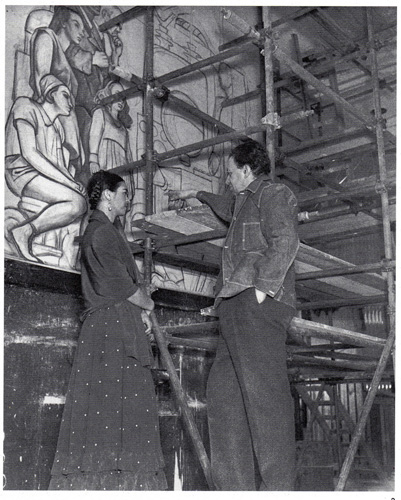 Diego River and Frida Kalo in the lobby of the Rockefeller Center. 1933
In the early 1930s, Diego River was the unconditional leader of the generation of Mexican monumentalists, one of the most famous and conflicting artists in the world. His open political sympathies for communism, brilliant monumental frescoes, a rich creative and socio-political life created the image of a genius-the creator of the new art of the twentieth century, which attracted the attention of a wide foreign audience.
The “American debut” of the artist took place in San Francisco in 1930. In California, the Mexican muralist managed to carry out three monumental work (“Allegory of California”, “Creation of Frescoes”, “still life and flowering almond trees”). A little later, from December 1931 to January 1932, with a deafening success, the personal exhibition of Diego Rivera in Moma was held - the second exhibition in the history of the museum after the exhibition Henri Matisse, dedicated to the works of one author (in 2012, the exhibition of River, extended and supplemented, was repeated in the same museum . - Ed .). For more than 56 thousand visitors of the museum, to see the works of the Mexican, including murals, specially prepared for the New York display.
Detroit battle
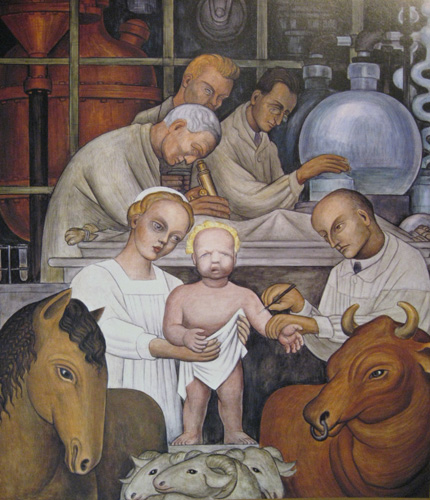 Diego River. "Vaccination". Fragment of the fresco "Detroit Industry"
Immediately after the exhibition , Diego River goes to Detroit at the personal invitation of Edsel Ford, the son of Henry Ford. In the industrial center of America, the artist receives an order for a fresco in the central court of the Institute of Arts on the topic “Industry Detroit”, for the work of which river is taken with pleasure and extremely interest: he is studying technology at local factories, the construction of modern conveyors, machine tools and giant machine -building equipment. It is curious that Henry Ford by the beginning of the 1930s had a reputation as an uncompromising anti-communist. In the period from 1929 to 1930, thousands of workers were dismissed from the Ford factory. Rivera arrived in Detroit a week after the next major scandal with strikers. And, despite this, an artist who vividly declares his position a fighter for the rights of the proletariat accepts an order and money from an industrial tycoon. The project in Detroit turned out to be difficult: a fragment of frescoes with the plot of “vaccination” caused allusion to the traditional iconography of the Nativity of Christ, which provoked a real storm of protest - in the press and in churches - against murals. Despite all the attacks, on the first day the finished fresco came to see about 10 thousand people. A wide public resonance has become part of the work itself and brought glory to the city. Events in Detroit can be considered a rehearsal of the general battle. A real fight for maintaining his work and the right to freedom of statement by River was still to survive. The next major project of the artist in the United States was the design of the main lobby of the central building of the Rockefeller complex in New York.
30 Rock
In October 1929, the US stock exchange collapsed. The largest crisis began in the history of the country's economy, called the Great Depression. Millions of people were without work. The government program of President Theodore Roosevelt “New Course” (it is customary to translate in domestic historiography, although the original name “ New Deal ” is rather a“ new deal ”. - Ed .) I coped only with part of the problems. Large private capital during this period becomes not only a symbolic embodiment of the American dream, faith in personal success and prosperity in the conditions of capitalism, but also by the real support of the economy. Thus, the construction of the Rockefeller Center , which began in the midst of depression, ensured more than 40 thousand people. Rockefeller family - owners of the largest oil company Standard Oil - initiates the construction of 14 buildings of the complex in the very center of Manhattan.
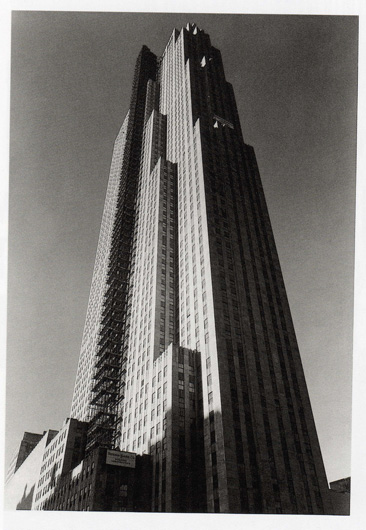 Rockefeller Center, 1933
Ebbi and Nelson Rockefeller (wife and son John Rockefeller Jr., head of the corporation) personally dealt with the issues of art design. Creation of a monumental picturesque composition in the lobby of the main building of the complex - Radio Corporation of American ( RCA , or 30 Rock ) was decided to entrust Diego River, although other candidates were considered - Henri Matisse and Pablo Picasso. In response to the given topic “New Borders”, the Mexican muralist proposed a complex multi -figure composition called “a person at a crossroads, looking with the hope of choosing a new and better future.” The architect’s initial requirement to create monochrome painting on canvas did not suit a river, he defended the right to use the technology of fresco painting and, most importantly, color to the customer. The work began in mid -March 1933.
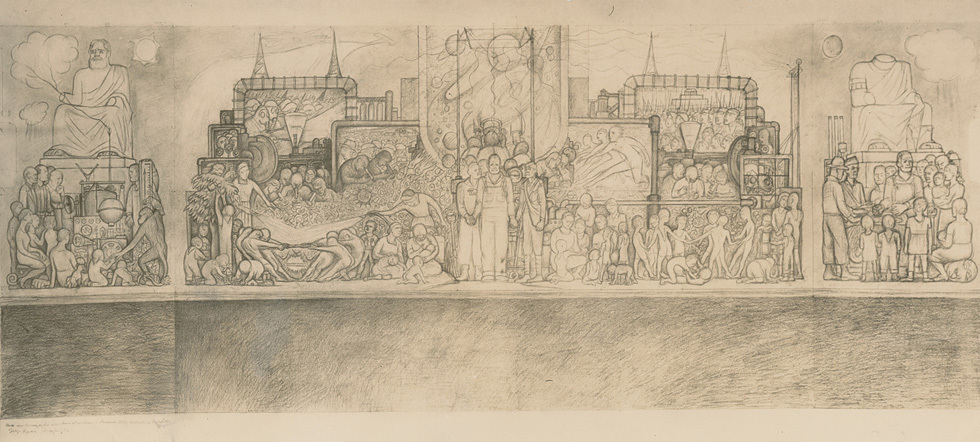
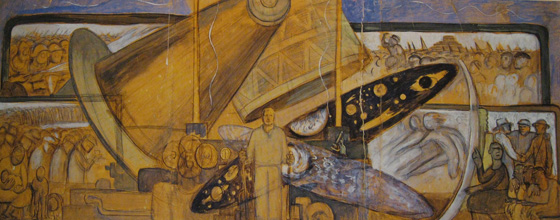 Diego River. A sketch for the painting of the Rockefeller Center in New York. About 1932. Paper, tempera, coal
 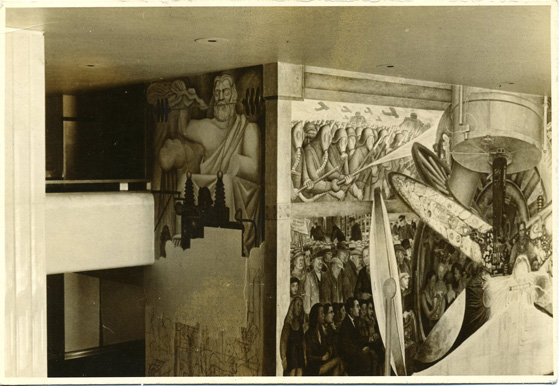 Fragment of the painting of Diego Rivera "Man at a crossroads", 1933
The fresco was supposed to consist of three parts: the central mural 5.85x12.5 m and two side - 5.10x3.25 m. The semantic and compositional center was, according to the artist’s idea, the figure of a worker that controls the elements. According to sketches and sketches, it is clear how the composition was modified, the layout was complicated, new elements and characters appeared. As a result, Mural turned into a world-order system, which was saturated with images, where two poles- the capitalist and socialist world- are separated by ellipses filled with images representing macro and micromyers. In the right side of the central murals, the revolutionary triad occupies a special place: the figures of a soldier, a peasant and a worker. Nearby, an image of a festive demonstration on Red Square, figures of athletes, an abundance of red flags. In contrast to invigorating scenes, demonstrating prosperous socialist reality, a different picture is on the left side of the central composition. The world of capitalism in Rivera is full of disasters: wars, chemical weapons, debauchery, illness, hunger and unemployment. The lateral parts of the peculiar triptych are devoted to the topics “The elimination of superstitions in the field of science” and “The death of tyranny”.
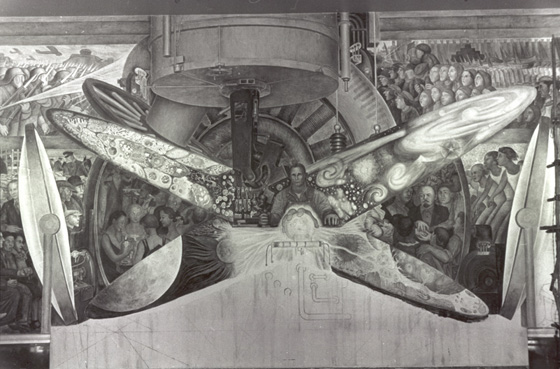 Diego River. Painting in the lobby of the Rockefeller Center
 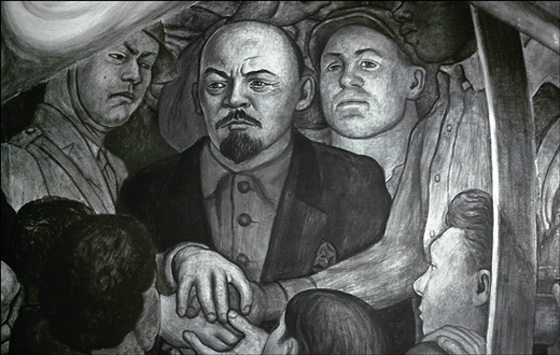 Diego River. Fragment of the fresco "Man at a crossroads." Rockefeller Center
The grand opening of the building and frescoes was planned for May 1, 1933. Shortly before the end of the murals, the site, where the artist worked with his assistants, is visited by the News reporter York World - Telegram Joseph Lilly. On April 24, 1933, his article appears with a defiant heading "River draws communist scenes, and John Rockefeller Jr. pays for an account." According to Rivera assistants, in response to the publication, the artist transforms one of the central characters in order to strengthen the polemic - the worker from the revolutionary triad is endowed with the features of V.I. Lenin. The image of the leader of the Russian revolution in the center of the capitalist world and the symbol of its inviolability, in the RCA building, formally caused a protracted conflict between Rockefellers and Rivera. A few days after the newspaper hype, Nelson Rockefeller turned in a letter to the creator of a contradictory mural with a request to replace Lenin's image with a generalized image of a working leader. To which Rivera put forward a oncoming proposal - to leave Lenin and add the figure of Lincoln to the composition. This option was not arranged by Rockefellers. Afraid of accusations of propaganda of communism and public unrest, managing the Rockefeller Center did not find anything better than to remove the river from work, and close the unfinished fresco from prying eyes with a protective screen. On May 9, 1933, it became a peak of the conflict, there was no access to the RCA building, an artist and assistants were withdrawn from the site. Lucien Blocha, one of the assistants of the Rivera, managed to take a photo of the murals in the state in which it was left in May 1933: this is the only reproduction of the work by which today we can evaluate the composition, plot and content. Rockefeller ordered Diego River to pay part of the fee in the amount of 14 thousand dollars (later this money, the muralist will spend on the creation of the fresco “Portrait of America” in New Worker ' s School ). An hour after the incident, a spontaneous demonstration gathered in support of the Mexican artist. Among the slogans they sounded: “We want a river!”, “Save the art of the Rivers!” The culprit of the dispute himself took an active part in rallies, regularly appeared on the radio, the artist’s name for some time filled all the news editorials. New York Times called the muralist "the fiery crusader of the brush." Along with the supporters of the artist, ideological antagonists also express their position. Thus, the US Communist Party accuses River of speculation and the use of communist rhetoric for its counter -revolutionary purposes (Diego River was expelled from the Mexico Communist Party in 1929).
Against the backdrop of a public discussion, which unfolded in the press and on the streets of the city, Abby and Nelson Rockefeller examined the option of preserving the fresco river outside the walls of RCA Building . The transfer of the wall with a colorful layer according to fragments for permanent storage in the funds of Moma was technically non -partial. In February 1934, the fresco was destroyed. The news soon reached Mexico City, where the author of the work was at that moment. “Cultural vandalism” - so characterized the actions of the managers of the river, comparing what is happening with the burning of books by the Nazis.
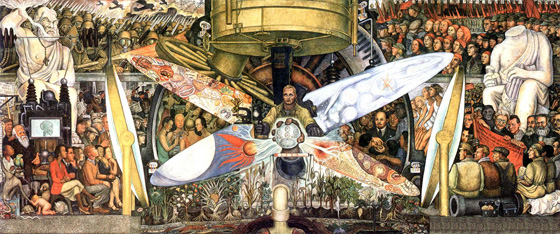 Diego River. Frescoes "Man who controls the universe. A man in a time machine. Man at a crossroads. " Palace of Fine Arts. Mexico City
 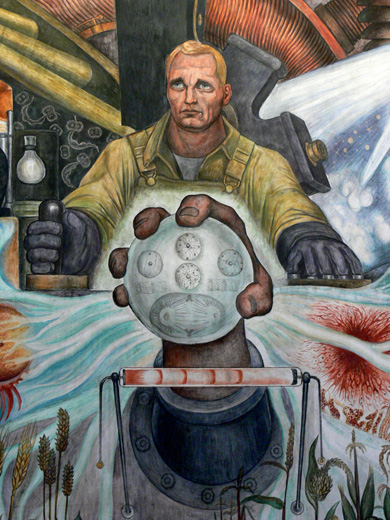 A fragment of the painting “Man who controls the universe. A man in a time machine. Man at a crossroads. " Palace of Fine Arts. Mexico City, 1934
In the same 1934, Diego River signed a contract with the Mexican government to create a fresco in the Palace of Fine Arts in Mexico City. In new circumstances, the artist repeated the New York work with some of the changes (added to the composition of the image of Marx, Engels, Trotsky, Lavston , Wolf and others).
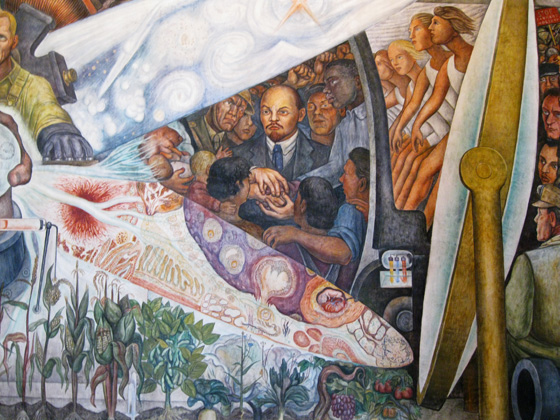 A fragment of the fresco “Man who controls the universe. A man in a time machine. Man at a crossroads. " Palace of Fine Arts. Mexico City
 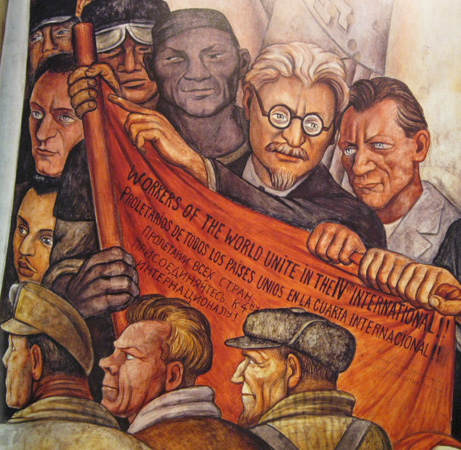 Fragment of the fresco "Man who controls the universe." Palace of Fine Arts. Mexico City
River often called himself a propagandist. “I want my art to become weapons, ” said the artist. The conflicts that arose around his works were often provoked and controlled by the scandalous muralist. A well -known formula: art gives rise to disputes, and disputes, in turn, generate and strengthen art. The dispute around the image of Lenin was originally initiated thanks to the press. Many consider all the work of the riveters in the United States as a large advertising trick, where the power of the American media acts as an ally to promote the artist.
The moral aspect of relationships with works of art and owners was revealed by the story of the painting of the Rockefeller Center (we also remind of a very recent history in Kiev . - Ed .). Who owns art? What if the frescoes of Giotto or Michelangelo would be destroyed at the request of time for the sake of certain interests? Is the price of a masterpiece loss with the common symbolic victory that Rivera won in history with Rockefeller? We lost another sample of artistic skill, but gained an important collective experience in solving moral and socio-political problems. The story around the fresco “Man at a crossroads” revealed contradictions within the American society itself. The economic crisis politized the public discussion, it was not without reason that the 1930s are called the “Red Decade”, left-wing ideas were then very popular. This is a period of political and cultural definition of America. The Rockefeller Center was supposed to become a cultural, economic, financial rod, return the faith to capitalism and salvation from protracted depression. The open neglect of the American ideals that Rivera demonstrated, provoked a powerful response. The battle for the Rockefeller Center has become a symbol and a manifestation of the contradictions that have accumulated in society, as well as the struggle for the unity of the future America.
The fresco is actually destroyed, but at the moment when it was destroyed, the work of art acquired symbolic immortality.