
Translated material
Wash off the past
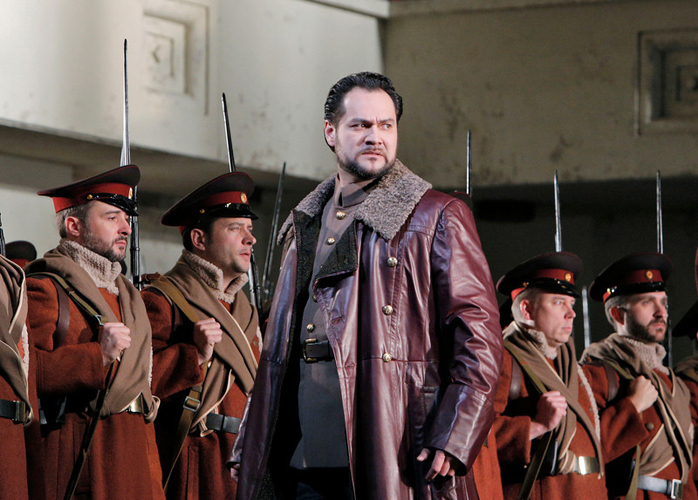
In Metropolitan Opera, the premiere of Prince Igor Borodin in the production of Dmitry Chernyakov took place. Behind the remote control was Dzhanandrea Knozed. On March 1, the performance will be shown in the cinemas of the world, including in Russia . New York impressions of Maya Pritzcker.
I don’t remember that I was waiting for any other prime minister to the metro, as the “Prince Igor” just shown. For many reasons. To begin with, this opera was last seen in New York in the production of City Opera (alas, now deceased) almost 20 years ago. Shortly after, Mariinsky showed the blatantly tasteless production of Yuri Karikov on New York tour, who brought even the hottest fans of the Russian opera into confusion. Well, in the metro, the first and only production of Igor was carried out a hundred years ago, and in Italian, and was last shown in 1917. We add that the Americans - especially the older generation - know the melodies of the opera in the absurd and, unfortunately, even the adaptable musical "Kismet", which can greatly cloud the perception of the original for them.
However, you can talk about the original with large stretches. Borodin, as you know, did not finish the operas, leaving behind only the libretto and a number of scenes written by him: some are orchestrated, others are only in the version for voice and piano. As a result, Russia and the whole world knew Igor in the editorial office and orchestration of Rimsky-Korsakov and Glazunov-until the relatively recent time, when Valery Gergiev and the Mariin residents recorded at Philips everything that Borodin was found from the original. The record, however, did not resolve the issue in whose version to execute the opera (not one is complete and exhaustive) and what should be the order of scenes and numbers.
 © Metropolitan Opera
Another one was added to these issues on the eve of the premiere: how this monumental musical epic Dmitry Chernyakov will put - a director who, on the one hand,, on the one hand, like no one else, knows how to breathe life, thought and energy even into the longest Russian operas (his “Ruslan” in Bolshoi, Khovanshchina in the Bavarian opera in Munich and Kitezh in Mariinsky - the best Examples), but on the other hand, it constantly causes the indignation of the guardians of traditions, when in search of a universal connotation every now and then destroys the templates, dear to the heart of those who have grown with them.
Chernyakov did not change himself. The version set by him in the meter is the best “Prince Igor” today: exciting the soul with his humanity, relevant in the best sense of the word - not by costumes or decorations, but the problems that he affects and forces to think about.
History is performed by people, people make mistakes. The mistakes of those who are endowed with power - the result of exorbitant ambitions, limitation, arrogance, egoism - lead to terrible consequences. So it was during the “words about Igor’s regiment”, it was during the Crimean campaign, the contemporary of which was Borodin, it was during the Russian-Japanese and First World War (Elena Zaitseva’s excellent costumes resemble this era). This is happening today at many points of the globe, and thanks to unprecedented access to information, we feel this with acuity, unknown to the previous generations.
 © Metropolitan Opera
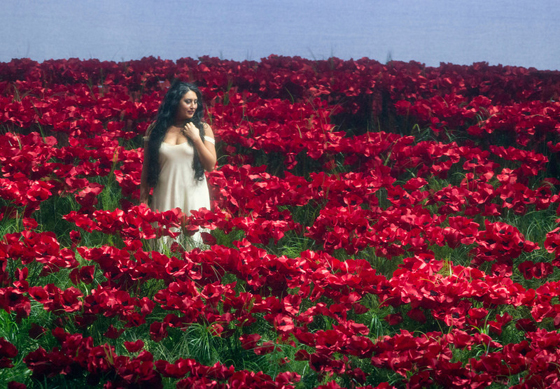
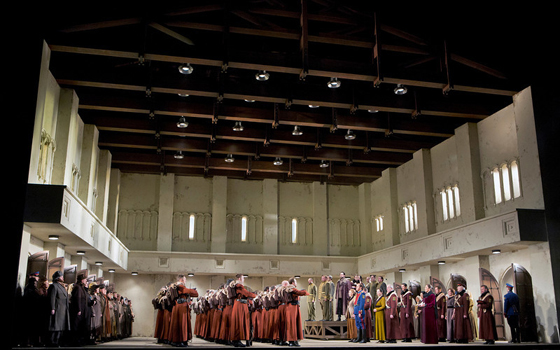
The performance is played in two contrasting spaces: tightly closed, with heavy doors, powerful beams and narrow windows of the temple, on the bright walls of which are already visible signs of dysfunction in the gap, and in the scarlet poppies of the steppe under the giant blue sky. For me, this contrast is internal. The border between the “Russian” and “Polovtsian” actually takes place in the soul of Igor, where both blue heaven, and joy and freedom are only a dream. And only returning to the destroyed temple and washing off his past (water, washing, purification - a returning metaphor in the play), you can begin a long spiritual transformation.
Igor (Ildar Abdrazakov), whose beautiful and imperious face appears on a huge screen at the first moments of the opera, goes all the way: from a decisive military leader to a prisoner crushed by defeat. But the director leads him further: the torment of conscience, nightmares, memories of the dead soldiers (another video between the prologue and the first action reports in several unforgettable frames, what happened at the time of the meeting of the Russian regiments with the enemy), despair, which is moving with dreams about happiness and will, depression - at the very end, a real attempt to atone and return to life. Not under the ringing of festive bells, not in the crown of the hero and the Savior, but in the humility of everyday hard work.
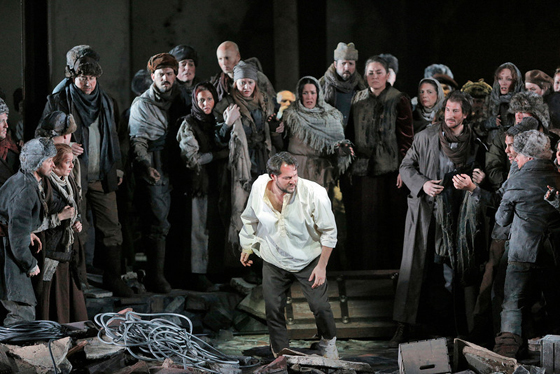
It is this story of Igor’s internal transformation that two of the most significant deviations from the more or less established text of the opera are determined: the last action has never been executed before, but a very important monologue (second aria) of Igor and a new final, which uses Borodin's music, and the Polovtsian act occurs earlier than the Putivlsky. The incredible beauty and multi -digitizedness of the Polovtsian action is represented as a series of visions and memories in the minds of the wounded Igor. Do not wait for the Voloski Odaliki and the soldiers waving with sabers (although there is ballet - in the production of ICIK Halili), but the resulting action is much more logical, deep and emotionally justified than a familiar heroic epic in sundresses, chain mail and kokoshniks.
 © Metropolitan Opera
The noble, but slightly cardboard Igor of the Soviet monumental style found blood and soul. One-dimensional hero has turned into a difficult, humanly recognizable character. Like, however, the rest of the characters. It is no accident that not only Ildar Abdrazakov, in which work on the role of Igor opened a talented actor, but in general, all the performers of solo roles create them as if again.
Especially good Anita Rachvvelishvili (Konchakovna) is seductive and desperately insistent in his love for Vladimir Igorevich: there is acting courage, and luxurious texture, and vocal wealth. Knyazhich (Sergey Semishkur) has no chance to resist this fiery flurry. After a lean, young, sharp, evil Galitsky (Mikhail Petrenko), it will already be difficult to put up with all the former Galicians, who usually were only Rabelazian buoyans. The deserter of the cheekbone (Vladimir Ognnenko) is an ideal adapter of “all time and peoples”: he is in the center and at the same time slightly away; He pushes, pushes, the first applauds, laughs the louder - and looks quite respectable, even elegant in his well -angled gray “deuce”. And even more traditional Yaroslavna (Oksana Dyka) and Konchak (Stefan Kochan) seem cleansed, washed from patina of old templates.
The musical director and chief conductor of the play by Dzhanandrea Knozed is a completely Russian Italian: ten years in Mariinsky, Debut in Met in the “War and Peace” by Prokofiev, almost a dozen Russian items at the Poster of Teatro Regio in Turin ... True, this “Igor” has the first one: he was a bit to Chernyakov’s ideas, with which he built together, with which he built together version met. With Italian warmth and cantiley, the highlighting the melody of the score, he at the same time gives her dynamics and flight. The orchestra met with enthusiasm, and this time the choir is simply beyond praise - even the Russian pronunciation is clearly and distinctly.