
Translated material
Parnassus - RPR =?
In the opposition
 Parnassus - RPR =?
February 10, 2014 Sergey Sharov-Delon
I will make a reservation immediately for clarity: I am not a member of the RPR-Parnas (or what to call it now), but for the last two years, for the well-known reasons, I interacted very tightly and closely with its leaders and ordinary party members. With all the main, public participants in the conflict, quite well acquainted personally, talked a lot with them, and with everyone I personally have good relations. Plus, my own right -handed views - perhaps I have a rare position of an external, third -party, but not at all outsider. That is why I considered it possible to express my thoughts about the split that had happened.
I constantly hear the conversations that the RPR-Parnas was originally an artificial association of the incompatible. But this, in my opinion, is not so. The unification of organizations that are quite organic in the radicality of organizations was quite organic in the fight against the authoritarianism of the second Putin and Medvedev presidency. The confrontation between authoritarian authorities does not exclude a strict confrontation, nor dialogue as such, but to lead both, uniting forces, obviously more effective than separately. But the third Putin term from the very beginning marked the turn of power from the authoritarian to the totalitarian system of power, to the rapid formation of a fascist state in the country.
This is a rather peculiar fascism without a “large project” characteristic of him-social (as in the USSR), Imperial (as in Italy Mussolini), racial-ethnic (as in Germany from Nazism and, partly, in the South Africa of the Aparteis era), conservative (as in Spain of the Franco or Portuguese of Salazar)-there were different “big projects”, but there were always different ones. And the current regime does not have it. And all his attempts for the simulation of the imperial or orthodox-Orthodox project are so simulacracles and remain with complete lack of demand: someone is able to believe that people in modern Russia will go to death for the “empire” or “Orthodox faith”? I am so unable. Two years ago, when the political trend of the third Putin term was already quite determined, I proposed to define it as “hollow fascism” and for today I consider this definition quite accurate. All the main features characteristic of fascism, except for the “large project”, are evident: the completion of the formation of a corporate state with a quasi-private and quasi-state property, which is in fact a formal cover of the economic interests of a narrow layer of the power elite, a quasi-pardy political system, in which none of the system parties, including the “ruling”, political party in a normal, generally accepted one is generally accepted. The meaning of the word is not a strict suppression of civil, political and economic freedoms and any civilian initiatives and organizations independent of the authorities (regardless of whether they are at least as many political in nature), stripping the information field, etc. But the “hollow” of the current version of fascism does not give her an instrument for abandoning external formal attributes of a democratic society-neither on racial superiority, nor on revolutionary class legal, nor on conservative-patriarchal values, she can lean due to their absence. But - and I want to emphasize this - purely formal attributes!
And in the changed conditions of the confrontation is no longer an authoritarian, but clearly totalitarian system, the question of the possibility of the possibility of dialogue with the authorities becomes fundamental for any opposition party. More precisely, for any party claiming the status of opposition. The clarification of the fundamental: in the totalitarian system to any batch there is an alternative-either to the opposition (with all problems, but also the prospects), or to become a “satellite party” (if anyone remembers the terminology of the Eastern European realities of the time of the Soviet bloc), with all the momentary privileges of systematicity, but without the long-term prospects viewed. In the second case, you can and, probably, need to negotiate with the authorities on any issues (in fact, on any more influence the “satellite party” and can be counted), sometimes, perhaps, even locally successful negotiations, but only we must be aware that the opposition party, leading such negotiations, ceases to be. Because the truly opposition party has a range of topics for negotiations with the authorities extremely narrow-only within the framework of the “round table” about the peaceful transfer of power, as it was, for example, in Poland in 1989.
In general, regarding negotiations with the authorities, a lot of things have been slandered recently. And the problem with amnesty and the fate of prisoners on May 6 only filed passion, on the one hand, and strongly confused everything in the brains of many, on the other. And you need to figure it out here.
In my deep conviction, human rights activists are such a special variety of people (and human rights - a special type of activity), which categorically excludes political engagement and requires special purely human, personal qualities from a person. The “human rights activist” cannot be called - they can only become, if not even initially, from birth. And to them, people who do the most important, difficult and ungrateful work to extreme work, you can and should go anywhere and talk with anyone - at least the hell! - And we need to gratefully perceive their efforts. But then - human rights activists. In the last year, I had to face the question in full, and I realized about myself: I can be a defender (I can’t judge how good), “offending”, in the amazingly accurate expression of Olga Romanova, I may also be able, but the human rights activist never. Here Anya Karetnikova and Zoya Svetov can - but I do not. And Alexander Podrabinek, who was striking about the appeals to power, is the same - “offending”, if not just a politician, but not a human rights activist. There are a lot of truth in his words - but political truth. And in the sense of communicating with power those who are in power - whatever they may be! - Householders are similar to doctors and, probably, real seats who provide assistance to anyone, despite their faces and position. But to politicians in the conditions of a totalitarian state, such omnivost is directly contraindicated - they should make a choice.
And now, returning to the events in the RPR Parnas, I can say that it seems to me that V. Ryzhkov and the comrades made a choice between “systematic” and opposition in favor of “systematicity”. This is their choice. And no matter how sorry that the split occurred, but in the conditions of the established totalitarianism, the preservation of the “systemic” and the opposition wing in one batch became really impossible.
What will happen next with the party V. Ryzhkov, S. Aleksashenko and their supporters is still unclear. Perhaps they will be able to register a new party, so far conventionally called the “Republicans of Russia” - a system party with experienced politicians is unlikely to represent a special danger to the authorities, and the power is unlikely to insert sticks into the wheels.
Much more interesting than the split for Parnassus will turn out. Actually, he - in addition to the inevitable and already by everyone who is not lazy, outlined difficulties - now there is a unique opportunity to become a real leader in the right -capacity wing of the real opposition of the current government. To do this, you need to shift to the right (the centrists and so Pond-Prudy, and the centrist position itself inevitably drifts from opposition to “systematic”), emphasize liberalism in contrast to protective conservatism and clearly identify active opposition. Moreover, with all its latest actions, the authorities thoughtlessly pushes into this right -winged opposition field of those who, in other, more “vegetarian” conditions, would remain in the unformed center of the political and ideological spectrum, representing an inexhaustible source of conformism.
The right (in the sense of “non-lane”, not socialist), liberal (in the sense of not conservative-preservative) and opposition (not conformist-system) positions-this is the remainder, after “subtracting” from the Parnas RPR, which has fundamentally big problems today and fundamentally serious pretexts tomorrow. Tomorrow, which will certainly come. And perhaps much more than it may seem now.
But in addition to the above, this Parnassus urgently needs new ones - and preferably young! -Persons on public-significant roles. I’m afraid that without such an update, even supporters will be difficult to believe in the positiveness of changes and new pretexts.
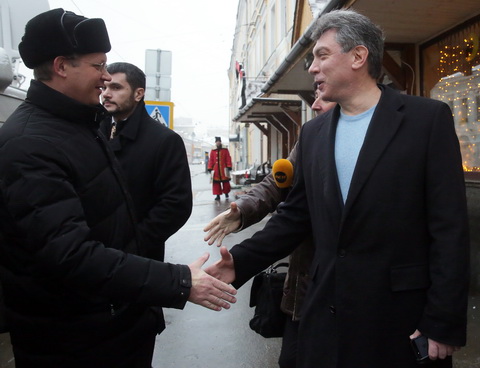
In the photo: Moscow. February 8. Co-chairs of the Party of the RPR-Parnas Vladimir Ryzhkov and Boris Nemtsov (from left to right) before a meeting of the Federal Political Council of the RPR-PANAS.
Photo by ITAR-TASS/ Pavel Smertin