
Translated material
In the city of Sochi Dark Nights
On February 22, as part of the Sinema Belief project, the premiere of the German film “Homes for Games” directed by Steffi Wurster, whichwas detained in Sochi for shooting a donkey . The film is dedicated to people who fall under the Olympic rink. The show (completely free), along with the discussion, will be held at Fassbinder Cinema Bar on Artplay. Follow our advertising!
Vitaly Zubtsov, 22 years old, journalist-volunteer
∗ I live in the Imereti lowland, in one of the Olympic villages. It can be seen that all this is built from scratch and looks from a needle, it shines. There are, however, objects that have not yet been completed - hotels, for example. The finish is ready, but work is still underway, the signs " Open soon " . But what is ready is done, it seems, to conscience. All stadiums amaze the imagination. I have seen three so far: for skaters, hockey and figure skating. They are large, beautiful, at night shimmer with all the colors of the rainbow. Inside, however, I have not seen them. Not a lot is ready. The day before the opening, when not all teams arrived yet, it was not clear with some where to populate them. For example, I observed the arrival of the national team, it seems, Argentina: they arrived, and the house assigned to them is not yet ready - also by decoration, it seems. And I had to populate them into another house, which was not intended for them, but that delegation was not yet arrived. Such a leapfrog was going on here.
∗ Volunteers live in four to five people in the room, conditions, to put it mildly, so-so. The beds in the rooms can be bunk. For example, in my room were two ordinary and just that. And now the binter -tier was kept on snot. When I climbed onto this upper tier, the bed fell on me: it was very light, and my weight outweighed it. Therefore, we dismantled this design and the upper tier put on the floor. In general, everything for people, one can say. It is quite convenient. I did not encounter yellow water from the tap, but the first time the colleagues, according to their stories, did not even have hot water. Thank God, settled. There is no kettle and a refrigerator in the room, that is, no one really counted on the refrigerator, but it would be very useful, because there is nowhere to store food, and there are few and bad volunteers. For example, for breakfast, two absolutely rubber pancakes with the same rubber cottage cheese are given. There is a cafe in the Olympic village, and the food there is very nothing, but going there every evening is quite expensive.
∗ We can communicate quite closely with athletes, coaches, and they willingly talk to us when they are free. They say that they really like how everything is done in Sochi for them, and that the snow is perfect. And yesterday I prompted the guys from the Spanish national team to the store, and for this they gave me their badge. No one has this, but now I have. The first in my future collection.
You have the right to sneeze only in strictly designated places.
∗ Normal logistics is not here. Volunteers from their place of residence get to work reaches public transport or on foot, because transport for media representatives is not available - these are restrictions on existing accreditation - but there is no other. So we drive mainly on ordinary buses, we pay for everything ourselves. And besides, we pass for a day for kilometers to -fourth, since the distances here are very impressive: for example, you need to go to a mountain village first by train, then by bus, and then on a funicular. A taxi call is complicated by the absence of a proper type of accreditation among the vast majority of drivers.
∗ It is impossible without the desired pass, sorry, even getting that for some reason it is still called Lavator . The inspection is strictest, and if you do not have one or another letter (category) on accreditation, then you have the right to sneeze only in strictly designated places. Yesterday, the Viennese waffle was taken from my control, which was finally upset. And thus left without breakfast.
∗ Journalists - Russian and foreign - live in separate hotels, which were in advance for them. I could not go with my colleagues from RIA Novosti, because the accreditation for the Olympics was over, it seems, already in 2012. When I myself enrolled in volunteers, I still studied at the institute. At work, it was difficult to go here, but still let go - I warned that I would go to the games, initially, when I was satisfied. We agreed that I would do something here at work, but we still decide what exactly. Now I am working as a volunteer in the daily Olympic newspaper - Daily Village Newspaper . Such, say, a journalist from volunteers, but I have access everywhere like a volunteer, therefore it is very limited compared to journalists who are accredited through the media center.
Alisa Nesterova, 18 years old, volunteer
∗ We were strictly forbidden to distribute interviews. I think that to control this Wi - FI catches well only in the corridor. You go out in the evening with a laptop ...
∗ In the hotel, I distributed a backpack with all kinds of useful things to come to the coming members of the Moka. There is a book in three languages with cards, a schedule of competitions, transport, banal phrases in Russian and other info. Unfortunately, a huge batch of books turned out to be defective. The sheets are glued, poorly printed ...
∗ The attitude towards us is friendly, especially among local ones. In stores they often ask: “Who are you? What are you doing? How to feed? ” For example, yesterday we purchased at the supermarket, and the girl at the box office says: “Wait a bit, something has come out a bit too much. Since you are ours, you can’t count you! ” And followed by Canadian volunteers. I am sure the shops will not remain in the way!
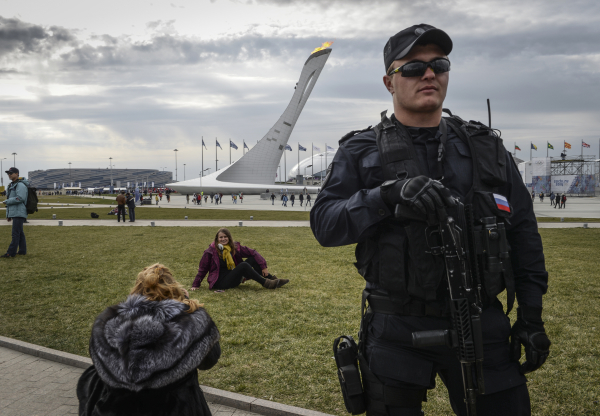
∗ Product prices are several times higher than usual. Yogurts are 70 rubles. And the tents are completely insolent! I can imagine what the inhabitants are. True, they are not visible at all. On the streets there are only police officers and Cossacks. I have one Dutchman, also a volunteer, said that the Russians have a strange fashion. He accepted the Cossacks for ordinary citizens.
∗ Not far from our Hotel “Coastal” are the houses where the employees of the organs live. At first, the police went in their own form, which was damn nervous, and then they were dressed up from Bosco . Have you ever seen a policeman in Bosco ? He looks kinder right away. Maybe after the games they will leave this form. I will try to photograph this. But we were also forbidden to photograph. Rather, do not photograph, but upload pictures. I wonder how they are going to follow this? Heshtags on Instagram ? Therefore, I specially do not carry a tablet with me.
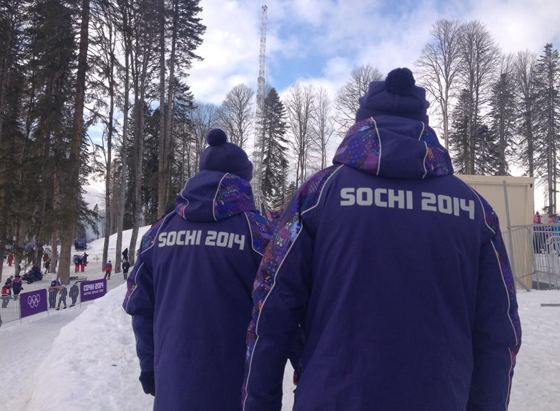 © colta.ru Security Service dressed in Bosco
∗ Я провожала людей из МОКа на репетицию. There were five or six foreigners with me plus a girl from the security service. I immediately recalled how my mother went to the GDR or Yugoslavia, and a security officer was necessarily attached to the Turgugus. So with us. All the way I told them something about the city, answered questions. Then that girl asked me suspiciously what we were talking about. I was already scared that I gave out state secrets, and she only worried, suddenly we discussed it.
∗ Police with English is better. I saw how on the street Patrudnoy stopped several foreign guests with large bags. "OPEN, OPEN, pliz!" - shouted to them with a terrible accent and, as in the Crocodile, tried to explain with gestures what he wanted from them.
∗ Siberians regret that bathing has been banned. Winter does not bother them. Many of them saw the sea for the first time. But everywhere the President’s signs that bathing during the Olympics is prohibited. The water is cold. Degrees 10. On the walrus. But if our medals win, then the desperate Russians are at a look. Along the coast, the ships are most likely the military. They will swim closer - we will find out.
∗ Mostly cyclists go through the streets. I often find athletes very often on bicycles. They are pretty annoyed by the local Armenian taxi drivers. They stand without work.
Vyacheslav Slavsky, 17 years old, student linguist
∗ Yesterday I could not go on the Internet, because there was no light again. Electricity and water are not enough to provide them with the whole city. We suffer, of course, we are local. There is no light around the clock, and Kubanenergo officially states that there was an accident and disconnects phones in the call center.
∗ He talked with many foreigners. They are unhappy. Even what they wanted to hide from them was hidden ineptly. Near the sanatorium "Voroshilovo" they built a skyscraper. They built, built, realized that they did not have time, and decided to demolish. They demolished, demolished, realized that they did not have time to demolish either, and decided to bother with a banner. On the banner, the inscription: "Let any peaks submit."
∗ Tactile stripes for the visually impaired are spoiled by the rain. You come - and the water splashes a knee. Apparently, they were built on the principle of "they will not see anyway." New roads also begin to fail. Obviously, the asphalt was put directly on the dirt. Moreover, in dry weather, the road workers cannot be found, but in the rain they begin urgent repairs.
Everyone understands that the performance will end and the scenery will be sorted out.
∗ Budgetors, students, schoolchildren were torn off from work or study and driven into volunteering. Prior to this - on the baton of Olympic fire. And if anyone left schoolchildren or students, they demanded explanatory ones. They said: you will leave just like that - we promise the consequences.
∗ of officials and special vehicles in the city is a lot, but there are almost no traffic jams. The Sochi was forbidden to travel along the Olympic lanes, and those who have old dumb "Lada" were generally forbidden to leave. They removed all illegal minibuses. But public transport began to walk more often, but tickets have become more expensive. The buses drove together with drivers from Belarus, and there are rumors that they will not be after the games. The Russian Railways will use the “Swallow” electric train at greater distances. In general, everyone understands that the performance will end and the scenery will be sorted out.
∗ The station in Sochi today resembles a prison. It is divided into three zones: suburban trains, long -distance trains and "swallows". Passengers are almost stripped during the inspection. Hard control with dubious safety of transportation.
∗ Migrants and people without registration expelled outside the city. As a rule, in Krasnodar or Anapa. They did not allow the group of opposition. They were canceled by fans passports. They detained ecologists. They arranged the grass of local bloggers who write about urban problems. All suspicious, mainly Caucasians, constantly delay and check the documents. I myself repeatedly stopped and demanded documents. Once I forgot my passport at home, they detained me and began to ask how to get there where I live, I study. In general, issues for knowledge of the city. Sochi is now closed for the entrance, and in order to be here, you need a fan passport, accreditation or xiva.
 © colta.ru
Dmitry Kovinov, 33 years old, manager
* Sochi in the beginning of the zero years is actually a village. And, of course, when skyscrapers begin to erect in a quiet, cozy village, it bothers and annoys many old -timers. For me, Sochi 5-7 years ago was completely unacceptable for life. When clothes could only be bought in the market at incomprehensible prices and incomprehensible quality. And it was necessary to go to the mountain slopes in tight and stuffy minibuses with drivers, with one hand spinning a bagel, and in the other holding a mobile phone. But now there are excellent roads, a super -power train of Sochi - Krasnaya Polyana, sports areas. Since childhood, I have been fond of mountaineering, skiing. For me, this is an important factor.
* I rode in Olympic objects - in particular, on the Rosa Farm - in the year before last, and they were already in excellent condition. The quality of the slopes is such that if a person is blindfolded, put his ears, lift the rope and let him go, then he will not understand what is in Russia. The preparation of slopes, tracks, lifts is made at the alpine level. More recently, I returned from the Austrian slopes and did not notice any difference.
The public procurement website in the appointment of an order clearly says: Animal disposal.
* It can only be as a shame for the weak knowledge of English and the reluctance to teach it. All these inscriptions, signs, ads written with errors are pretty disgraced by the country. Well, some will have to compensate the language with hospitality or the art of facial expressions and gestures.
* I sometimes go running along the crossed terrain and mountain paths. And for these classes I choose places less poppy and crowded. For example, the surroundings of Krasnaya Polyana and the Caucasian biosphere reserve. But there you need a special pass, and it is enough to receive it with hemorrhoids. Once on the forum, I read that when meeting a forester, it is better to speak English. He will take you for a foreigner and will not contact you. Two times it drove it. A few days before the Olympics, I decided to set a personal record. In the morning he moved out of the red clearing and ran around the mountains into the most remote places. In the distance I saw people in camouflage and shout to them so joyfully: " Hello !" I ran closer, and they ask me in confident English: name, surname, address - and then the whole interrogation in English. In general, the “foresters” turned out to be employees of the GRU (the main intelligence department. - Ed. ) In complete ammunition, with machine guns. They took my backpack for the search, and there the phone is in Russian. “Guys, I'm sorry, the demon was guarded,” he told them about the trick with the forester. They asked: who is it, from where? I say: from the red clearing. They: this cannot be. From here, with Red Polyana, at least two days to go. They checked me for three hours, by walkie -talkie in Moscow, they reported on the detention, they wanted to call a helicopter. But everything ended peacefully. We even then made friends on Facebook. In short, from his own experience was convinced that the border on the castle (laughs) .
Alexander Valov, 29 years old, blogger, activist
∗ In most inhabitants of euphoria. They are satisfied with new roads, interchanges, cinemas, shopping centers. And many are simply afraid to criticize the Olympics. It is felt universal intimidation. Nobody holds antiolympic actions and, I think, does not plan. There were inscriptions on fences, urging the mayor to resign. During the resettlement of residents, I saw how they posted posters like “Putin, we are illegally evicted!”. At the same time, there were scammers who were presented to human rights activists or officials and promised to resolve the issue for a certain amount.
∗ The operatives once again came to me before the Olympics. They seemed more polite than usual. They began to actively send the summons to the Investigative Committee and the police. Once they generally offered to leave Sochi during the games. I published a large number of sharp materials that were not a little included in the propaganda plans of the authorities. On TV, they showed a beautiful picture how for migrant workers they created all the conditions in one of Lazarevsky’s sanatoriums. And we are really. Migrants were taken to garages on Gorky Street. This is the territory of the police station. There they were in terrible conditions, without light, water, heating. Nowhere to sleep. About a thousand people were taken. Among them were citizens of Russia, Ukraine, Belarus, and many were quite legally in Sochi. One Georgian told me that he was kept there for a week.
∗ The mayor of the city is very picky. For example, he did not like the material about the cutting of budget money. 34 million rubles were spent on social advertising, but on TV it was never shown. We also wrote about the shooting of stray dogs. The city hall denies this, but there is a publication with reference to the public procurement website, where the order is clearly written in the appointment of the order: Animal disposal.
∗ In the most terrible conditions, the village of Akhhtyr was the village, where now even worse than before the Olympics. In Soviet times, buses went there, there were roads. Today, even the water from the wells has disappeared. Plus, they began to bring garbage from Sochi, they arranged a landfill. The local branch of the Communist Party recently achieved to ensure that buses would go to the Akhhtyr. But why buses, when there are no roads?
∗ A huge Olympic torch was included in the city. It burns beautifully. But how much gas does it take? And people nearby, at the state farm "Russia", gas only on papers, but not in fact. They spent gigantic money, paved pipes underground, and all for the sake of torch. Residents ask why there is no gas, but they are answered that it will be fired, to create obstacles.
 © colta.ru
Tatyana Begget, 25 years old, yoga coach
∗ You arrive in Sochi, sit in a taxi, call a hotel, and the taxi driver says: "Ah, well, this is a normal hotel." But this does not mean that there will be a pool, jacuzzi, air conditioning. This only means that it is completed. One taxi driver told me how he took guests from Sweden to the hotel, where everything was with the exception of the roof. The Swedes were in complete shock. They booked places two years before the Olympics. I was more lucky. I live in a Soviet -type hotel. The roof is in place. But interruptions in electricity occur, and often turn off the water, especially when you soap your head. However, Russian people are accustomed to everything. But private business is flourishing! Local grandmothers with signs “Housing. 2 thousand per day ”are in great demand.
∗ There are only volunteers. Some of them say that 16 thousand are paid for their work, someone is paid, but few, and someone-that works for free. And we cannot find out this question. Either volunteers from different organizations, or someone clearly infringe on the rights.
∗ I most often meet the Japanese on the streets. They are very surprised that in Russia there are such modern technologies. I represent their surprise when they learn about the cost of these technologies. So we will see the round eyes of the Japanese.
∗ Most foreigners are found in nightclubs. “Russian Girls are Beautiful” leads the top of the most common phrases here.
∗ Всюду говорят про хоккей или фигурное катание в окружении пальм. Между пальмами поставили скамейки и создали такое подобие Майами-Бич. Но на фишку зимних Игр в субтропиках обращают внимание только шведы и финны, которые, видимо, в принципе обращают внимание на пальмы.
∗ Через каждые пять метров стоят полицейские и приятно удивляют своей вежливостью. Возвращалась в два часа ночи в гостиницу. Заблудилась и спросила полицейского дорогу. Он узнал по рации, как доехать, посадил в автобус и сказал водителю, где мне остановить. Ему только платочком осталось мне помахать.
∗ Служба безопасности на объектах очень круто обыскивает. Наверное, они перед Играми прошли специальные курсы массажа. Иной раз хочется специально куда-нибудь пройти ради этих прикосновений.