
Translated material
The theater is contrary to
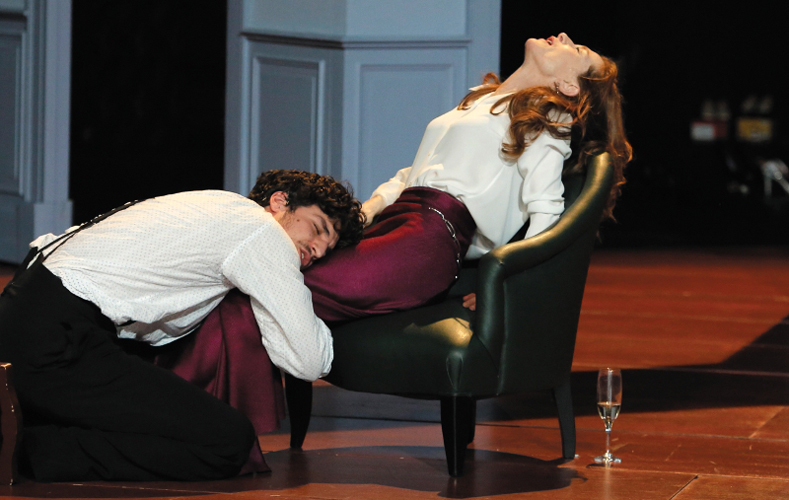
Before the premiere of “false confessions”, Luke Bondy said everything correctly - and after the premiere is also correct. Deep, subtle, smart. About the mechanism of manipulation at Marivo. About gender, about danger, about theatricality ... Marivo in France is often put, and this is not only reasonable, but also inevitable: the French theater can be proud of his genius with no less right than a moliere or racin - with the only upset that Marivo, although it is not easy, incomparably darker and merciless than both of them. Especially late, which is just with “false confessions” and begins. His stories about a cheerful masquerade in the name of love, in the process of which masks grow to the heroes and gradually begin to change them, so that you won’t understand the final why all this was and what, in fact, achieved something, so everyone broke in the exquisite mirror labyrinth of obstacles and appearance-at the same time the triumph of the theater and its exposure. The models developed in Marivo’s plays are so universal that, for example, his “sincere” - unassuming one -acting one -acted one, written in 1739 - still remain an ideal, murderous answer to all theaters.doc and other championships of sincerity, reliability and truth nearly. They talk about Marivo, explores him, hundreds and hundreds of works in a variety of scientific disciplines, from gender sociology to psychoanalysis, are tired of him tirelessly - and Bondi seemed to carefully read a considerable share of this stream. So his “false confessions”, released in January on the stage of the “Odeon”, is the performance of an unconditionally thin, intellectually enriched and dotted with traces of all sorts of ingenious concepts. But this is if you don't look.
 © Pascal Victor
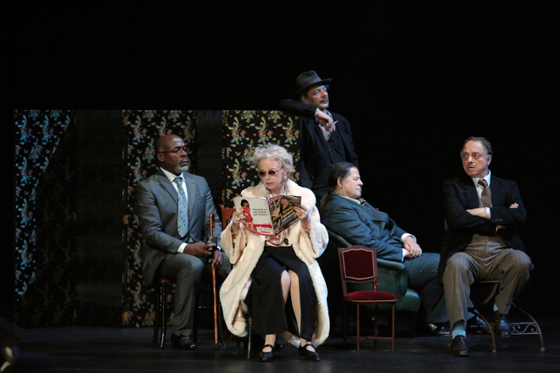
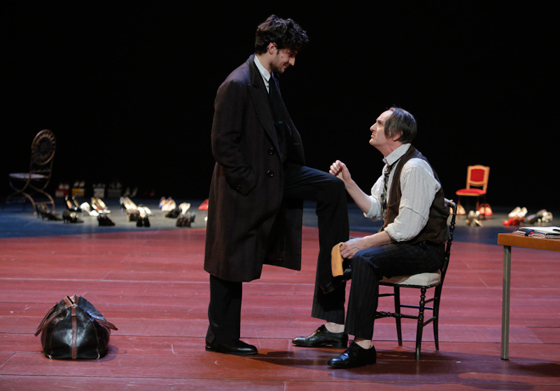
For no matter what Luke Bonda has in mind, laying out neatly circles from Parisian shoes on the Armsen, lighting the starry sky behind the back of the heroes when moving from the first act to the second or forcing fragments of scenery silently,-and he clearly meant something-such a combination of pretentiousness with professional helplessness, as in his current staging, not in his current production. I would have made less subtle material, what can we say about Marivo. Others of his decisions are perhaps even acceptable. For example, the exhibition of the performance, begins ten minutes before the third call, where the main character, the rich widow of Aramint, takes plastic lessons at home and carefully (albeit without much success) repeats the teacher’s movements, thoroughly writing them down in a notebook; Later, dictating a love letter to another, silently in love with her, in order to provoke a doranta for recognition, she will begin to make the same plastic exercises, and they suddenly gain confidence and density from the storm of feelings. Or here is a mirror on the back of one of the doors, where Araminta sometimes looks secretly from others and almost from itself. Of course, she has long closed the question of love and other romantic nonsense for herself-not a girl, tea, an adult business woman, calm and reasonable, and that a dorant, it turns out, fell in love with her, this is not funny, but still there is no, no stealing in a mirror: yes, it seems, nothing else ... ah, all this is stupid. Before the last scene, she will again approach the door with a mirror, open it, and there, instead of her reflection, a dorant. Which, in fact, means that the denouement is already inevitable with its recognition.
Small, middle -aged, red -and -haired. Great.
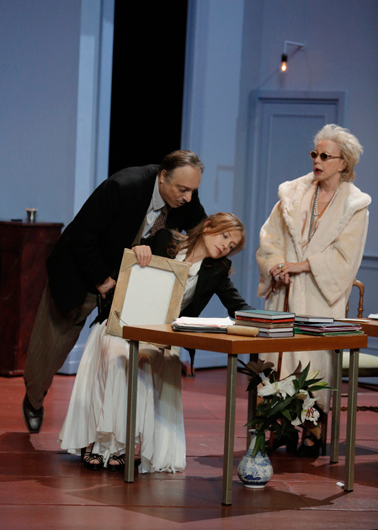
In themselves, these moves are possible and in a sense are even witty - but this is wit -walking access, nearby, without support. So, perhaps, you can put in the third year - but not in the fourth. And the above examples are from the best, they have at least a two-part drama with a wigged-transmission; For the most part, the directorial decisions here are not only blatantly simple-minded (like large bills that have been shifted by all the diaries in the house-the widow is rich-or smoldering cigarettes, which Araminta takes out of the hand of the sleeping dorant, so far no one sees, herself to drag out once: yeah, there is a feeling, and one-time), but also one-time. But this is already destructive for Marivo. He is the playwright of the 18th century that his plays are impeccable, total functional: complex mechanisms where everything is connected with everything. Where no scene is the main one and not a single passage; Where each gesture, every word, every movement of the soul has a response and causes a chain of irreversible consequences. Bondy has a meaningful scenography, a sloppy set of single (and sometimes poorly compatible with each other) gags and a fragmentary, dashed development of characters. The fragmentation of the levels and elements of the performance (and, as a result, the dysfunction of even the most “invented” of them) leads, in particular, to the fact that in the streaming performances of Marivo you will meet infrequently: the complete lack of an ensemble. It will not work out so; Even if the director does not make efforts at all and makes all banality, the very essence of Mariva’s drama-the rhythm of the replica, the logic of relations, the extinct proportion of the stage presence of heroes-inevitably organizes some kind of unity of the troupe. This is Bondi Luke had to try hard so that this would not happen. And the point is not the actors: they, of course, are different in terms of skill, even very different (the legendary bulge in the role of Madame Argan gives an amazing master-class in the technique of grotesque, while Louis Garrel, prescribed by a doranta, is only enough to designate the male presence in the room), but the set tasks are fulfilled diligently and without rest. The point is the tasks themselves. And why they are set in this way, and not otherwise. More precisely, in the almost complete absence of this “why”.
That, perhaps, could be finished. Yes, at least not to start at all: there is nothing valuable and original in Bond's mistakes. If - contrary to all of the above - on the stage of the Odeon Theater did not take place, and a genuine theater, and the genuine Marivo did not take place. If Luke Bondi did not have in the sleeve of Joker, who was not able to cancel even directing Luke Bondi. If Araminta had not played Isabelle Jupper. Small, middle -aged, red -and -haired. Great.
 © Pascal Victor
If you try to describe the game of Jupper in one word, then this word will be “scherzo”. Vortex inner pace, virtuoso drops of rhythm - and not a single one, for more than two hours in the main role, a “fat” accent; Jupper plays Marivo as Martha Argerich - Chopin. And this is precisely Marivo, you won’t confuse here: this is his union and the struggle of a person with his chosen mask, his inextricable is the bitter triumph of love and a dumb hopeless fear of abandoning her, his drunken excitement of the masquerade and the screech of the torn brake blocks of the soul during a change in the fate. Against the general background of the play, the Jupper game sometimes seems almost excessive - but this is not the pressure of living, not the power of expressiveness: this is the intensity of the coherence of existence, which ensures the illusion of ease of movement along the line of the role. Thanks to the poor directing, Bond Juppees at times acquires the mechanics of her skill: like almost any great actress, she needs an intelligent author, and therefore at the beginning of the performance, when the Araminta is not yet involved in the whiper of the plot, until the very second when Dubois tells her that the dorant loves her - Juppper works as if inhoil, inventing himself in advance, playing the secondary one, playing the second time, playing the second Maruvo, where Maruvo has not yet begun for her heroine, on clean equipment, out of nowhere, without motivation, folding the rhythm of gestures and reactions.
But when Araminta is already involved in the plot and the gears of the motivation are completed, Jupper gets the opportunity to work freely no longer with the second plan - but with the distance between the first and the second, with the gap between disbelief and hope as the main object of the role. That is precisely why Aramint needs the recognition of the dorant: while his love is not expressed, that aramint that is visible outside, which has a long -grown larch, there is no reason to change, it only grows from the inside with the human authenticity that makes the heroine sometimes freeze in place, for the rest of the time it allows her to see more and react faster than she would like it. The recognition - spoken from the outside that occurred in the visible, stage world - does not just change the behavior of the Araminta: two forces, on both sides, attached to her mask, who forgot about the love of the widow, break this mask, and Jupper at the end of the second action plays this broken as an explosion, in an instant - literally filling the whole scene. The released energy was almost ill with her - and then throws it out of the chair, causing to rush around the stage with a red -hot shock of red hair, going with a soundless cry.
 © Pascal Victor
And on the contrary, Jupper plays a denouement - the recognition of Araminta in the finale of the play. Actually, the most difficult thing is there - this is not this scene itself, but all the third action previous to it: when the mask has already been dropped, the old is broken, the new one has not yet been found, not designed - when the love of the doranta has already become a reality, but not yet its own. Again, you have to play a role, protecting the doranta from mother and companion, again has to seem decisive and accurate, removing into the subtext the process of bearing your own feeling conceived from someone else's recognition. Typically, to solve this part of the role of the actress, they choose any event that provokes a provocative phrase that will allow Aramint to finally be aware of their love, or even simply play the whole act, from the very beginning, already with this knowledge, or, on the contrary, are hesitated to the last, to a replica with the recognition of the heroine, hearing which, as it were, who had already spoken, understands that she had just said the truth. In the Jupper, the process of “pregnancy with love” proceeds so organically that it does not need any strong third -party influences, it will not be interrupted ahead of time and will not go unnoticed: when it is born, then, therefore, the term. Araminta was left alone, in rage, in confusion, in anticipation; Harlequin enters, says that he had just seen a doranta. "And how is he?" - Almost automatically, for it is absorbed in his inner turmoil, Aramintu asks. “Crying,” answers Harlequin. And suddenly the face of Jupper brightens. Smooth. It becomes calm. Further, Harlequin speaks of something with Dubois, but it doesn’t matter. The two-minute pause of Jupper, during which she does nothing, but simply stands bright, foul, among the outstanding performing achievements in the history of the theater. Araminta is on the sidelines, one, on its own, and loves doranta. He is not on stage yet, he will come then, and Aramint will tell him everything, and Bond's scenery will begin to ride, because he, you see, see the finale - and all this will also be unimportant. Because on stage there is simply Isabelle Jupper and glows with love. And there is no such theatrical technique with which this technique can be carried out. But for some reason there are people who do it. They are called actors. And they are.