
Translated material
Freedom or death
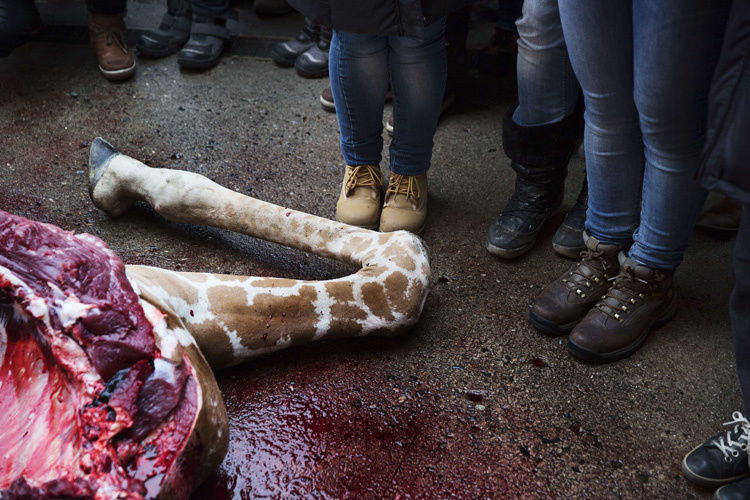
La Vie Devint Sévère Pour Marius.
Victor Hugo , " Les Mis é Rables "
I don’t know anything about Giraffe named Mari, but one can say for sure. All his ancestors-the ancestors-giraffes, the ancestors-punish, the toothy ancestors of the Cretaceous period-managed to live enough time to leave the offspring behind. Tens of thousands of ancestors, millions of years. So if the theory of evolution is generally suitable in order to judge what one or another animal wants, then here is the most true prediction: Mari was not a suicidal mizogin, he wanted love and did not want to die at the age of 18 months.
Whether he had the right to life and happiness is a difficult question. Personally, I believe that animals have no rights - and in this, without a doubt, most of the inhabitants of Denmark diverging me. In addition, I believe that the life of a giraffe is definitely no more than the life of a dog that a motorcycle shot down. But the recent scandal is completely different.
Residents of Russia and Denmark are not worried about the fact that giraffes are killed on the hunt, although this happens many times a year. The death of this giraffe, therefore, was shocked by everyone that he was killed by people who, by the family of their activities, should seem to engage in the prosperity of giraffes. They killed after serious thoughts, contrary to public protest and quite significant. They killed, as we all deep down, from the most good intentions. These were not a maniac-visual class, but zoologists who do not want giraffes anything but good. In its own, of course, a specific understanding of the words “giraffes” and “good”. And they were quite consistent.
First you need to understand what the employees of the program for the propagation of the giraffes who were sentenced by Maria are doing. They are engaged in Eugenica. That is, their tasks are not limited to ensuring that individual giraffes live well, and the herd grows - they monitor the genetic composition of the population. Since it is not easy for a person to evaluate how beautiful the giraffe is beautiful and smart, they use theoretical ideas: closely related crossing in greenhouse European conditions leads to the accumulation of harmful mutations, and for the population it is harmful. It would be possible to add fresh blood giraffes, but there is nowhere to take: to catch animals in the will of the zoos do not have the right to. In general, the Mari, who, apparently, was the fruit of closely related crossing, there was no “benefit” for the population, and, therefore, it had to be removed.
The logic of the zoo looks frankly inhuman. The only problem is that Mari was a giraffe, not a man.
The likelihood of undesirable consequences is a rather bad reason to guarantee the animal of the opportunity to multiply, and any person intuitively understands this. In the end, a hundred years have not yet passed since the chairman of the US Supreme Court confirmed the right of Kentukka to sterilize the nearby woman, motivating this by the fact that "three generations of imbeciles are quite enough."
After Maria's personal life lost all meaning in the eyes of the caretakers, a reasonable question arose about his fate. Someone said that it is enough to castrate a poor animal. The caretakers refused. This, in fact, caused a wave of indignation. Why couldn't it be sterilized? Because "castration is a dangerous procedure, an anesthetic animal can fall and break the neck." In other words, the operation, with a slight probability of attracting death, is worse than guaranteed death. This seems to be a nonsense to any person with the remnants of common sense, but for an official who is responsible for the giraffes, this is the most natural reasoning. It is one thing-he made a decision and killed Giraffe, completely different-if something went not according to plan . How can you trust giraffes to people who have something out of plan?
In the same way, the Copenhagen Zoo refused to give Maria to his colleagues. Why? Because it is necessary to transport it first, and then - he will not have proper conditions for life. You may again think that the vile Yorkshire weather is somehow better than death, but a real official will never release responsibility from his hands. Listen to Pavel Astakhov. It is better to die at home than to live in a foreign land.
Employees of the Copenhagen Zoo simply brought paternalism to a logical end. First, the giraffes are fed and impressed, guarded and treated at the expense of the state. Then - out of the best motives - they decide who he should sleep with. And then it turns out that this particular giraffe cannot enrich the gene pool of the European Giraffe population, and someone else could have welfare on its rations with a more acceptable set of alleles. (This is also almost a quote.) And there is also a lot of sequence: limited resources should be spent on the maximum benefit for everyone, and not on genetic freaks.
Universal indignation was caused exactly by the fact that the administration of the zoo explained all its logic from beginning to end - and this logic looks frankly inhuman. The only problem is that Mari was a giraffe, not a man.
If we want to give them freedom and respect, then maybe it is worth starting to close the zoos?
The only reason the giraffes live in Copenhagen is that people want to look at them and laziness to go to Africa. This means that employees of the zoos do their work exclusively reasonably: they need to ensure as long as possible the existence of a small European population for demonstration in cities and weights. It is also desirable that the skins of the animals are glistening and they do not suffer too much from hereditary diseases - it’s a pity.
When the pieces of the murdered Maria fed the lions, the zoo staff silently said that in nature this is constantly happening, let the children look. And although in nature, of course, the lion has to run to get a piece of meat, in their words there is some truth. Wild giraffes suffer and risk much more than their relatives behind bars, and die ten years earlier - usually without anesthesia. If we want them to suffer less, we must admit that the zoos do a good job of their work. If we want to give them freedom and respect, then maybe it is worth starting to close the zoos? It is impossible to want both at the same time.
In the 1830s, animals who died in the zoological gardens of London were sent to anatomical to the great zoologist Richard Owen (it was he who made an amazing discovery that the return guttural nerve at the giraffe descends from the brain to the brain, guided by the aorta and rises back to the larynx, making a hook of several meters along the road). Owen began his memoir, published in the "messages of the zoological society", with these words:
“After a break of many hundreds of years, civilized European nations again met live samples of rare animals from remote areas of the globe; And as a result of the great moral revolution that happened during this time, they can explain their collecting with higher motives than those who guided the ancient Romans, filling their exhibitions and circuses. ”
I do not urge to close the zoos, but while they exist, it is strange to regret the giraffe named the Roman consul.