
Translated material
What is feminism in Russia?
Colta.ru continues the heading "Likbez" , in which experts share with us their views on the fundamental concepts and phenomena of culture and history. Warnalist and literary critic Anna Narinskaya briefly sets out the history of the feminist movement to explain why it was not really in Russia and there is still no.
 svoboda.org Anna Narinskaya
The term Feminist appeared in English in the 80s of the XIX century and designated women and men who support the idea of legal and political equality of sexes. This, of course, does not mean that a thought that would qualify today as a “feminist” did not exist and did not develop until this time. For example, my “beloved”, so to speak, the feminist - Afra Ben: an English writer, playwright and an adventurer of the restoration era. In the essay “Own Room”-the most important text about a woman and literature, more precisely, about a woman and a word-Virginia Wulf writes about her as one of the first women writers whose voice was heard and recognized precisely as female.
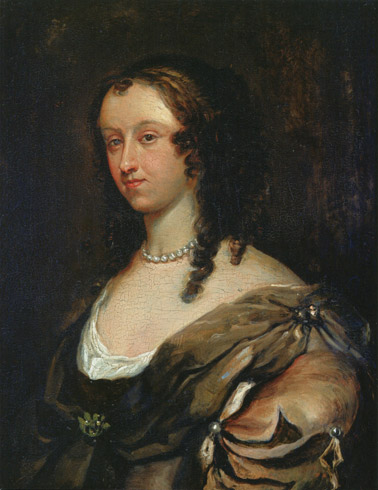 © Mary Beale Portrait of Afra Ben
The heyday of feminist thought is considered the end of the 1960s-70s-the beginning of the 80s. It was then that the feminist discussions in the West finally came out of the marginal corral granted to them and began to be considered as discussions about the state of society and thoughts in general. The works of this time, by the way, are the first theoretical feminist texts that have become known in our country among, let’s say, people seeking knowledge (I am not talking about excerpts from Kollontai and Krupskaya). This is due to the fact that in the wake of many in the nineties in the nineties in the new French philosophy, the work of Julia Kristeva with her thoughts about "male control over the language" reached us along with Foucault and Baudrillar.
This boom of feminist discussions in the late sixties led to the fact that the theory (and in fact - a mixture of theories) of radical feminism formed. Radical feminism considers (and disputes) the female position not only in social and political life, but also in all other areas, including intimate life. One of the most replicated statements of the radical feminism “Personal is political” quite accurately summarizes its essence. The whole story of such an important phenomenon for the United States as s Exual Harassment (that is, the definition that there is sexual harassment, and the decision that it should be punishable) is the result of the recognition of the value of these thoughts by society.
This type of feminism is “radical” in relation to two feminist trends that formed long before it - liberal and Marxist.
Liberal feminism is concentrated on the requirements of all equality in public life. For me, the main name in liberal feminism is male. This is the name of John Stuart Mill, the most important philosopher of the 19th century, one of the founders of the philosophy of liberalism. For him, the freedom of the woman was part of the concept of individual freedom that he develops.
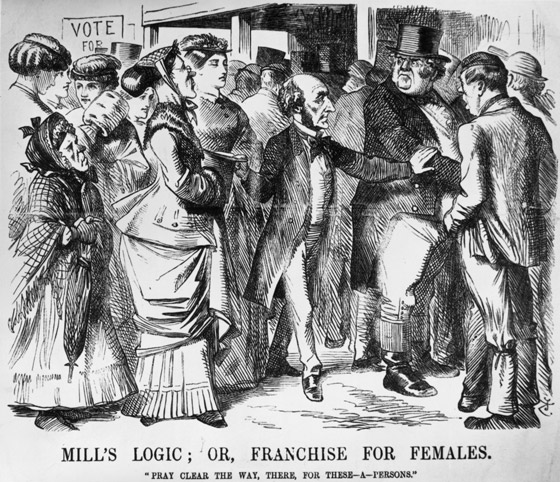 Sharz on John Stuart Mill in Punch magazine, 1867
In 1869, Mill launched the work of the “subordination of a woman”, in which he argued that the woman’s subordinate state was a relic of the primitive past, and not the result of progress, and that, remaining “frozen” centuries, it is now that this progress hinders. This work had the effect of an exploding bomb, was the subject of incredible controversy and spiteen. It was practically instantly translated into many languages, including Russian. The unpleasant “cut women” of Russian literature of that time (including the characters from the “demons” who came out in 1871)-they read Mill.
Today, within the boundaries of the so -called civilized society - that is, in Europe and North America - the requirements of liberal feminism can be considered completed. I can say that I recorded the official recognition of this from the lips of the most important leader of the movement. A few years ago, the same Julia Kristeva came to Non / Fiction Book Fair. Now this is a beautiful elderly lady who, in the sense of the struggle for female rights, is interested only in the third world, because she believes that the absolute equality of men and women has been achieved in Europe.
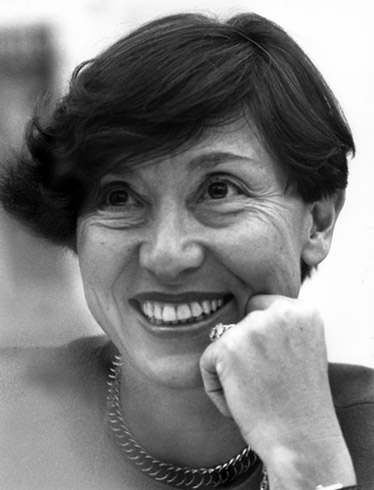 Julia Kristeva, 1989
Marxist feminists in response would say that this absolute equality in the class society is de facto available only to representatives of the middle class, but this is not the most popular discussion today.
All of the above, of course, the most runaway sketch necessary to go to us beloved. What is the “feminist” in the eyes of our, let’s say, the average compatriot (and compatriots)? This is a psychopath, which will give in the face to the one who gives her a coat or opens the door in front of her. Like this is such a whim. Well, there is still an opinion-less often pronounced out loud-that they are all either lesbians, or somehow especially Fordless in bed.
The latest considerations are, by the way, a typical "I heard a ringing, but I don’t know where he is." Initially, this ringing emanated from the incredibly successful book of Gemyen Grire “Woman Junuch”, published in the 70th year. The idea of GRIR was that in a traditional family, a woman’s sexuality was terribly clamped, because family life, including her intimate side, was designed by men. And accordingly, the role of a woman is reduced to the position of the eunuch. This book was a real bestseller, sold in department stores and became part of pop culture. In the completely lovely book of Sue Townsend, The Secret Diary of Adrian Moulo, published in the UK in the early 80s (it was written on behalf of a 14-year-old boy living in a poor English suburb), it describes how the hero’s mother reads the book of Gemymen Grire and she absolutely blows the roof: she stops painting her nails, shaving her legs and wear a lifchik. And with these unshaven legs, she goes to the store, and the whole suburb is looking at her in horror.
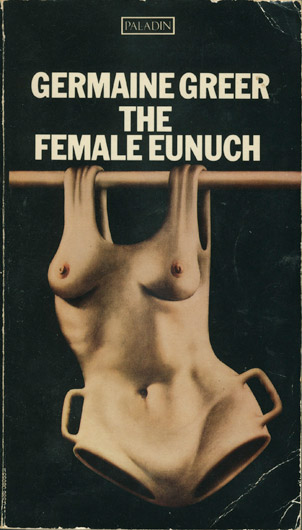 "Woman-Jew" General Grire
What is piercing the heart when you read it from our corner? That in the Soviet Union there was nothing like this. Our women did not even have time for real, in full, as my children would say, to compete for their rights. Only women “with self -awareness” managed to turn around, as the revolution happened and they all gave it to them from above, in the form of directives. As a result, what happened always to the directives. They: a) were performed formally; b) were perceived hostile or at best ironically. Say, the figure of Alexandra Kollontai, which personifies the Soviet feminism, is considered in a completely different way with us in the West. They have an important character, the first woman who became a minister and planted equality, as is considered a huge number of Western experts, with great success. And what do we know about Kollontai, except that she promoted the “theory of a glass of water”, equating sexual relations with any other physiological act?
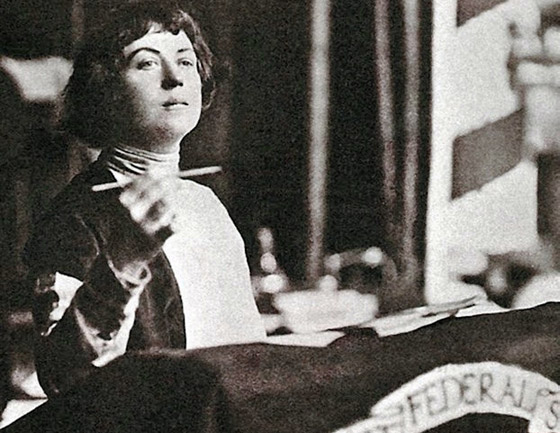 Alexandra Kollontai
Another popular (and well -known) Soviet “feminist” slogan: Leninist “every cook must learn to rule the state.” According to statistics, by the 60s, the Soviet Union was a place with the largest share in the world of women in medium-sized layers. This meant all these aunts with halars on the head, all these “comrades of the Paramonovs” described by Galich, sitting in the regional committees and executive committees. Their presence in these places, in an understandable way, was not canceled - at the human level - relations like “women - fools” and generally complete family non -rights, and perhaps only strengthened it.
And if we talk about the thinking and even dissidential strata of society, then there the idea was in resistance to state pressure in general, and no one thought about discrimination of women separately.
In addition, there is still an interesting nuance. Feminism in all its manifestations implies resistance to conventional religions: any religion suggests that a woman should know her place - albeit not secondary, but special and unequal. And in the 70s-early 80s, many representatives of the intelligentsia-the dissident, including the Jewish, turned to religion, since it was considered as an antidote from the SOCK.
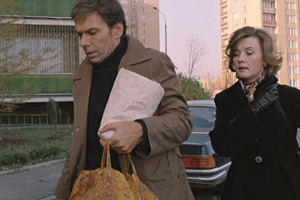
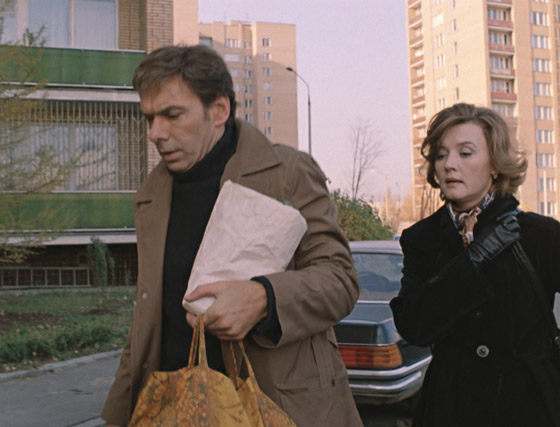 © Mosfilm Frame from the film "Moscow does not believe"
In principle, the completely consensus gaze of the inhabitants of the Soviet Union is expressed in the film "Moscow does not believe in tears." A very simple thing is said there: a woman can earn as much as you like, a man will decide. The funny fact that this film was released in the 80s, when the US was just a surge of the feminist struggle in the United States. And at the same time, he was given an “Oscar” - according to many, he revealed the essence of the “other”, and more simply - he narrated about the mysterious Russian soul. Reigan, before meeting with Gorbachev, specially showed this tape so that he could better understand his overseas interlocutor.
The Soviet regime replaced, in a stamped manner, but not that wrong, capitalism with the cult of wealth. And - which in our case is more important - a cult of success. This success very quickly formed a gender sign. For a man, success meant to be rich, for a woman to be a rich girlfriend. This configuration has been preserved to this day. You can conduct an experiment and ask the audience who Dasha Zhukov is - be sure that the answer will be not an “important galleryist and publisher”, but “Abramovich’s friend”.
In the West, the time of the direct struggle of women for rights has almost ended.
This opinion is felt familiar and comfortable. Accordingly, to please him and thereby make a profit, the whole car of commercial pop propaganda works. And with sincere directness: any book is littered with books such as “How to marry a millionaire”, “The path to the heart of a man lies through the stomach”, “Make your image so as to please the man.” And with some postmodern fig in his pocket, as is done in the series of Valeria Gai Germanicus “A Brief course of a happy life”. In this sense, it is interesting to compare it with the American prototype - the series "Sex and the City". He also offers four women who think only about men, sex, etc., but nominally they are all very carefully successful women, that is, it is presented: they have something else in life. And Guy Germanicus puts his heroines in a mossy office, they buy something in the transition, generally live a terrible life, do not say and do not think about anything other than their relations with men.
 © Channel One Hard from the series "Brief course of a happy life"
Today, it would seem that many feminist values could penetrate here from Western television products, in other words, from the series, which are now so passionate about. But! In the West, as I said, the time of the direct struggle of women for rights has practically ended due to exceptional success in this field, and most of the series reflects this situation. Take the advanced, let’s say, films-the Danish series “Crime” (and his American remake “Murder”) or the Danish-Swedish “bridge”, which are considered exclusively feminist show, because they show us a woman-detective as a certain superheroin. But if earlier, in any movie, a woman-police should constantly prove to the male colleagues that she was no worse than them, and this was one of the threads of the plot tension, then this is no longer and cannot be. Her superiority is justified by her rank, and this can no longer be done, there are more important things to do. In the “crime”, the first season of which I personally consider one of the highest achievements of Tekino, in principle, there is even a certain return to femininity. The mistakes that the heroine make and the insights that visit her are often associated with the fact that she is a woman. This is just the rehabilitation of the phrase "Women's Logic", which in the West would recently be considered sexist.
What female rights are put up with Pussy Riot - we do not know.
That is, we missed the time of “their” direct feminist statements - such as in the film “Telma and Louise” (which does not mean that we did not watch this film, which means that we did not perceive it as a film about “female”) - and immediately entered during the statements more complex. Which to us - not having the feminist background - is quite difficult to recognize.
In the sense of the fact that we are going on with feminism today, Pussy Riot is extremely illustrative. Members of this group call themselves feminists, but does anyone know about the feminist platform Pussy Riot ? Even if she is formulated somewhere, she does not reach anyone at all, including even those interested-for example, me. It is important for society that they are against Putin, against the Russian Orthodox Church and to protect the rights of prisoners, and in general it is important that they are. What female rights they defend - we do not know. The feminist component of their views, whatever it is there, is not interested in anyone, and, frankly, it does not seem that they were somehow very interested in it themselves. In any case, they do not demonstrate it.
And this is very significant. What would be now becoming a real feminist in Russia? (I’m deliberately not talking here about a completely discredited “official” feminism named after Maria Arbatova, about the brisk columnists about “sex and relationships”, whose position comes down to the eternal “all men - scum”, and - unfortunately - about very sundowing smart theorists, such as Nadezhda Plungan, who, I think, do it today, I think today. marginal.)
What is a “feminist” in the eyes of our, let’s say, an average compatriot (and compatriots)? This is a psychopath, which will give in the face to the one who gives her a coat or opens the door in front of her.
To be now a feminist in Russia means, in my opinion, to go to a conscious simplification of your position. We must talk about those positions and achievements of feminism, which we, due to the above circumstances, missed. And to talk about this an accessible, understandable language. It is necessary to discuss and defend things that have long been discussed in the West, have become a banality there and even tired of everyone and which, as a result, it is customary to look down on this. It is, for example, about political correctness so despised by all. And in this sense, all these ridiculous stories with pinching over the ass or read by me on Facebook become relevant about how the teacher invited the schoolgirl to wash the floor with the words “you are the future hostess”. To begin with, it is necessary that the women themselves understand that the shield by the ass is not a compliment, but humiliation and why it is impossible for the teacher to say this, and then discuss more complex problems.
Of all the people who expressed their opinion publicly, the closest to such a position seems to me Masha Hessen - in any case, while she lived here. I know that she is by no means popular in all circles - and many of her opponents are much prettier to me than she, and I myself do not agree with her in a huge number of issues. But in this sense, her behavior seemed to me the most consistent and the most practically correct. She was not shameful about all this-banal-to say, she was not afraid to seem funny and not intellectual enough in this sense. And this is very important.
Recorded Denis Boyarinov