
Translated material
System Igrek
Remember Shukshin:
But to us, air designers ...
- You are by rail.
- No, I'm by rail, but with an aviation bias. We are now developing the Igrek system: a railway without bridges.
- How is it?
-So. Here is a train, on the way - a river ... But there is no bridge.
- Well, what about?
-Very simple: the train is plannedly rises into the air, flies through the river and again sinks to the rails.
-Where will he have wings?
- No wings are an air cushion. The steam locomotive lets a powerful stream of a worked pair for itself - and a couple, a couple ...
From great literature to reality, one step.
The other day I stumble upon the news : Scientists of the Siberian Research Institute of Aviation named after Chaplygina made a project of high -speed renal transport built on the described principles.
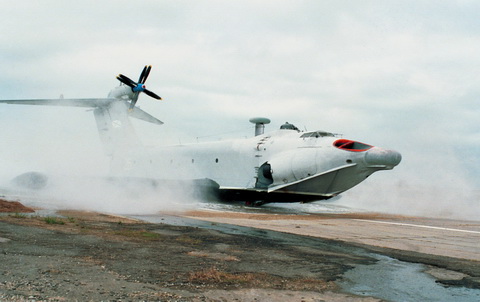
We are talking about creating a kind of “flying train”, capable of steaming above the surface of the highway - overpasses standing on multi -meter reinforced concrete supports - due to the screen effect. Simply put, leaning on an air pillow.
According to the project, Aeroexpress will be able to transport up to 200 passengers at a speed of up to 600 km/h at relatively low energy costs. At the same time, the estimated cost of the construction of one kilometer of the route should be 5 million dollars, that is, about ten years cheaper than a kilometer of paths for the vaunted Sapsan.
The proposal of Novosibirsk scientists is by no means a literary metaphor in the Fantasy genre, as it might seem. In Russia, there is vast experience in the construction of such devices - ekranoplanes, the first of which was “inflated” back in 1961. Since then, several dozen such machines have been built - mainly for the military.
Further development of promising technology, the collapse of the Union prevented. Already today, such cars tried to build individual enthusiasts, but with varying success. Probably the most famous company in this series - OTK CJSC - went bankrupt in 2011. Although interest in the topic did not fade away. In particular, a couple of years ago there was news about the beginning of the development of a new platform for ekranoplanes with a carrying capacity of 600 (six hundred!) Tons with two Russian scientific institutions. Now the good news came from the Novosibirsk Academgorodok.
Promoting their project, scientists from the Research Institute. Chaplygina reasonably believes that the “air train” is a high -speed and relatively inexpensive system - a good solution to the country's transport problems with its huge distances and an unheated territory. I only remind you that it was precisely because of the unbearable price-under trillion rubles-halfway, in fact, that the project of the high-speed railway (VSM) Moscow-Kazan choked. About her alleged continuation to Yekaterinburg now do not even stutter.
But even if you do not encroach on the holy - of course, they will not refuse the idea of building a HSR - ekranoplanes may not turn out to be a reasonable alternative when mastering hard -to -reach territories, including eastern Siberia and Arctic.
How does this happen today? Just one example: the northernmost railway in the world Obska-Bovanenkovo-Karskaya, built by Gazprom for its projects on Yamal. It began as a Komsomol construction in 1986, and was completed almost a quarter of a century later-in January 2010.
The exact amount of the costs incurred probably does not know. However, the road with a length of 572 kilometers was set to the balance of Gazprom at the cost of 130 billion rubles. That is, according to conservative estimates at a price of $ 7-8 million per kilometer. Even taking into account difficult climatic conditions, it is very expensive. Experts, referring to world practice, are called a “fair” range of 1-3 million.
Where is the margin, want to ask after our president?
In August last year, Vedomostidescribed one of the, probably, numerous cuts of the saw. According to the newspaper, at least 13 out of 70 of the bridges erected throughout the highway did not correspond to the approved project: instead of the concrete plates provided by them, wooden sleepers laid under the rails. Also, in some cases, ice cutters needed to protect bridge supports were not built. As a result, Gazprom could be calculated for 19 billion rubles or approximately 15% of the cost of the entire road.
Also, according to Vedomosti, the management of Yamaltransstroy, which was engaged in the construction of 22 bridges, was affiliated with the top management of the gas monopoly. In the TFR in the know, but they have not said their word yet.
And another remark. In September 2009, Putin proposed to transfer the long -suffering Gazprom Railway of Russian Railways at the balance sheet value. The head of the monopoly Yakunin-by golly, should pay tribute to his bureaucratic courage-then did everything so that this does not happen. It turns out that the “golden” road worked at idle speeds: the volume of goods transported through it was (and, obviously, there is) not only to recoup it, but even to justify the current maintenance costs.
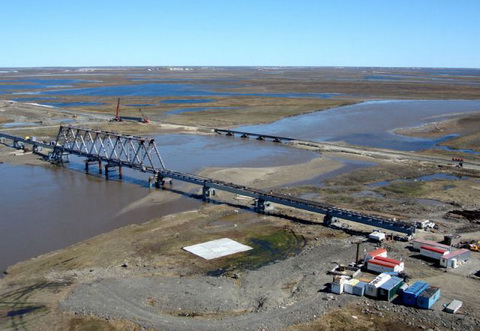
In a word, the polar railway turned out to be a typical corruption history, of which there are many in Russia. Now imagine how ekranoplanes fit here, the use of which would make most of these costs simply unnecessary.
In the Russian context, the relative cheapness of the technology proposed by Novosibirsk scientists is not its dignity, but the main weakness. Not the same, excuse the expression, a multiplier effect. Than to steam over the development of a new technological industry, it is much easier to buy all iron-the same high-speed trains, giving them our proud bird names-somewhere in Germany, and then, without unnecessary noise and dust, proceed with the development of the budget for the next grand infrastructure project.
Such a wretched igre system.
In the picture: the marine catamaran "Gemma". Transports 260 passengers, speed - 35 knots. Photo by Alexei Zhigailov /ITAR-TASS /