
Translated material
Almost eternal topic
Very soon the Afghan crisis will again become a headache of Moscow
Exactly 25 years ago, February 15, 1989, the last Soviet soldier left Afghanistan. In Afghanistan itself, this day is celebrated as Victory Day
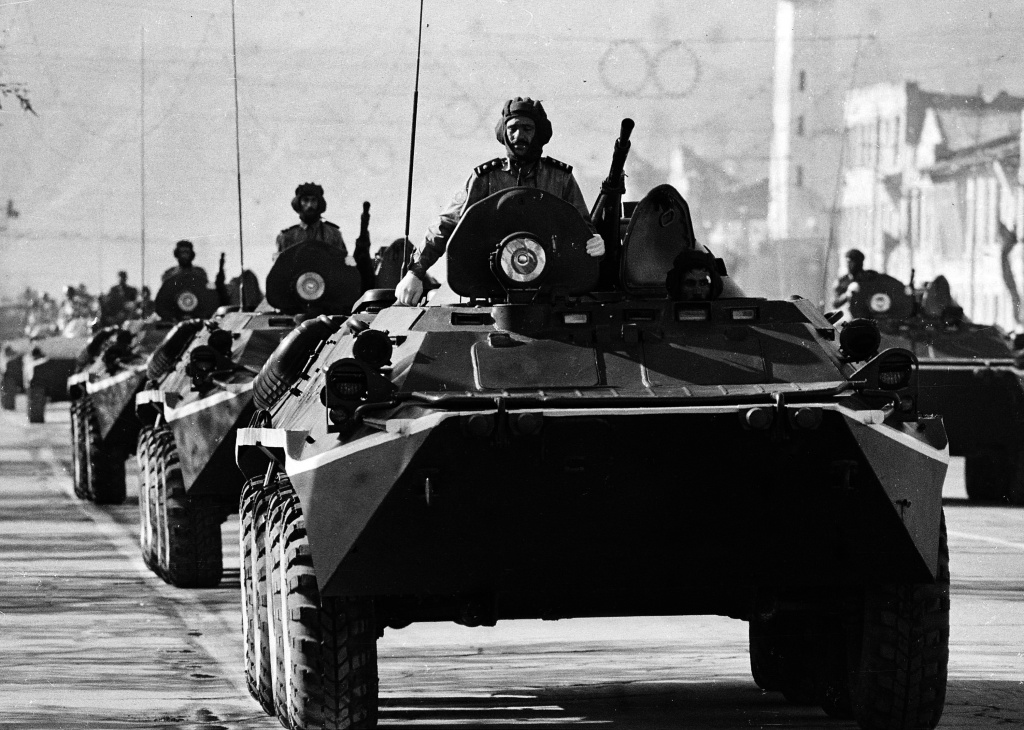
In Kabul on February 15, it is celebrated as the day of the victory of the Mujahideen over the USSR. If discussions are still popular in Russia about considering the Afghan war won or lost, then the Afghans themselves have a rare unanimity in this matter: of course, they won. Moreover, the result of this victory, according to the Mujahideen, and after them the new generation of the Afghans, was not only the departure of the Soviet Army from Afghanistan, but also the collapse of the Soviet Union itself. Many Mujahideen in Kabul are sure today: it is the world that they owe the collapse of the second superpower at the end of the twentieth century, the cessation of the Cold War and, as a result, by the radical reconstruction of the world political system.
"Zapfgan" societies
The price of the Afghan war of 1979-1989 was great for both Afghans and Russians. She forever changed these two peoples. Fifteen thousand dead Soviet soldiers and officers - approximately the same amount in our country in automobile disasters - turned out to be an excessive victim for the late Soviet society. The goals of the “War behind the river” were less and less understandable to the country with each year, which sent their sons to the “limited contingent”. The guys from Russia, Ukraine, Belarus, the Baltic states, the Caucasus, Central Asia were dying for Afghan socialism at a time when none of them believed in socialism in their homeland. Such a “cognitive dissonance” could not but give rise to a powerful psychological complex, which, on the very historical region of the USSR, manifested itself in a massive sense of injustice of any sacrifice in the Afghan war.
Russia and other CIS countries were largely formed as "Zapfgan" societies. The “Afghanization” of social and state life in the era after the USSR appeared especially fiercely and openly in numerous armed conflicts in the post -Soviet space, in which the veterans of the Afghan war took an active part. Karabakh, Transnistria, Chechnya, Tajikistan, Abkhazia ... As a result, tens of thousands of dead, millions of refugees and forced immigrants. Who knows, maybe these conflicts would have been avoided if by the time of the collapse of the USSR in our country there would not be a large number of healthy and strong men who passed Afghanistan and confident that with the help of a Kalashnikov assault rifle, almost all problems can be successfully solved.
Revenge of children
The losses of Afghanistan from the war of 1979-1989 were even more terrifying. About a million killed, more than five million refugees who have lost their homeland for many years, having lived almost all their lives in camps for immigrants in Iran and Pakistan. In these camps, swelling from new and new refugees throughout the 80s of the past century, in the end, a mysterious, fierce and merciless Taliban grew. “Searching knowledge” (as the word “Taliban” is translated into Russian) Young graduates of the Pakistani Madrases were carefully grown by the Interdepartmental intelligence of Islamabad (ISI) from children and adolescents from Afghan families who fled to Pakistan from the socialist experiments of the Babrack Karmal and more and more fierce methods of “limited contingent”. In December of the 79th, when the first camp columns of Soviet paratroopers entered Kabul, they were 5-10 years old. In the mid-90s, they matured and charged with simple and sharp, like a razor, the ideas of radical Islam, returned to Afghanistan with weapons in their hands under the banners of the Taliban. The cruel and terrible political regime proposed by them, which they proposed by them, was ruined by the war, was based not only on religious fanaticism. The Taliban took revenge on the adult world for the horrors, blood and death that they experienced by children. They wanted to scare this world in the same way as they were once scared by it. The cruelty of children is the worst, all the more matured children with a Kalashnikov automatic machine.
In different eras
Today, a generation that grew up after the war of 1979-1989 is entering the political arena of Russia and Afghanistan. Afghanistan is one of the youngest countries in the world, more than 80 % of modern Afghans are people under the age of 30. The Afghan elite and the Afghan people live in different historical eras. The ruling class, like other post -Soviet elites, is busy with personal enrichment, corruption schemes and power struggle. The rural Afghan out howling was hidden in anticipation of the revenge of traditionalists, who threatens to become a reality a year later - after the departure of American and NATO soldiers. The city Afghan class hopes for the best and is looking for ways to preserve the achievements of Western modernization of the last decade. Let's see how he succeeds. Until now, archaic has always won the archaic and modernization in Afghanistan.
In Russia, a country, rapidly aging, having lost interest in adventures, requiring great expenses and tension of forces, a generation of Afghan war rose to the political Olympus-those who fought in Afghanistan in the 80s or whom he then whipped through their hearts with his cruel and cynical aesthetics. And this generation will soon again solve the “Afghan issue”. As soon as the last American soldier leaves the foothills of Gindukush, the Afghan crisis, who, for more than ten years, former the head of the West, will be the headache of Moscow.
It seems that, contrary to some forecasts and councils, Russian politicians will no longer play in the Afghan war - the military return of Russia to Afghanistan is practically excluded. The emissaries of the Kremlin, in particular, in the Shanghai Cooperation Organization (SCO), who declared at the end of 2013, made this: the SCO will not deal with the issue of maintaining security within Afghanistan. And if Russia does not want to do this in the SCO format, that is, with the participation of Great China, then it is completely difficult to believe that Moscow will decide to join Afghanistan in the format of the CSTO (organization of a collective security agreement. - The New Times) or even more in high alone.
For the Kremlin, a priority task for the coming years will be the construction of an “iron curtain” around the perimeter of the northern Afghan borders. And, of course, the creation of a new post -Soviet myth about the Russian victory in Afghanistan in 1989, which, however, is no longer any desire to confirm.