
Translated material
Alexey Kudrin: "There will be no spontaneous fall of the ruble"
While in Sochi, Russia is beating for the victory - in the long -ending Cold War, including, money continues to flee from developing markets: Kazakhstan unexpectedly devalized its tenge by 20%, Russia was missing in January (net outflow) $ 17 billion.
About whether it is worth preparing for a crisis why it was eliminated by the Supreme Arbitration Court and what to wait after the Olympiad-the journalists' questions as amended by The New Times were answered by the long-term Minister of Finance and Deputy Prime Minister, and now the dean of the Faculty of Free Arts and Sciences of St. Petersburg University and Chairman of the Committee of Civil Initiatives Alexei Kudrin
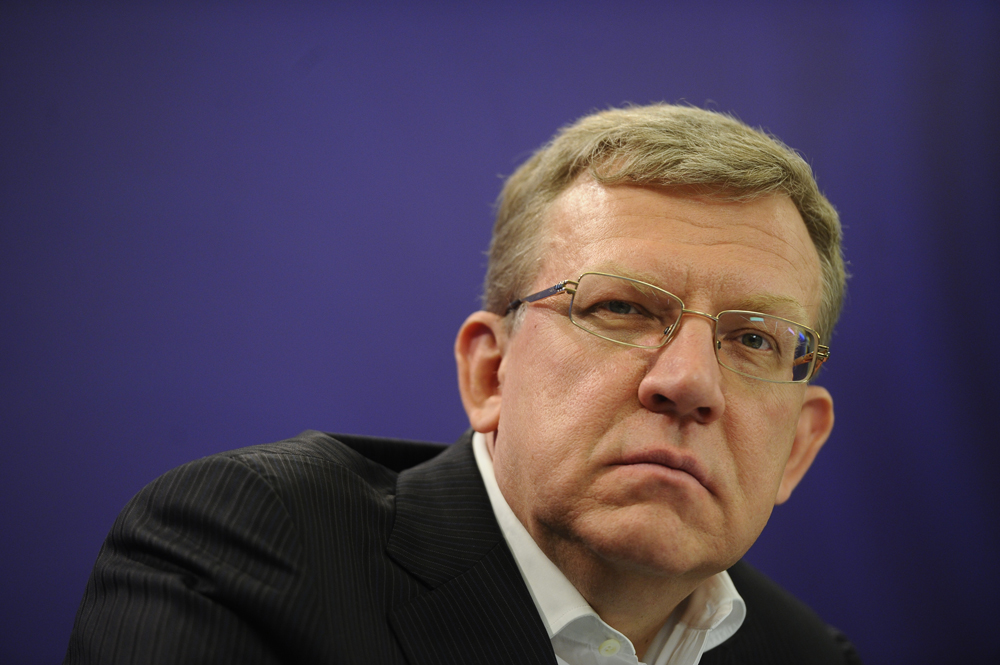
| *The New Times No. 1-2 and 3 of January 23 and 30, 2012 |
When we met with you two years ago*, and a year ago you predicted that the situation in Europe and the United States will deteriorate, did not exclude the second wave of the financial crisis. Today the situation has unfolded: Europe is growing a little, in the USA, growth over the last quarter of 2013 is 3.2%, and from developing markets, including from Russia, money is running, zero growth in industry. Why?
Let me answer consistently. So…
Europe
Last year, there was a recession in the eurozone - the fall amounted to 0.4%, and the European Union was very weak in the European Union - 0.1%, and only in the third and fourth quarters left the recession. Now it will be possible to fall in the economy in Slovenia, in Cyprus. I do not exclude that the same problem will be in several countries. In general, Europe will show a plus. But it will be a weak plus. And this is due to the fact that the main problem is debt, it will not only not decrease, but will increase in 2014: in Spain, in Greece, in leading countries, including the UK. That is, the rate of increase in debt will be higher than the growth of GDP, and so it will continue until 2016. And two years ago and a year ago, debts in Europe grew against the backdrop of the fall of economies, so I expected the worst scenario.
But now the question remains, will Europe be able to cope with this increasing duty? Banks will still be very sensitive to debt obligations of the southern countries of Europe. And if there are problems again there, then this will immediately affect the value of securities on the balance sheets of banks. Yes, while the countries have been serving these debts, the last two months the profitability of debt bonds has decreased - 1.5–3.5%, these are quite reasonable numbers for them. But the debt will increase. And in the event that they cannot serve increasing debt, this can become a detonator of the crisis both in Europe and in our country.
There is another significant risk that Europe is faced with today: it plunges into deflation. This is another unexpected challenge. Since May-June last year, prices fall in 15 EU countries, including Germany, Spain, Italy, France. This is a very unpleasant story: Japan once survived it and received the very “lost decade”. Business does not want to invest in lower prices: if prices fall, then what is it a business? Deflation kills incentives for growth, so the growth of GDP we talked about can stop or go to zero. Mario Draga (head of the European Central Bank (ECB). - The New Times) is a difficult time now - he is trying to decide on politics so as not to fall into this deflation. Finally, speaking of risks for Europe, it must be said that two weeks ago the Constitutional Court of Germany admitted: the ECB policy to support financially undisciplined countries, such as, for example, Greece, which the rest of Europe was forced to save, does not comply with the Federal Republic of Germany. If this is the case, then they can recognize all the actions of the European Central Bank inappropriate legislation of the European Union. Now it was decided to transfer this issue to the European Constitutional Court - it is put in a terrible position.
And what will happen?
I can’t imagine that they made this decision: everything will collapse, the profitability of state bonds will reach out of prohibitive levels, and Europe will again slide into a crisis. I do not exclude the option that the European Union will have to urgently make changes to the constitutional documents so that the ECB has the authority to carry out a policy of assistance to the countries of the countries. Further...
"
The Fed bought up a month for $ 85 billion, and thus $ 85 billion of net money went to the market. a week ago this amount was reduced to $ 65 billion
"
USA
Some risks for developing markets also carry the United States, the financial authorities of which have begun to reduce the volume of their support for demand in the markets through the purchase of state mortgage bonds - this is known as QE, or “quantitative mitigation”. The Fed bought up a month for $ 85 billion, and thus $ 85 billion of net money went to the market. And since banks turned out to be holders of this money, they were looking for the use of dollars to these billions and thus created the investment process. Not only in the USA, but also in Europe and Russia, where this money also went in the form of investments, and generally spread a thin layer around the world.
| ** Ben Bernanca, the head of the Federal Reserve System (General Bank of the United States), headed the Fed from 01/28/2010 to 01/31/2014 *** Janet Yellen, Professor Berkeley, headed the Fed 03/03/2014, before that was the deputy Bernanka. The portrait of Yellen The New Times published in No. 33 dated 10/14/2013 |
So, from December this amount has been reduced to $ 75 billion, and a week ago it decreased to $ 65 billion. Ben Bernanke ** before leaving took two such steps. In this sense, he tried to show the vector of politics, which would be continued by his successor to Janet Yellen ***. It is believed that Yellen will act even more rigidly than Bernanke acted in recent months.
Explain to the uninitiated why the Fed considered that it is not necessary to throw more money to the market?
There are basic indicators for all central banks, for example, inflation is 2% in the USA, and Bernanke said that another indicator is introduced during the crisis - a decrease in unemployment to 6.5%. And although unemployment in the United States is still higher, there is nevertheless there is a trend for its decrease, which means that the Fed has decided, the time has come for a slow reduction in the volume of ransom of mortgage bonds.
So the Fed will continue to continue the “quantitative softening” policy? After all, this is what investors have been following especially closely all over the past years ...
It is assumed to continue.
In the same volumes?
Supposed. They do not announce in advance, but the market has prepared for this. But the volumes will decrease every month. And if inflation begins to go off for 2%, then the Fed will stop pouring money. In short, everyone plans that another year, well, maybe with a small transition to the next, the Fed will continue this policy.
Russia
 |
 |
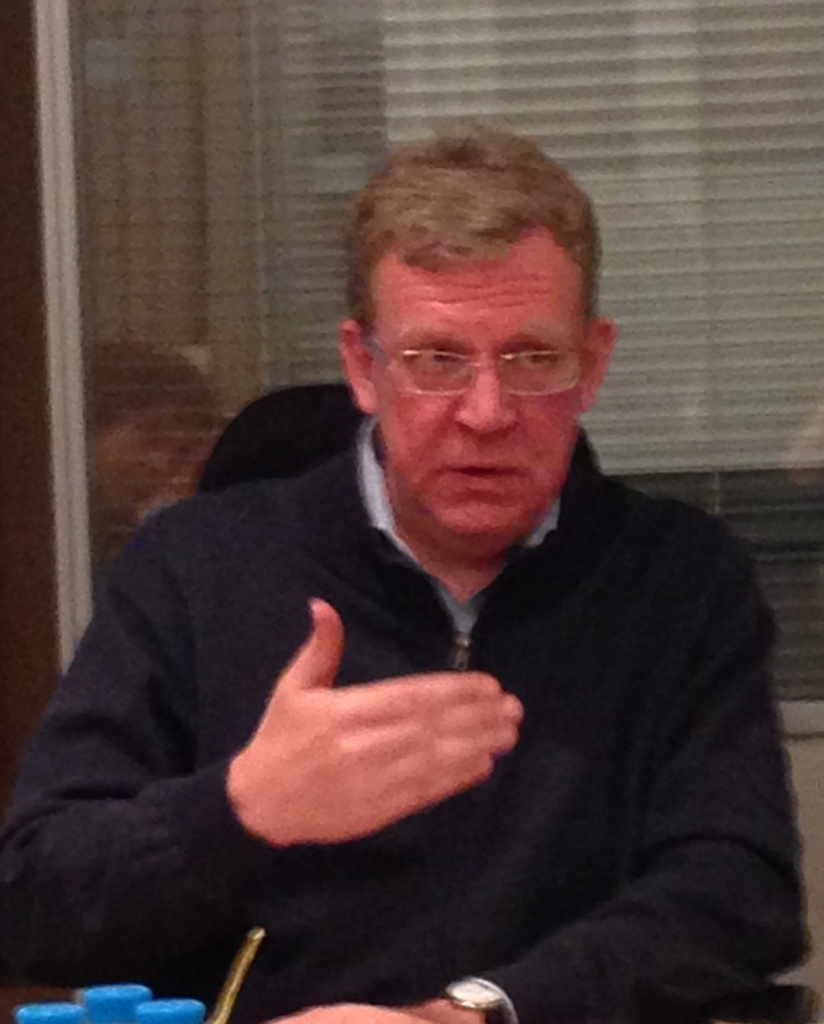 |
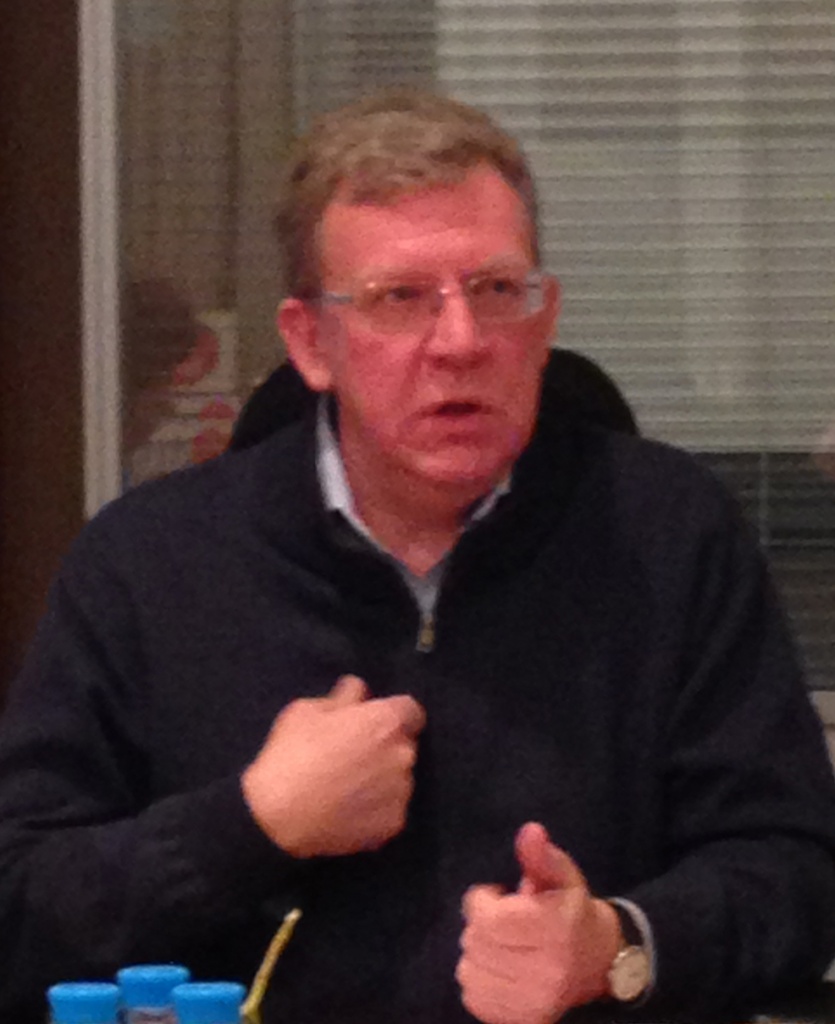
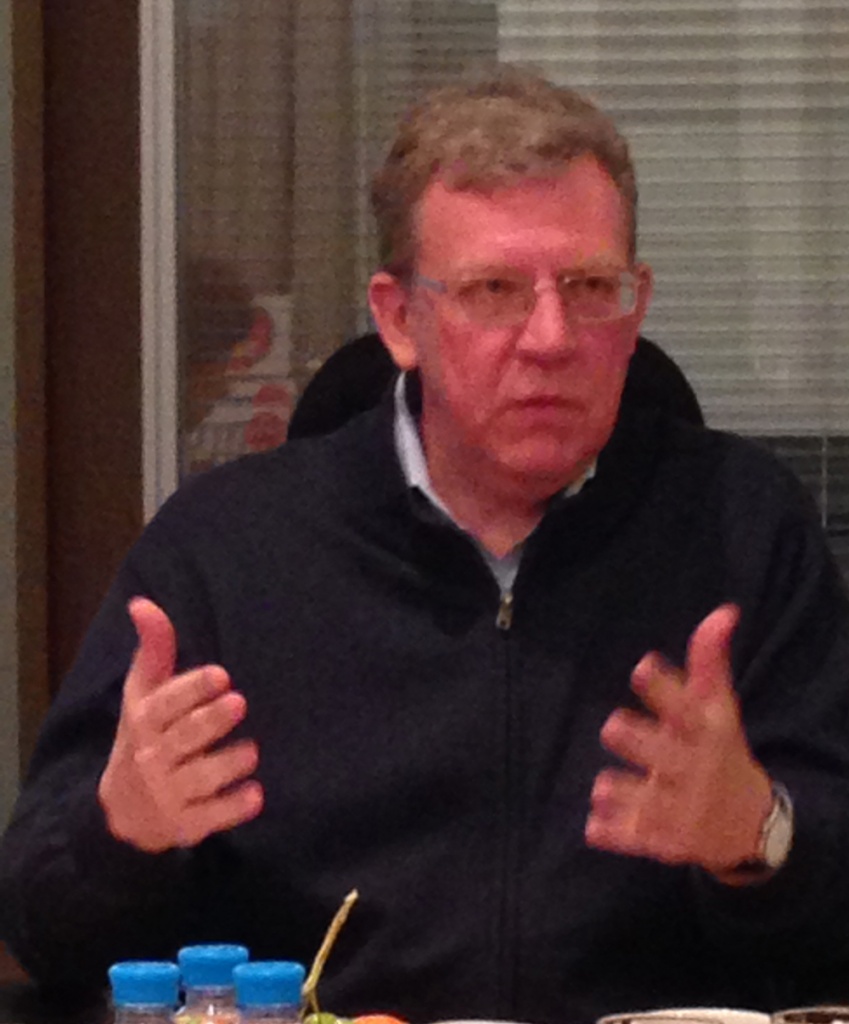
| Alexey Kudrin in the editors of The New Times. 02/08/2014 |
And how does this affect the situation with us?
Money creates demand. There is extra money, they go to the purchase of assets, securities, oil contracts, in order to leave, deposits, factories, shares there. As soon as the amount of money is reduced, the demand squats slightly. And first of all, it affected developing markets.
From the middle of last year, when the market realized that the Fed has been starting a policy of reducing the volume of money stuffing, the purchase of Russian assets by investors has decreased significantly. Our stock market ended the last year almost to zero, that is, everyone who invested in securities and shares of Russian companies lost. The American market has grown by almost 25%, some assets have grown and significantly more. And we all lost.
This, by the way, creates new fears of investors for next year: do not invest in Russian securities, they say, we will not earn anything on this, and why invest there? In addition, when the flow of money in the global economy decreases, the money becomes more expensive for those who need it, and the rates are growing. As a result, it is possible to earn both in developed Western markets, and at the same time risks are lower than in developing markets. The period when in Russia was sky -high
The profitability and it was stable - this period has passed. Now - a slowdown in growth rate, there is a stock index, so now there is an outflow of money from Russia and Brazil, from everywhere. The world believes: in countries with developing economies-and I will remind you that Russia was recognized as a country with a market economy only ten years ago-weak and political and economic institutions, the rules, protection are weaker. In addition, it was necessary to carry out structural reforms - as Germany, Greece, and Spain are now doing, reduce costs, government expenses, etc. Our countries - Brazil, India, China, Türkiye, Russia - turned out to be more slow, more inertial, more populist.
What is called, welcome to political sciences, Alexei Leonidovich: populism is an almost inevitable consequence of authoritarian regimes and dictatorships, when Soveren has the need to buy the alias of the population with all sorts of social candy - in order to avoid protests from the poor layers.
Yes, it is political institutions that do not work in this situation, I agree. There is no sufficient political competition, but there is a certain fear of losing authority and ratings. All developing markets were in this position: they have less stable political systems.
Do you think the crisis is waiting for Russia again?
There will be no crisis. There will be stagnation. I said before: if the world economy is growing by an average of 3%-plus minus, then for us an increase of less than 4% is already stagnation. Because we need to catch up with the world and, therefore, the growth below this feature means that our share in the global GDP decreases.
And the recession?
We are on the verge, but most likely we will avoid. I think that we will restrain ourselves within last year level in terms of GDP growth - 1.3–1.5%. Unless, of course, something unexpected happens-in the West, in China or the USA. China, by the way, is also in a risky zone. Even the Chinese, the Chinese still give an official forecast for the growth of their economy 7.5–7.6%, but after two to three years they see only 7%-seven percent as an average until 2020. That is, they simply switch to another growth bar due to various other problems, their overproduction, their “bubbles”.
Ruble
 |
 |
 |
Today, for $ 1 they are already asking for more than 35 rubles, for the euro - 48.1 rubles. Meanwhile, the bankers told The New Times in the fall that by the end of 2014, the dollar would cost 34 rubles. And one more question: before, people who earned in the foreign exchange market knew: the price of oil is growing - the ruble is strengthened, and vice versa. The price of oil is still high-they give $ 108.73 for the barrel of Brent, but is the ruble losing weight?
I will give an example. In 2007, from memory, we had, in addition to increasing oil prices, capital influx of $ 80 billion. We had such a double influx through the trade balance and through the balance of capital. These two factors contributed to the strengthening of the national currency. Now our oil price is not growing, and the outflow continues significant, the outflow will remain this year at the past level: from $ 50 to $ 70 billion per year. This is the first thing that weakens the ruble. The second factor: export in Russia is not growing - oil, gas -snowflower, the metal does not grow, that is, foreign exchange earnings do not increase. And the import, on the contrary, increases, the trade balance is compressed - this is the third fundamental factor. And oil - in any case, the trend is just that - will decrease. All this together and leads to a slow weakening of the ruble-one and a half to two rubles per year. So I believe that by the end of the year it will be within 35 per $ 1.
And what to store money - our readers ask?
I always told everyone: the dollar, the euro, rubles. If you put it off for two or three years, then lay out in three piles, if you have current expenses, then you need to store savings in rubles: inflation will most likely be slightly lower, that is, this money will not depreciate, you are not particularly interested in the course of inner life.
And the budget - at what price for oil is now being balanced?
At $ 107 per barrel, we had a budget deficit of 0.5%. This means that at $ 110–111 per barrel, the budget is approximately balanced. Most likely, it will be preserved.
How quickly prices will increase?
Firstly, the temporary lag between the weakening of the ruble and the increase in prices for imported goods is about three to six months-there are reserves in warehouses at old prices. Secondly, the importers are not guided by these fluctuations, but to longer trends. And if the main investment banks today give a forecast of 35 rubles per $ 1 per year, then the importers are about to plan. That is, they do not pull the prices for each leap, they are more smoothly reviewing. And there will be no spontaneous fall of the ruble.
All the last years there has been a conversation about the privatization of state-owned packages: Rosneft was going to sell back in 2011, now they call 2015 ...
In my opinion, in 2015 this issue has already been removed, in my opinion, until 2016 there are no more large sales of Rosneft. But I believe that sales of large state -owned packages should be carried out carefully. For example, the privatization program that was developed a year ago was a little fussy: there were partially privatized there, and Rosselkhozbank ... Investment flow into the Russian market is not rapidly increasing, so it is impossible to sell both the VTB and Sberbank package in one year. In 2013, the receipts of privatization funds were planned in the amount of 427.7 billion rubles, then reduced to 52 billion, and amounted to 42 billion rubles. At the same time, the plan for 2014 was reduced by 134 billion rubles, and for 2015-by 437 billion rubles.
According to your estimates, what is the share of the state in the economy today?
If we consider state corporations and state -owned companies, then approximately 50-60%.
Does it bother you?
Embarrassing. It is embarrassing that companies in which a large share of the state often operate on the market very aggressively, with the participation of an administrative resource, and even sometimes attracting law enforcement agencies.
The period when Russia was sky -high profitability and it was stable - this period has passed
"
And a little about politics
Speaking about the problems of developing markets, you noted as a problem, including Russia, low political competition, hence the tendency to populism instead of the necessary structural reforms. Those who are engaged in China are also talking about a similar problem: backward political institutions stand in the path of development. In Russia, the institutional environment worsens before our eyes. Of the latest examples - the liquidation of the Supreme Arbitration Court. How do you - the Putin's long -term Minister of Finance - evaluate this decision?
There is an official explanation: sometimes those who use the services of the court, they go on the same issue to arbitration and the courts of general jurisdiction, and as a result, different practice practices begin to take shape. Therefore, they came to the conclusion that the highest bodies of these two branches of the court should be combined. But it seems to me that this factor could not be the only or decisive for uniting the Supreme Court and the Supreme Arbitration Court.
Then what became the real reason?
I don’t know. As far as I know, for representatives of these ships, this was an unexpected decision.
For the sake of liquidation, you went to amend the Constitution - what interests can stand behind this? For example, one of the versions is to make the judicial system even more controlled?
It seems to me a weak concept. Because both vessels were and remain in the zone of influence or attention of the authorities.
Another version: is a super -shroud created to lead it - after his resignation from the post of prime minister - Dmitry Medvedev?
And this version does not seem serious to me.
From your point of view, does the elimination worsen the institutional environment?
Now - yes. Because now it is not clear how the new system will work. Certain standards and practice were achieved inside the arbitration court. And in general, he earned significantly better in recent years. And in this sense, such a restructuring, it seems to me, is not entirely clear. And for a certain period will even cause, perhaps, difficulties.
You know how the head of our supreme power works. Deterioration of the economic situation - how can this affect the actions of the authorities in the field of politics? One version: even more twisting of the nuts is coming so that the authorities can insure themselves from possible protests; The other is exactly the opposite: the nuts will be released, so that more people begin to do business and provide their families in the conditions of a contracting budget. Your version?
My expectations: there will be more such maneuvering - in the current parameters.
Pessimists believe that after the Olympics it will become much worse.
I don't believe it. I think that the state will have to significantly overestimate its expenditure obligations. First of all, defense expenses will have to be reduced. I think that they will not dare to increase taxes. And this means that the share of social expenses will increase in the budgets of all levels - they will also be financed and also indexed. Which, in turn, unfortunately, will generate stagnation.
I do not plan to create a political party. I once gave the floor to support the civil society of Russia, this is my duty
"
Another question: why did the president decide to have mercy on Mikhail Khodorkovsky?
It seems to me that there was a desire to close the problem with minimal losses.
But the whole of 2013, the security forces threatened the third thing?
Perhaps it could be made on paper, but it would be difficult to prove it, and it would hardly be perceived in the world as evidence. By the way, the president in one of the speeches said himself about his doubts about this case. So he was in the subject. It seems to me that he quite reasonably solved this problem for the country, for himself and for Khodorkovsky.
The version of Khodorkovsky himself: Putin, releasing him to freedom, gave a signal to the security forces - de, guys, played ...
Для меня это маловероятно.
Суд в Гааге, который в июне должен вынести решение по иску миноритариев ЮКОСа к Российской Федерации на $100 млрд — в какой степени эта перспектива могла повлиять на решение помиловать Ходорковского?
Я не думаю, что Гаагский суд подвержен таким политическим влияниям.
Вы верите в слова Ходорковского, что он не будет заниматься политикой и не будет бороться за активы ЮКОСа?
Да, безусловно, не будет.
А амнистия Толоконниковой и Алехиной из Pussy Riot, освобождение из тюрем активистов Greenpeace?
Я думаю, что фактор Олимпиады здесь присутствовал, но не как решающий. Это был раздражитель — для Запада прежде всего.
Почему канцлер Германии Меркель принимала такое живое участие и в освобождении Ходорковского, и в амнистировании Pussy Riot? И чем Запад должен будет заплатить за этот гуманизм российской власти?
Я думаю, что Меркель просто представляла в этих переговорах Запад, поскольку у Германии тесные отношения с Россией. Есть еще версия, что сам Ходорковский был связан по бизнесу с некоторыми немецкими компаниями… Может быть, и это повлияло. Что касается Pussy Riot, то и тут инвесторы могли как-то повлиять. Они, наверное, говорили своим российским партнерам: «Знаете, все такие случаи, как с Pussy Riot, нам приходится объяснять акционерам: что происходит в России, как принимаются судебные решения и защищены ли в таком случае их акции, не потеряют ли они деньги, которые вложили в нашу компанию». И хотя не стоит переоценивать роль иностранных инвестиций, тем не менее Германия — один из крупнейших инвесторов…
Алексей Леонидович, вы гомосексуалистов боитесь?
Я — нет (смеется).
Отчего их так боится российская власть?
У меня осталось две минуты — можно, мы не будем это сейчас обсуждать?
Тогда два коротких вопроса: вы подавали заявление о вступлении в «Единую Россию», о чем недавно писали «Известия»?
No, never.
Вы будете создавать свою политическую партию?
Нет, я не планирую создания политической партии. Я когда-то дал слово поддерживать гражданское общество России, и я считаю, что это мой долг. Этим я и собираюсь заниматься.
фотографии: Сергей Бобылев/ИТАР-ТАСС, Е. Альбац