
Translated material
"Shoot or turn around?"
Theater art studio Sergei Zhenovach plays "Notes of the Dead" Mikhail Bulgakov
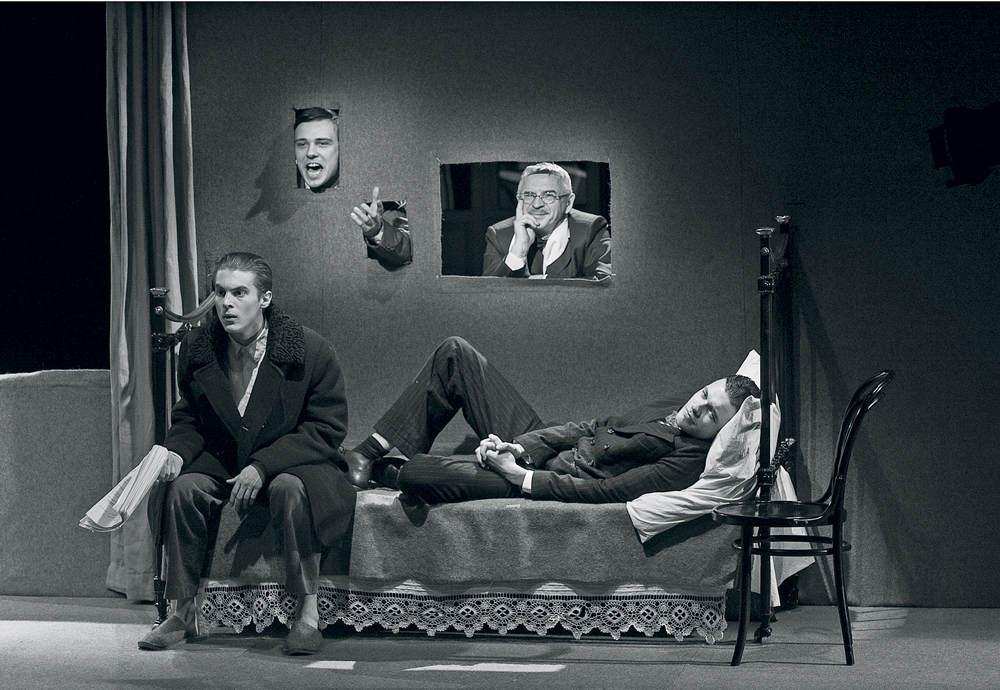
Ivan Yankovsky as Maksudov (left) and his phantoms are the characters of an independent theater
The unfinished “Theater Roman” - a cheerful, mocking and creepy work - Bulgakov composed in an atmosphere of despair, from which he no longer got out until his death. In 1936, they defeated and banned the “Basal of the Holy”, Bulgakov left the Moscow Art Theater, wrote a meaningless “Batum”, glorifying Stalin, terribly fell ill, returned to the “master” and died in his bed in the spring of 1940. The Theater Roman still remained a mystery, it is impossible to determine its genre, it is all woven from scraps of prophetic dreams, floating memories and nightmares. The satirical cheerful, painting the morals and the life of the main theater of the country and its inhabitants, was pulled into quotes and jokes. Indeed, the best that is written about the theater, about theatrical nature, about the theatrical mystery and theatrical quackery, is the story of Bulgakov.
Maksudov and turbines
Sergei Zhenovach has a unique gift to translate prose into the language of the theater. In the repertoire of his theater - Prose of Chekhov, Dostoevsky, Leskov, Platonov, Dickens. His artists learned to own someone else's word, as their own, they are not scared by kilometers of literary texts, they turn any literature into a drama of feelings, into a theater novel.
Bulgakov in the shower of the director occupies a separate place, he seems to be placed in a special frame made with his own hands.
Zhenovach is sick Bulgakov, he does not part with him, as with a disappeared friend, with whom he did not finish about something important with whom he leads and conducts an incessant dialogue. Zhenovach put the “White Guard” in the Moscow Art Theater in 2004, connected a novel and play in it, together with Alexander Borovsky invented a luxurious image of the performance-a huge, flying in the blackness of the bridge, as if erupting from the planet, according to which small people rushed with horror faces. The White Guard has been going on in the theater for ten years, and we do not have a better performance about the turbines today.
Zhenovach also called his beloved heroes to the “Notes of the deceased” - Alexei Turbin, Nikolka, Elena Talberg, Lariosik, Junker, Petliurians and Red Army soldiers will arise on the stage in the brain of the writer Maksudov, in a chaotical backdrop of an independent theater, then in his dreams, then in visions, then in genius rehearsals Ivan Vasilyevich.
Bulgakovsky Maksudov composes “Black Snow” - a play about the Civil War, Zhenovach directly quotes the “White Guard”, his Maksudov composes “Turbine Days”.
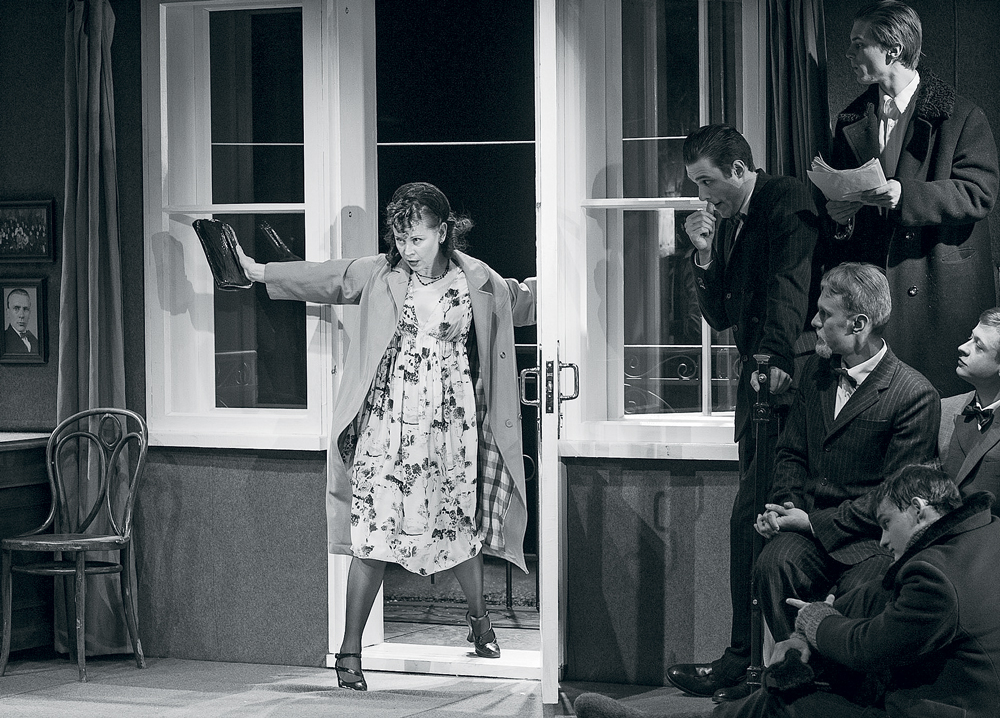
"Star" output of the artist Perekhina (Olga Kalashnikova)
High disease
The image of "Notes" is a clash of comfort with chaos. Mainted by time desk. Photos in frames on the wall - Bulgakov himself, Elena Sergeevna, parents, house. A crumpled bed, on which, pressing into the wall, lies a man in slippers on the bare foot. Green lampshade lamp. Cream curtains. There is a balcony and blackness of the night. A snow -white shirt dries on a rope. The wind rinses the sleeves. From somewhere from behind the wall a monotonous waltz walks along the keys. A person takes out a gun and puts it to the temple.
There will be no shot, because it is said: "No shots!" And a person does not have a dagger to stab, as the founder of an independent theater Ivan Vasilievich.
The main character, the writer of Maksudova, is played by the young artist Ivan Yankovsky, this is the third generation of the famous surname, the grandson of Oleg, the son of Philip and Oksana Fanders. Bulgakov spoke about these with the words of Voland: "Blood is a great thing!" The young Yankovsky plays a man broken, torn, sick with despair and talent. The whole performance is an attempt to live, an attempt to break out of black outside the window, an attempt to replay a story and come up with a different path of fate, believe in an imitation of harmony and happiness as the actors believe in their role.
Collision with the theater, with the theater! - This is the same attempt to replace one absurdity to another. The theater - with its madness, the lack of any logic and a cheerful mess - heals the hero from the impending darkness of death and plunges him into the world of a “high illness”.
And the entire independent theater is gathering at the bed of Maksudov, not crawling out of felt slippers. Here is the impressive bombardes (Igor Lizengevich), and the mocking nimble Yelagin (Vyacheslav Yevlanteyev), and the Holen handsome Patrikeev (Dmitry Lipinsky), and the growling avant -garde player Thomas Strizh (Alexander Proshin), and the curly bristly bristry Perekhina (Olga Kalashnikova), and Prima Veshnyakova (Marya. Kurnevich), and as many as three secretaries of the Toropetsky (Katerina Vasilieva, Evgenia Gromova and Maria Shashulova) - in the same copper wigs and with smoking mouthpieces in long fingers. The famous Bulgakov phrase "This world!" Maksudov does not pronounce, because in his eyes he is a mixture of enthusiasm and horror, and he rushes into this alien and strange world, as in the abyss, as in the blackness of the night from the balcony.
"
The best that is written about the theater, about theatrical nature, about the theater mystery and theatrical quackery, is the story of Bulgakov
"
Rehearsal of death
Maksudov’s meeting with Ivan Vasilyevich (Sergey Kachanov) is a meeting of two obsessed people, lonely, passionate, vulnerable, suffering.
Ivan Vasilievich speaks in phrases from the works of Stanislavsky, hates playwrights, torments the artists at rehearsals and delights his ingenious “theory” with rapture. The rehearsals of the scene from the “turbines” turn into a hilarious theater cabbage, when the actors play more terrible and terrible after each remark of their genius, and the process itself becomes an unbearable torture for its participants. The suffering playwright every now and then raises his eyes filled with tears and shouts with a prayer: “Well, when, when will my play come out?!”
The play will not work. The audience, laughing, will not notice how the scenery will creep in different directions, lie down, like a house, which was knitted with an earthquake, turning the scene into a shapeless pile of rags, ironings, broken chairs, crumpled papers and motionless bodies lying under them. The theater will end as suddenly as it began.
The theater will fulfill what is destined for it: after all, it was said - "No shots!" Let us better all fed together with a dagger!
Photo provided by the press service of style