
Translated material
From under the blocks
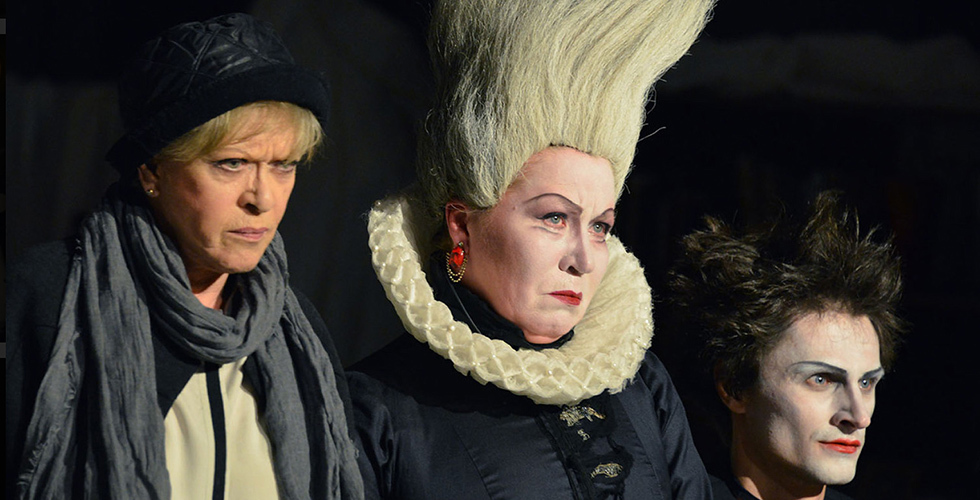
The place in the latest history of the domestic theater was reserved for Alice long before the release of the performance, which became the debut of Andrei Mogovy as the artist of the St. Petersburg BDT and at the same time the first meeting of the artists of the great dramatic with the bearer of a fundamentally new artistic code for him. Few, however, could have assumed that this first experience of the dialogue of the famous director and the legendary troupe would be so instructive and fruitful: Alice is definitely destined to enter the annals of the modern Russian scene of one of its iconic milestones.
The foregoing does not at all abolition the fact that in the local context of the creative path of the mighty one to recognize “Alice” is not easy - there are enough problems in the performance, and very serious: seams with dramaturgy, offensive miscalculations in the literary composition, now and then and the unpleasant moralizing pathos - despite the fact that the role of the literary text in Alice is more than more It is important than in each of the recent productions of the director, where the word played a completely official role of one (and by no means the most significant) of the layers of theatrical whole. Annoyed by the fairness of other messages of the performance, you are sad about the absence of that multidimensional associative volume that you habitually distinguished the mature works of the mighty.
 © Bolshoi Drama Theater named after G.A. Tovstonogov
The paradox, however, lies in the fact that the Hamburg account does not make any sense in issuing Alice: the performance does not only tell about the tectonic seam that separates the “glorious past” of the great dramatic from its “difficult real”, but in fact this seam is-and it could hardly be more harmonious or “well made”. Not being the best creation of the mighty director, “Alice”-which is much more important-became the unconditional victory of the mighty as a Khudruk BDT.
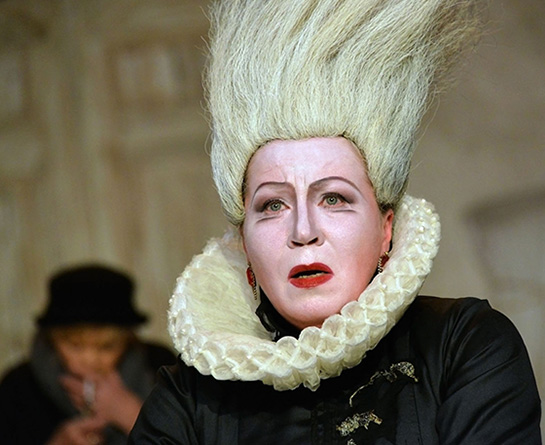
It is not by chance that the mighty gives the role of the main character of the performance by Alice Freindlich, and the point here, of course, is not only that with the thoughts of the today's dramatic name of the people's favorite, it comes to mind almost in the first place - although it can be assumed with confidence that in the metataral plot of the play, the image of Freindlich as a genius Loci modern BDT had fundamental importance for the director. It is almost no more fundamental, it seems, for the author of Alice was interaction with an artist who had a similar experience with the BDT troupe: in fact, Freindlich repeated the mighty thirty years later, in 1983, being an artist who came to the large dramatic troupe from a completely alien to her aesthetic environment. It was extremely important for the director not related to the creative roots with the BDT in his first work to rely on the experience of his stranger who survived several decades ago when meeting with the Tovstonogovsky Theater.
 © Bolshoi Drama Theater named after G.A. Tovstonogov
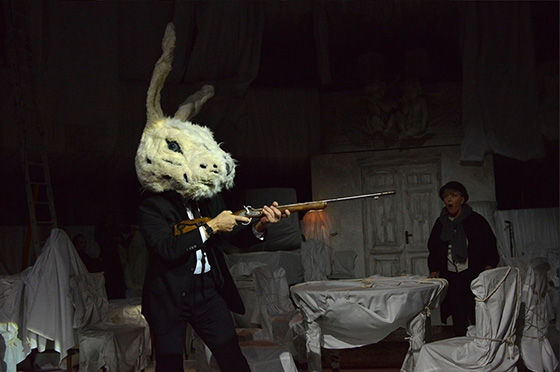
With the Carroll plots, the play of the mighty is generally very, very indirectly: the heroes of Alice are travelers from nowhere, doomed to “memorial run in a circle” (which, of course, the history of the BDT is guessed), trying to break out of the bad infinity of the past, answering the key question of the play: “What are we doing here?” Among D Ramatis Person æ “Alice” there are both a rabbit, and a huts, and a caterpillar, but Anatoly Petrov, Valery Ivchenko and Sergey Losev along with Andrei Sharkov, Gennady Bogachev and other artists played primarily by themselves - illuminated by the mighty attention of the mighty cores of the Osit. And frozen between the past and the future of a great dramatic. Their leisurely autobiographical monologues that open the second act “Alice” are imbued with some kind of incredible for the modern Russian theater of the human (if not humanistic) trepidation the climax of the performance, for which he, as it sometimes seems, was conceived by the director. The tragic-derivative tonality of these monologues makes us recall at once the two best opuses of the mighty-the “play that is not” (2001), the play that the role inevitably becomes the fate of the artist, and about the Alexandrinsky “Isotov” (2009) with his thought that the reality of memory is much more material than the reality surrounding us, and that our whole life, in essence, subordinates its laws.
“Alice” is definitely destined to enter the annals of the modern Russian scene of one of her iconic milestones.
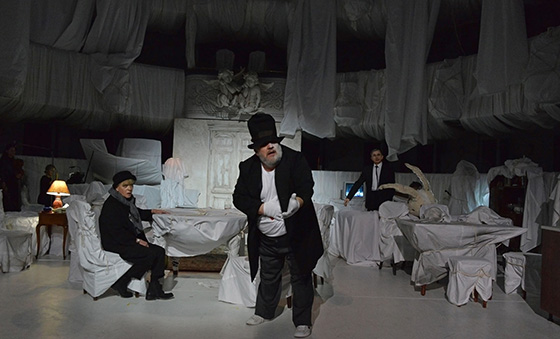
The situation of the time of the forced stay of a large dramatic stay outside the native walls, reflection on the impossibility of the existence of an artistic organism outside the house and the unnaturalness of attempts to enter the volume of the BDT into the space of the Kamennoostrovsky Theater - the circle of plots developed in the scenography of Alice by the co -author of the mighty artist Maria Tregubova. The internal conflict of today's existence of the BDT is exhibited in a play at different levels - unexpectedly strongly, for example, works on the scenographic plan of the trivial, in essence, a technique of transferring action to the hall when placing the audience rows on the stage. It does not accidentally seem to be a protagonist of the play at the same time as familiar and alien: the Kamennoostrovsky’s auditorium is decorated with attributes of the historical scene of the BDT-the legendary chandelier and the Angels Putti from childhood; The artist wraps up lodges and tiers in white paper, in which fragile things usually pack during the move.
 © Bolshoi Drama Theater named after G.A. Tovstonogov
After the premiere, I asked one of the assistants to the director if the theater plans to limit the rental of the production of one season, having removed it from the repertoire of this spring, when the troupe returns to the historical building of the BDT on Fontanka: such a move would repeatedly increase the sound of a performance, closely attached to today's history of the great dramatic, this moment generated and engaged in its tense “Here-and-now” by research and comprehension. “Alice” is autobiographical to a certain extent documentary: before taking a step into the unknown of the future, stunned by a steep career turn Andrei Mighty invites the elders of the Tovstonogovsky Theater and the BDT public to join the process of self -knowledge and self -reflexion, having outlined - or, at least, reprimands - complexes, phobias and frustrations, generated by complicated for all Without exception, the participants in the process are circumstances.
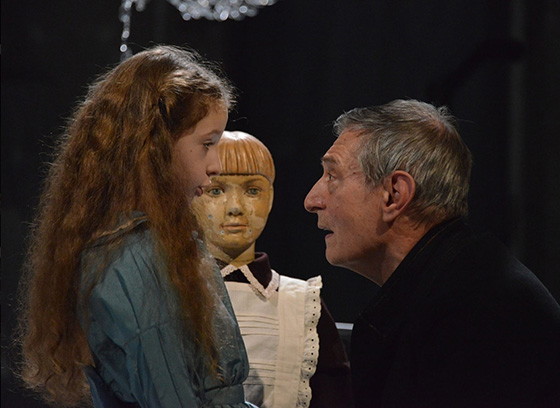 © Bolshoi Drama Theater named after G.A. Tovstonogov
Such, if you like, the metatrait super -unit is not so much a performance as a psychotherapeutic session, which, in fact, is Alice. The mighty one has long cherished the idea of the theater as art therapy begins in a large dramatic from the action to the extreme of intelligible goal-setting-to return to the roots by establishing a dialogue with the elders of the troupe, to revive the theater in a lethargic hibernation, melting the blocks of the ice of academism for a long time, which was constrained by the BDT. The assigned tasks are realized by the powerful not without brilliance: intending to see “Alice”, you are going to the BDT out of habit-and only on the way home you understand that you have been in some other theater. It seems to be the same-but at the same time completely different: in a new way of explaining, in a new thought and breathing. This is difficult to reflect in the rational understanding of the aftertaste - perhaps the main result of the performance.