
Translated material
Go through the Maidan
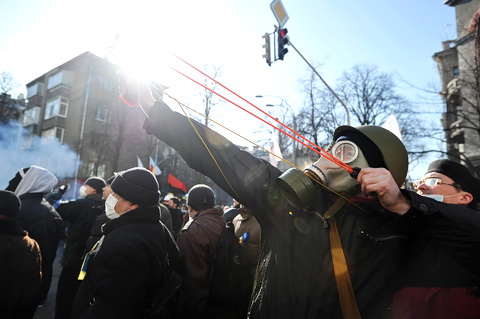
A characteristic description of one of the Kyiv Gavrosha gave in early February my Kiev correspondent: “The other day after the rally in Khreshchatyk, I went for a sandwich in McDonald's ''. Nearby, a modest food was bought by a Maidan boy of about 17 years old. The muffle from the contusion grenades (I heard poorly when the saleswoman asked about surrender), the right wing of the nose was shot with a plastic bullet and hastily sewn, half the face was flooded with green. Cut under the machine, dressed in camouflage. The heart sank-this boy came here from some village and a child is still quite. I to him: “At least put on the glasses, they hit the eyes and neck, cattle” (it is useless to dissuade him to climb on Grushevsky, apparently he made his choice). He is with an innocent smile of a teenager: “So, an uncle, I’m dressing up! - And added, a little serious. - There you are not 'McDonald's'' with garnish marmers, there is a reference of Viyne. "
The question is, in what war does this guy feel? For freedom? For finding a life prospect that he and his relatives abducted by the heirs of the Soviet nomenclature? For the dignity of a person who is constantly humiliated in an oligarchic, manipulative and mafia state? Does he realize the impulse that brought him to the barricades? Or was he suffered muddy waves of a mass carnival? One thing is clear that there are people on the Maidan who are ready to stand to the last, because the authorities do not hear them, as it has not heard all the last 22 years of independence.
Even against the background of outstanding Russian corruption, the bureaucrats of neighboring Ukraine under Yanukovych escaped to the leaders in a kind of competition to rob their peoples. Do Kyiv events go beyond the framework of conflicts typical of corrupt states? Similar riots regularly occur in third world countries and do not even have visible resolution in the future.
In 1917, in the cradle of East European Orthodoxy, the rebellious masses renounced the old traditions, and the bodies of thousands of the dead dotted the streets, slopes and parks of the ancient city. How did it happen that the picturesque hills, inhabited by good -natured Kyiv “Antiks”, became an arena of long and extremely fierce violence and mockery of man? Historians note that the main masses of the Ukrainian population came to the revolution without a “crystallized national identity”. In the last quarter of the XIX century. The project "Big Russian Nation", which on equal terms included all three branches of the Eastern Slavs, crashed. Close mentally, in language, household culture, traditions, these three peoples could not merge into a single national organism. Only one of the reasons is the dogmatism of the tsarist bureaucracy.
The confusion of the Provisional Government, which led to the collapse of the fronts and the spill of the Bolshevik campaign in the army, pushed it to the surface of the local political life of a radical socialist mood: Vinnichenko, Petlyur, Golubovich ... to stand up at the helm of power, they led a competition with the Communists to the extremes of the slogans and the cruelty of actions. One of the vivid theorists of the national movement Dmitry Dontsov so explained the failure of the Ukrainian revolution: her leaders were frantically imitated in their politics by the Moscow Bolsheviks. It is known that "the public wants the original, not a bad copy." The deserters were massively recorded in the formed Ukrainian units, Kyiv flooded decorative “Cossacks”, changing the public atmosphere for the worst. One of the pillars of the Ukrainian democratic movement Vladimir Naumenko (1852-1919) wrote in desperation: “Immediately in the broad circles of the newly-minted Ukrainians, evasion towards the chauvinistic path began to be noticed ... The carrier of the authorities more and more condes the suffocating atmosphere of violent methods.”
The leaders of the National Revolution, following the Bolsheviks, believed that all funds were good to achieve their dreams. The same can be said about the leaders of volunteer forces.
Selois soldiers wanted only one thing: to live in their own way on their own land, outlined by the outskirts. Everything that interfered with this was subject to destruction. At first, such leaders as Petliura and Makhno, and then the Leninians, skillfully used such a mood. The reckoning came in 1930-1933, during the Holodomor and Great Terror, when the rural world of Ukraine turned into a wasteland dotted with corpses. Thus began a huge era of unconsciousness.
The Ukrainian SSR became the reserve of faithful communist personnel, a landfill for the experiments of the KGB. August 1991 residents of Ukraine, like the rest of the republics of the Soviet Empire, met in a state of loss. After 70 years of totalitarianism, people in their mass lost both national and spiritual identity.
The reforms of the 1990s, inexplicable, incomprehensible, became a shock for Ukraine. The processes of impoverishment here were experienced more than in Russia, since the country was poorer, and the local nomenclature was used to keeping itself more impudently and defiantly. It is enough to indicate that the first president of the revived independent Ukraine was the former secretary of the Central Committee of the Communist Party of the Communist Party of Ideology Leonid Kravchuk. Not so long ago, he headed the anti -religious campaigns in the republic, and then suddenly in public speeches to refer to the Holy Scriptures, teaching the people.
Back in the early 1980s, the Republican KGB raged. Around his residence on Vladimir Street, as on yeast, a whole quarter has grown, given to the possession of special services. At the same time, another powerful department also paid close attention to the local civil society - GRU. It seemed incredible, but in the capital of the peaceful republic, military intelligence agents actively acted among the population, recruiting young people for their specific tasks. It is not surprising that already in the 1990s in independent Kyiv, special services felt like an oil cheese. One of my former investigators in the prosecutor’s office was headed by the Department for Combating Organized Crime. A similar picture was with other persecutors of Ukrainian dissidents. Naturally, the first private and “independent” newspaper of Ukraine “Kyiv Vedomosti” “established” the native of the GRU, and its editor -in -chief collaborated with the KGB.
Free Ukraine, like free Russia, from the very beginning was pierced through the metastases of the communist past. Frank populism and paternalism of the ruling circles, their continuation of the Soviet strategy of “flushing of the brain” - all this drowned out the growth of consciousness in society. We add to all the said economic pressure on an ordinary person, his growing lawlessness and a sense of depth and we will see an analogue of the current dead end situation in Russia. At the same time, there is a small, but obvious difference in position.
In Ukraine, it is affected by the homogeneity of society, whose members retained a sense of unity, community of cultural space. For the most preservation of small village and provincial urban worlds, it led to the fact that the current of religious traditions and family traditions that had a slow healing influence on people had never been completely stopped here. Economic migration to the West gradually contributed to the occurrence of even in the most socially neglected layers of the people of a completely adequate idea of the modern world. Another difference: Ukrainians are accustomed to theft of officials. But under Yanukovych, bureaucratic Kamarila began, as in Russia, to emphasize its superiority over ordinary citizens. Many people began to understand that they are on a social day, they will not succeed in getting up from this power. They began to reason in a simple way: if it continues, then we and our families will find ourselves in the stall, like Russians. All this, taken together suddenly earned in the conditions that developed in Ukraine by the end of 2013.
It is extremely important at what values a person who has reached the last line rests on. It is one thing when they are driven by an offended feeling, and then everything can turn into a breakdown in chaos and big blood, as happened in the civil war. And completely different, when a person who rose from his knees feels his own dignity: the divine right of the individual to freedom. Apparently, the people of the Maidan do not perceive the "three heroes" - the leaders of the opposition - their plenipotentiaries. After all, both the "Fatherland" of Yatsenyuk, and the "freedom" of Tyagnibok indirectly left the Soviet ideological heritage, and they have completely different goals than the awakening society.
Nevertheless, in these difficult circumstances of the political turmoil there is hope for the hidden logic of the new era, which began from the end of the XX century. Enrace the mythology of red totalitarianism. The CIS citizens, after the collapse of the left utopia, fell under the heirs of its heirs, think about simple things: legality, justice, legal security, once sprouted in history on European grounds. If the Maidan has those who understand how much a thorny path leading to the conquest of a worthy life, then subsequent events can take a new dimension. Spiritual measurement, which so quickly disappeared from the democratic movement in Russia.
Bernard Levy, who had visited Ukraine the other day, said that the heart of Europe is now in Kyiv. Is it so? In any case, this is not the heart that once clogged with the dream of a worldwide revolution in the square of the Bastille. Rather, another thinker who has learned Christian values in the Gulag maid, president of the Ukrainian Pen-Club Yevgeny Sverstyuk, is right. Recently, he actually turned to the castor of the post -Soviet rulers: “The unfortunate heirs of the school of violence, your time has passed!”. For Sverstyuk, the very fact of the current Maidan already showed the victory of “morally close -knit people”. True, the matter remains only small: do not hand over their victory to politicians.