
Translated material
Fifty shades of blue
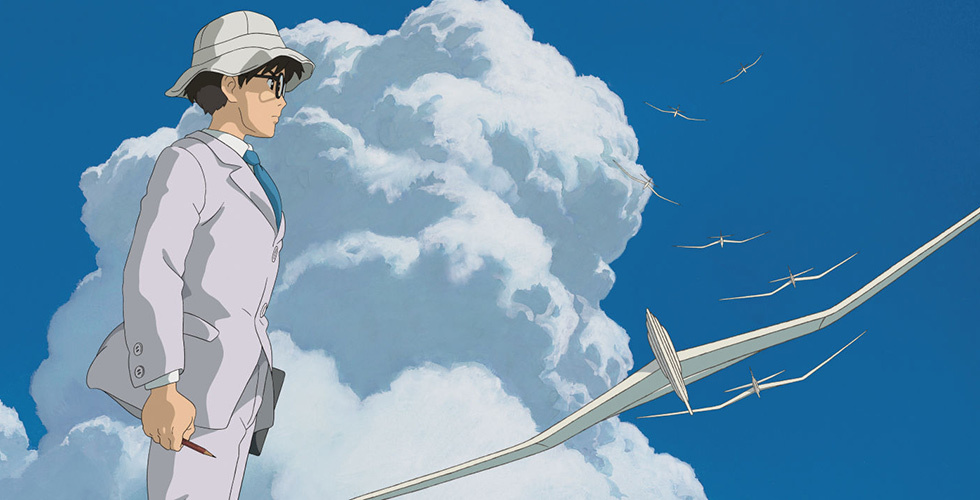
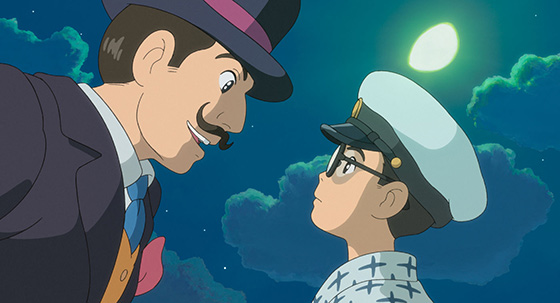
The baby dreams that he runs along the green grass, and above him at the top of the screen is a hypnically blue sky. In the sky - similar to the caravan of the squadron of Italian airplanes. On the main one is the mustachioed Count Kaproni. The count jumps from his flying miracle, meets the boy, calls him in blue.
In the morning, the boy wakes up and puts on glasses. His name is Horikosi Dziro, he will grow up and become an aircraft designer, will go to work at Mitsubishi Corporation and collect the lightest and best combat aircraft of the early 1940s-the Mitsubishi A6M Zero deck fighter. Very soon, four hundred Zero will be accompanied by Japanese bombers in the attack on Pearl Harbor, and Dziro will wander in their dreams between huge heaps of the melted metal. But this is nothing, because there is still a clear sky, and in it is a flock of flimsy flying fish from aluminum.
 © Central Partnership
“The wind is strong” - at the same time both the most adult and the most helpless film by Hayao Miyazaki. The tragedy of the scientist in the world, where any knowledge is in the service of the Ministry of Defense? That's not. Miyazaki is not a rebel or pacifist, his hero is not an academician of Sakharov, but a film is not so much a drama as a sad statement that in our world beauty and pain go hand in hand and you just need to try. High the deadlines, go to the service and love your craft. Do what you should and do not lie in bed.
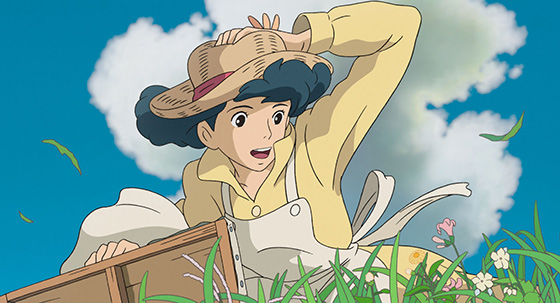
The word "humility" sounds boring - and as the story "Wind" is no more fascinating than the textbook on sopromat. The drawn designer of Horikosi and his pretty environment (even machine gunners on airplanes look like cute tin soldiers) live in a stormy life of the heroes of the girl-painting girl. The first meeting of the young Dziro and his future wife on the footing of the train, the romantic experience of the danger - the great earthquake of 1923, again a random meeting in the forest sanatorium; A hut carried away by the wind, a beach umbrella overturned by the wind. Tuberculosis, an escape from the mountain sanatorium (this is the lyrics of the poet-tuberculomic agent Hori Tatsuo), a secret marriage in the house of the boss, into a biography of the aircraft designer. But first of all, planes. Clean duralumin, flaps, cables. “Be closer to me,” the fading wife asks Horikosi, and he obediently moves the desktop close to the mattress.
 © Central Partnership
Human life for Miyazaki is a small thing. She will be enough for one thing, and this is one-of course, the work (Hayao-Sensei himself always lived in the same way, spending the night in the studio in the cot, almost without participating in the upbringing of his son). The thing is the opportunity to become something big, and all the heroes of the “wind” are only a slightly more mobile part of the general historical background, which is much more interesting here than the characters, conflicts and the inner world. The signs of the Tsaitgayst are scattered in the film abundantly and without unnecessary explanations, and these signs of time will be difficult to understand the child. Here are the fellow students in the eatery over Dziro, poked with sticks in a piece of Macrel: "It is time for you to learn how to eat meat." In this phrase, the great cultural revolution of the Meiji era, who called up thousands of provincials in the cities, into the army and the fleet, which forced them to change the village identity to the national - by accustoming to white rice and Curry with beef. But Dziro in the night Berlin shies from the chase of some people (in a coat) for others (in working jackets). Will a little fan of Totoro and Nashikai understand that those who will go in a coat in a coat in a few years in a march along Nuremberg, and after and throughout Europe?
However, all these are also only details-albeit accurate, but disparate, not related to a large story-discourse. The fact is that Miyazaki is still not a narrator, but an artist. And what is breathtaking from here is a line and color. Yes, rather, it is the color that is hypnotic, filling everything around the blue. The sky lives, the sky breathes, changes color, makes the screen bottomless. Like Yves Klein or Derek Jarmen , Miyazaki patents his shades of blue. But this is not the jarmenov blue of death and non -existence, here is the color of the impressionists, tangible air, infinity - distances, sensations, expectations or opportunities. The real conflict of the “wind” is played out just in the plane of the frame-lodging, between this limitless shapelessness of the sky and the obviously narrow, close framework of everything below. He is a sensual, almost tactile metaphor for that real tragedy that the film is in a disciplined silence, obviously not wanting to drive romantic nonsense into the head of the youth. But judge for yourself: is it not sad - all your life to do planes, but never to rise above the desktop yourself?