
Translated material
Our theater "Taliban"
A terrible year happened to the Russian culture - 2014 was declared the year of culture. But something even more terrible happened to the Russian theater. They became interested in the imperious vertical and even - Lord, is it a reality or a dream? - Central TV.
More recently, it seemed that the figure of the theater director for analytical programs of the main Russian channels is not more of interest than the figure of the leader of the macrame manufacturing mug. And suddenly, Melpomene recalled the honored workers of the blue screen - Dmitry Kiselev in the “Vesti of the Week”, Alexei Pushkov in the “postscriptum”. And somewhere else on the fifth channel was also remembered. And now literally all the inhabitants of the country know: the most urgent problems of modern Russia are not a falling ruble and rising housing and communal services, but the establishment of the boundaries of the stage interpretation of the classics and the possibility of a theatrical experiment at the state expense. We more or less resolved the rest of the issues. It remains to deal with these - and we will heal!
Even President Putin is already aware: the boundaries of the interpretation are still not outlined, damn it. The Supreme Commander -in -Chief was told about the unit on the cultural front by the cultural figures themselves during the meeting in the city of Pskov, widely lit in the media. Here, for example, - they told the president - in order not to walk, in the Pskov Theater. Pushkin’s recently appointed artisticlies Vasily Senin completely outrageously set the “Count of Nulin”, but this may directly affect the moral state of society ... The president thought.
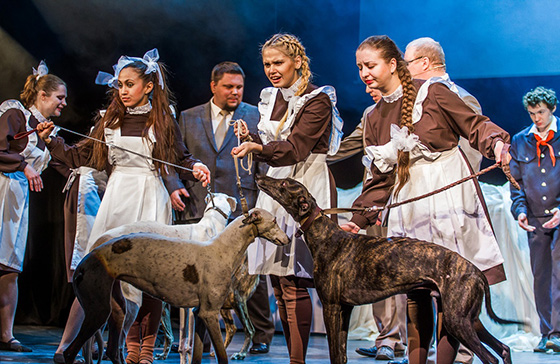 informpskov.ru scene from the play "Count Nulin" Vasily Senina
The best discussion of the directors of Russia joined the current conversation on the rights and obligations of the directors: the recent editorial in the city of Culture, dedicated to the harm of liberalistical infection in general, mainly tells precisely about the figures of the domestic scene.
It is worthwhile to say, to be glad that of all the arts theater suddenly turned out to be the most important for us. By this, to a large extent, we owe theater to the Theater, which has come out of the state of social apathy, and in some places that he had completely stood on the territory of the Council. For a long time, our scene was exclusively a place:
- respectable bourgeois rest;
- Deanery of the reproduction of various traditions;
- Home intellectual joys;
- In the ideal case - the search for a new theater language.
And suddenly it turned out that the theater could also be provocative, and sharp and explosive. That he can fall into the most pain points of society, not only on the tiny stage of Theater.doc and a slightly less tiny scene of Practice, but also on a large, more recently academic, stage of Moscow time. The recently arising Gogol Center clearly outlined its continuity with the early Taganka. And the “ideal husband” and the “Karamazovs” of Konstantin Bogomolov were excited even by those who had long forgotten why they were needed at all - these directors are with their performances. And it began to seem that we were about to return in those days when the progressive theater was an essential media substant and the main outlet of the oppositionly-minded intelligentsia, and the authorities in the person of cultural departments established the notorious boundaries of interpretations in it.
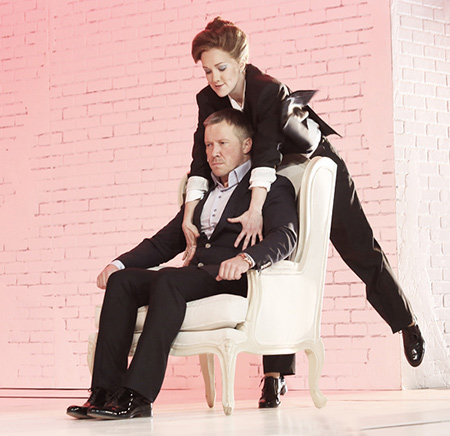 © Mikhail Gutherman Scene from the play "Perfect husband" Konstantin Bogomolov
But something does not work in this old scheme. It doesn't work categorically. The watershed for a long time no longer passes along the society - power. It passes through the most extremely electrified society, in which literally everything becomes the subject of a fierce discussion - Pussy Riot , Maidan, Olympics ... And even a superficial analysis of these endless disputes that have moved from the kitchens to the pages of social networks, allows you to understand: in the Russian electorate, literally in all its segments, now more than ever a request for conservatives. values. Including theatrical conservatism.
Indeed, if you think about it, in the transfer of the main monster of the Russian TV, Dmitry Kiselev, who designated the circle of theatrical adversary (Serebrennikov, Bogomolov, “Practice”, experiments all sorts of bad things), nothing that I would not have heard from time to time from the lips of the sweetest theater scholars, charming artists of the capital's and provincial theaters, and representatives of academic theatrical science. And critics of quite progressive publications. Not everyone, of course, but many, oh, many ...
Putin, glory to you, is more or less, as the “Count Nulin” is interpreted there, but this is deeply not indifferent to the theatrical “Kabala Saint”. In theater universities, you will now find much more opponents of the new directing than among the employees of the Ministry of Culture.
The explosive theater causes monstrous irritation primarily in the very theater community: all provocality is considered in it something deeply indecent and is perceived exclusively as a self-PIR.
In general, no matter what side you look at, a picture of the confrontation of a freedom -loving theater and a showering, an irreplaceable theatrical thought of power, is malfunctioning for an intellectual eye. Moreover, until recently, the only reliable defender from the theater and near -theater “Taliban” was, paradoxically, the power itself.
Even President Putin is already aware: the boundaries of the interpretation are still not outlined, damn it.
While the St. Petersburg “Cossacks”, having learned about the arrival of Thomas Ostermaeer “Death in Venice” to their city, threw a pork head to the Lev Dodin Theater and painted its walls with anti -Semitic slogans, the municipality of St. Petersburg built the same Dodin a new theater building (better than ever). The same reactionary, as is commonly believed, the city authorities allocated money to Dodin to hold an international festival, which came just the performance of Ostermaire.
The adversary of Vasily Senin, not only muddling over the “Count Nulin”, but also held a very successful Pushkin festival in the city, is supported by just a local governor. But some representatives of the Pskov Theater Community deadly hate. So hate that they send letters with threats to trim the tongue (“Read carefully, cerebellar!”) And write on the walls of the surrounding buildings: “Burry Pushkin!” Letters are signed with restraint: "Skobari."
By letters from the worried public, the Moscow Art Theater is also littered. Oleg Tabakov is worthy (so that I really want to take off the hat!) Withstand pressure in connection with the performances of Konstantin Bogomolov, but there is a firm feeling that the campaign against the Moscow Art Theater was not deployed by the Kremlin or the Ministry of Culture, but individual representatives of the same theater community, who have long dreamed of taking the country's main theater.
Gogol-Center arose, as you know, on the initiative of the current head of the Moscow Department of Culture Sergei Kapkov. But the accusations of highlighting the state funding for the “dubious theatrical experiments” of Serebrennikov did not sound from the lips of the city hall or the city Duma, but from the mouths of the theatrical figures themselves, who perceive any reformist body movements as an attempt on centuries of culture. And also - that’s what Zagogulin - from the side of opposition publications, sacredly confident that there is no evil not from power.
This hatred of power in an acute request for conservative values is that which fundamentally distinguishes the present time from a sweet, old, mimic stagnation, where life seemed black and white (here we are good, and there they are bad), where they longed for liberal freedoms, where the dissidents did not like the inspection of the Politburo, but loved the figs showing him in his pocket progressive artists.
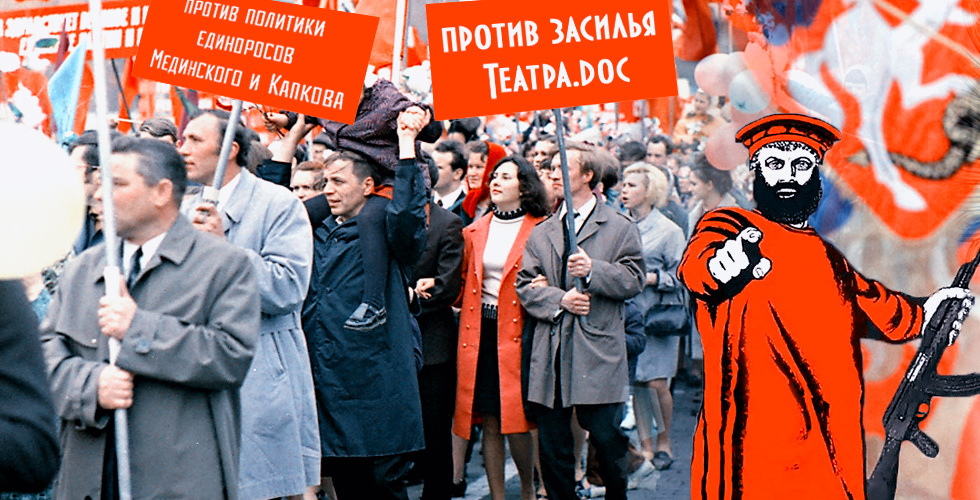
“We are warmly protesting against the policy of the United Russia and Kapkov, against disgusting institutions like the Gogol Center and the“ Theater Leader’s School ”, against the dominance of“ theater.doc ”, against the collective Zholdak-Bogomolov, against the abuse of Pushkin and the contract system”-this is how the aggregate protest moods of the theater community can be formulated.
And the worst thing will happen if the authorities in the framework of twisting of nuts in the media, in politics, in the economy will satisfy a request for conservatism in the field of culture. It will break the neutrality and pass to the side of the Taliban. Then, the theater threatens the culture and especially directly depending on the State Domotency, worse than stagnation. They face total collapse.
The saddest thing that will happen at the moment when the Russian theater is experiencing a genuine flowering. I do not remember such a lively theatrical life in the last twenty years. It contains everything-and a small theater that is unshakable protecting its traditions, and Alexandrinka, looking for new forms and growing with new areas, and the Fomenko Workshop, who suddenly found a new breath this season, and the Vakhtangov Theater, which recently conquered Paris, and Gogol-Center with the Theater.Doc, and Zholdak with the Gogol Center. Bogomolov.
This theatrical heyday became possible precisely because the state until recently was not worried about the boundaries of stage interpretations, did not establish the framework of the theatrical experiment, allowed the theater to be not only entertaining or deanery, but also provocative, and evil, and looked through the scenic exposure of national myths through her fingers. Only a great country, a patriotic rage - the destiny of a zapalnoy and notorious province is decided on self -criticism.
It will be sad if all this suddenly ends at once.
We once had a fundamental science. Now horns and legs remained from her. How and why it happened is a separate conversation. But the fact remains: it was - and almost did not. So, we now have an amazingly interesting, diverse and competitive theater. It can be destroyed, but can be preserved. Well, for example, in order to have something to tell about the world at the opening of some future Olympics.