
Translated material
Grigory Gritsenko: The devaluation of the weak
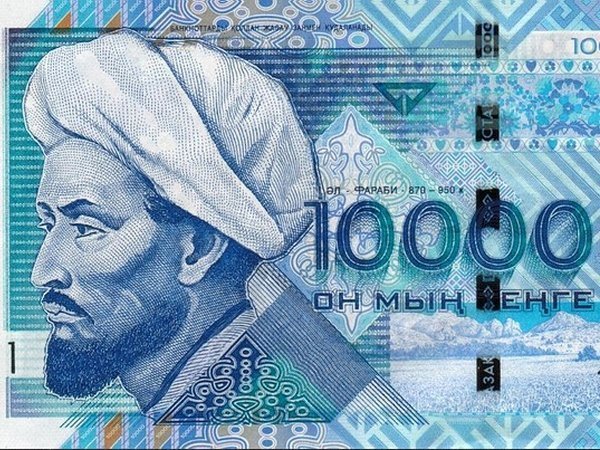
Grigory Gritsenko 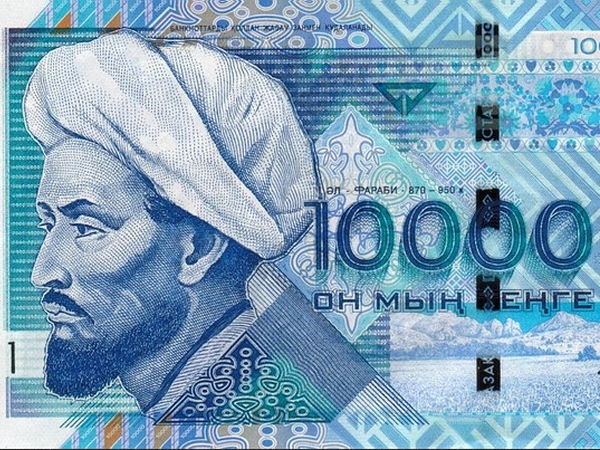 Al-Farabi on a bill of 10,000 tenge
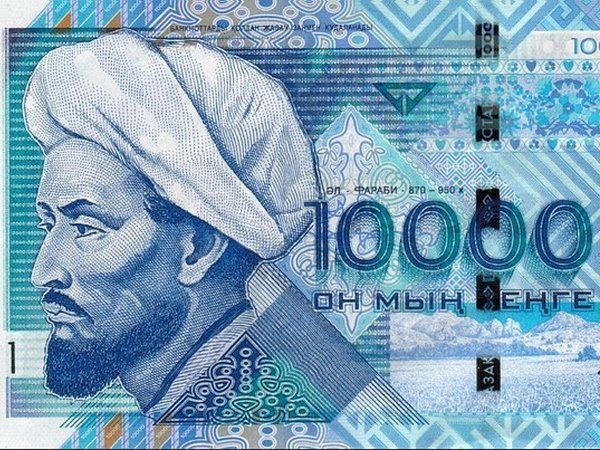 Al-Farabi on a bill of 10,000 tenge
The process of devaluation of weak currencies, which began at the end of 2013, apparently, begins to acquire a universal character. And if initially it took place in countries that are quite far from our borders, like the states of Southeast Asia and South America, now a wave of lowering the courses of weak currencies has touched both the Russian ruble and the currencies of our closest neighbors-Ukraine and Kazakhstan.
So, if at the end of 2013 32 rubles were given for the dollar. 70 kopecks, now it costs more than 35 rubles, that is, in almost a month the Russian currency has been devalued by 7%. The Ukrainian hryvnia, which has long been at the level of 810-815 hryvnias for $ 100, is now quoted at the level of 864 gr./$ 100, that is, has decreased by 6%. And, apparently, this is not the limit. And the Kazakh tenge, also for a long time, formerly stable currency, literally in one week of February collapsed by 19% - from 155 tenge to 184 tenge per dollar.
At first glance, the currency situation in countries with a weak national currency looks almost the same, differing only quantitatively - the rate of falling of their courses relative to international currencies. The explanation for this fall is given the same thing: owners of capital withdraw their funds from developing countries in order to invest them in developed economies, since economic growth began there.
But this explanation is very weak. In fact, the depth of devaluation is caused not only by the outflow of capital, but also by the entire structure of relations with the world economy of a country, which in many cases is quite individual.
If you conduct a relatively detailed analysis of foreign economic relations, then several groups of countries can be distinguished, depending on how they interact with the international market of goods, the labor market and the capital market.
For one group, the basis of the national economy is the production and almost complete export of a rather scarce set of goods that it is able to produce; In turn, these countries buy on the world market almost all goods and services that they consume in their farm. For another group, export is not a vital area of activity, since it has a fairly capacious domestic market and its production sector produces a fairly wide set of goods. However, the country is involved in international trade in order to fully load the existing production apparatus or because the prices of external markets are higher than the prices of the domestic market; And she needs import only to supplement the range of internal manufacturers.
Moreover, this “addition of the assortment” has several gradations: part of the imported products cannot be made inside this country due to natural-climatic or mining-geological conditions; The other part is because the domestic market of this product is very narrow, and it is easier to import them than to produce at the place of consumption; The production of the third part is too capital -intensive or protected by patents, so it is imported, and not organized production on the spot; And, finally, the ratio of internal and external costs of production and transportation of analogs makes imports more effective than domestic production.
It should be noted that countries with a weak currency can be exported to the world market “key” or “basic” goods, and widespread goods of mass demand can be exported. That is, it is possible to export oil and gas, gold and uranium, but you can coal, business wood, ferrous metals, or textiles and toys. Accordingly, the country's monetary and financial position varies significantly depending on both volumes and the structure of its export. Countries with a small volume of exports to fluctuations in external conditions can react and react. Countries that take out “key” goods are more or less resistant to external shocks. But countries that take out goods of mass demand can suffer greatly from external shocks.
Similar rules apply to import. There is an import of “key” goods (and this is food, medication and fuel), which is quite difficult to abandon, and there is an import of mass demand goods, the consumption of which can be temporarily reduced or even completely abandon it, by led by internal production.
The interaction of countries with a weak currency with the world labor market looks much simpler. As a rule, these countries export their labor force, and for them only the size of this export and, accordingly, the amount of money transfers received in foreign currency. In principle, in the world economy, labor migration has long been not special. But if this or that country is highly dependent on the income of citizens working abroad, then it can go sideways-in the case of any crisis of its citizens (as disenfranchised foreigners) they will immediately dismiss, and the income received will immediately disappear. And if they are also exhibited from the "receiving" countries, then the socio-political conflict in their homeland is practically guaranteed.
As for the interaction with the world capital market, before moving on to its consideration, one remark must be made. The fact is that for some reason in our country, it is customary to understand only the movement of short -term speculative capital (the so -called “Hot Money” or “hot money”) by the influx of foreign capital. But besides this type of capital, there is another, which is called "direct foreign investment." As a matter of fact, only direct investments are important for the real sector of the economy of a country. As for speculative (portfolio) investments, they affect only the currency course and the stock index, and the short -term.
Now, if we consider the movement of capital, it should be noted that the countries of the world are divided into exporting capital, and countries, importing capital. Why there is such a separation is well known. For capital exporting countries, internal savings exceed internal investments, and among the capital countries, internal investments exceed internal savings. Therefore, an excess of savings of one group of countries is used to finance investments of another group of countries.
As a rule, capital exporting countries are simultaneously countries-clean importers of goods. The cost of imported goods is paid at the expense of income by previously made investments in other countries. In turn, the capital countries of capital are clean exporters of goods, and at the expense of part of this export they pay income to foreign investors.
Here, along the way, it should be noted that already in this, quite simple scheme for the interaction of an individual country with the global market of goods and capital, the threat of a crisis is lurking. So, if the country - the exporter of capital - will receive a much smaller amount of income from foreign investment than it usually received, then it, to equalize the payment balance, will have to reduce her imports and, as a result, domestic consumption. And, in turn, if the country, the country of capital, will decrease export currency revenue, then it will also have to reduce imports and consumption to pay income to foreign investors. Of course, in both cases, the reduction in imports occurs by devaluation of the national currency.
At the same time, it is completely optional that countries with a highly developed economy appear to be exporters of capital (or, as they are also called "old industrial countries"). Very often in this role are countries with a not very strong level of development (say, raw materials), which do not have interesting projects for investing on their territory, but export income is very, very decent. And therefore, they prefer to invest excess savings abroad.
At the same time, countries of capital are often imported by countries with a fairly high level of industrial development, the internal savings of which are completely insufficient to maintain the optimal pace of economic development. Therefore, they have to attract foreign capital and, if the volume of this attraction is insufficient, growth rates in such countries can decrease significantly or even fall to zero.
And, at the end of this theoretical scheme, it should be noted another nuance of the market of capital of countries with weak currency. This nuance is that some of the internal savings are not invested in domestic assets that bring income and not in consumer goods, but in a firm foreign currency. Moreover, savings in solid currency (a kind of foreign currency reserves) are formed not only by monetary management bodies, but also by other economic agents: companies and households. Why this is done is also well clear - to protect savings from possible impairment. And it is also clear that if a crisis begins in world markets, a stir of excitement appears on a solid currency.
After we examined the main schemes for the interaction of countries with the world market of goods, labor and capital, we can proceed to the analysis of the situation in individual countries.
Our closest neighbor Kazakhstan ended up in exactly the same story as most countries with weak currency. Its export is a relatively small set of raw materials: oil (40% of all exports), grain, metals and metals themselves (black and non -ferrous), as well as gold, silver, and uranium. In principle, although this is raw materials exports, but the goods are mainly exported “key”, therefore, from the point of view of the stability of the inflow of foreign currency, it is more or less normal here. Even if there are some fluctuations in world prices on these goods, they will not have a significant influence.
But as for the import, here the situation is quite difficult. His imports are an almost complete set of consumer and investment goods. Further, in addition to mass imports of goods, Kazakhstan carries out the same mass import of services, and if the export of goods significantly exceeds their imports, then what relatives of the services, then, on the contrary, a stably high superiority of the import of services over their export.
This situation is well understandable. Since the population of Kazakhstan is 16 million people; On a global scale, such a market is not so large as to organize mass production of goods on its territory. They are easier to get from other countries, which is happening in practice.
A similar situation - and with the movement of capital. Since Kazakhstan mainly attracts capital, he has to pay large income to foreign investors who significantly exceed the income received by the residents of Kazakhstan from their foreign investments.
The current account of the payment balance of the Republic of Kazakhstan and its components
billion dollars. | 2011 | 2012 | 2013 |
Export of goods | 85.1 | 86.9 | 83.4 |
Import of goods | 40.3 | 49.1 | 49.5 |
Trade balance | 44.8 | 37.8 | 33.8 |
Export of services | 4.3 | 4.8 | 5.0 |
Import of services | 10.9 | 12.9 | 12.0 |
Balance of services | - 6.6 | - 8.0 | - 7.0 |
Balance of wages | -1.7 | - 1.9 | - 1.6 |
income to payment | 28.2 | 28.3 | N.D. |
Income to receipt | 2.1 | 1.9 | N.D. |
Balance of income | - 26.1 | - 26.4 | -25.1 |
Current account | 10.2 | 0.6 | 0.1 |
As you can clearly see these data, Kazakhstan had to pay for commodity imports, imports and income of foreign investors only at the expense of their commodity exports. At the same time, the whole complexity of the situation is that the export is more or less stable (although the conditions in foreign markets are not very good), therefore, an idea of the high level of foreign currency stability of the country's economy is created. But this is only an illusion. It was enough only to import goods and services to increase, as an active balance of payment balance, it was boiled to almost zero.
Accordingly, it is not necessary to say that the currency crisis and devaluation tenge provoked the outflow of capital. This devaluation caused an increase in the import of goods and services with stable exports. The devaluation began when the increase in imports “ate” the existing positive balance of the current account of the payment balance.
In this regard, Kazakhstan is very similar to Russia (or Russia - to Kazakhstan), since at the expense of Russian exports, both the import of goods and a negative service balance and non -residents are paid, the positive balance of payment balance was also replaced by zero after the increase in the import of goods and services. Therefore, the way out of this situation turned out to be the same: the devaluation of the national currency.
True, there are still some differences between them. Firstly, the set of industries and their goods they have produced in Russia is much larger than in Kazakhstan, so there is a chance that, due to the devaluation of the ruble, domestic production will be able to increase the production of products, carrying out the so-called Import substitution. And secondly, the official foreign exchange reserves of Kazakhstan are only $ 24.7 billion, or half the annual import of goods. And Russia's foreign exchange reserves, despite their reduction over the past year, amount to almost $ 500 billion, that is, approximately equal to one and a half -year imports. In other words, the Russian monetary authorities have a much larger field for currency maneuver. But on this the differences in Russia and Kazakhstan end.
See also: Grigory Gritsenko Currency failure Grigory Gritsenko Alarming Balance