Date
Author
Николай Дзись-Войнаровский
Source

Preserved copy
Translated material
The economy of the Russian Federation can accelerate to 7% per year. What did the wounds advise Putin?
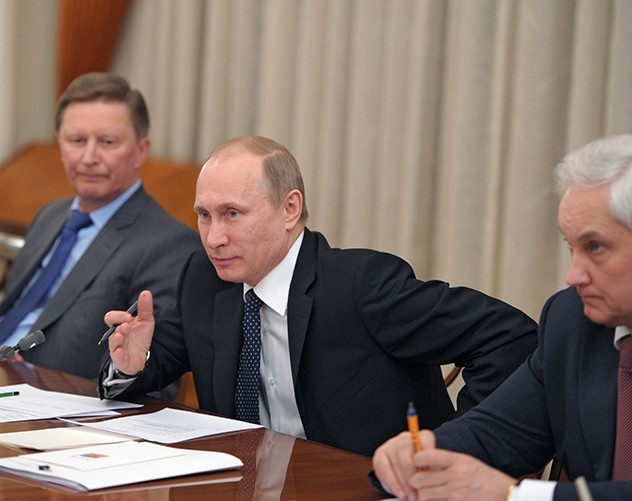
The Russian economy in two years can grow 7% per year! Agree that against the backdrop of insidies from the government that GDP growth has already gone into a minus, this news cannot be published without an exclamation mark. More precisely, it will grow at such a pace if Russia complies with the recommendations of the report “Russia on the way to a modern dynamic and effective economy” edited by academics of the Russian Academy of Sciences Alexander Nekipelov, Viktor Ivanerov and Sergey Glazyev. The report was published on December 19, 2013 on the RAS website, a month later it became known that RAS was preparing an offer to the government on its basis, and on Wednesday morning, on February 19, Academicians met with President Putin, the heads of the Ministry of Finance, mayor, Central Bank, assistant to the president Andrei Belousov and the head of the administration Sergey Ivanov ( the transcript of the meeting , a list of participants ).
With the first of the editors of the report-Mr. Nekipelov - the accusations of plagiarism, found in his monograph by the vice-rector of Rash (now vice-rector of HSE) Konstantin Sonin, are connected. Later, the RAS rejected the accusations, the signature under the conclusion, about the absence of plagiarism, including another RASH employee, and at the same time the co -author of the RAS report, academician Viktor Polterovich. Glazyev is a famous politician of the left flank, now an adviser to the President of the Russian Federation. Also in the meeting by the Academy, President of the Russian Academy of Sciences Vladimir Fortov and Evgeny Primakov participated, who does not need performances. Well, another editor of the report, Viktor Ivaner was remembered by the public by calling the ex-director of the RASH Sergey Guriev Zhulik.
Looking at the list of academicians, one could expect some odious report that it was time to nationalize everything back. But no - the document turned out to be quite interesting, although not without controversial moments and common places. For example, the authors write a lot about the fact that it is necessary to strengthen the role of strategic planning. However, our government does not seem to be accused of the absence of long -term plans - there are strategies and forecasts until 2020, 2030 and even 2035, and the state budget is accepted immediately for three years. Or do academics believe that you need to plan somehow differently? But how exactly? Alas, there is no clear answer in the document.
The reader can independently read all 93 pages of the report or get acquainted with the interesting theses chosen by us:
The beginning of the report (rather long) is dedicated to the current state of the Russian economy and how it came to it in the 1990s and 2000s. In short, the diagnosis of academicians is as follows: the macroeconomic policy in the zero was good, but instead of purchasing dollars in a stabund, it was possible to invest more within the country. This is generally the leitmotif of the document - the state should or itself invest more in the country in infrastructure, science, technical re -equipment, medicine and education, or stimulate the business to do this. In the dispute of those Russian economists who insist that first we need to create good institutions (a fair court, lack of bribery, etc.), and then build investments, otherwise they will simply be pulled out, and those who believe, on the contrary, academics are on the side of the “investment”. “There is no alternative to building investment activity in the next few years. Otherwise, no institutional reforms will not be able to return the lost dynamism of development, and the frontal increase in restrictions will make it impossible to consistent with the challenges that arise, which will ultimately lead to a new round of financial restrictions and the final dumping of the economy to the inertial increase in GDP in 1-3% per year, ”is a little foggy, but categorically declared it categorically declared. Authors.
Further - the main measures for investment:
The intensification of all the possibilities of building investments in fixed assets (due to state, private, foreign sources). The achievement by 2020 approximately 35 percent rate of accumulation of fixed capital. The revival of investment engineering both on the principles of creating new production of domestic products, and on the principles of deploying industrial assembly production. Ensuring the growth rate of the production of investment goods ahead of the growth rate of the domestic market of such products. Increasing production facilities in infrastructure and road construction. Research and development with the aim of creating non -resource enterprises competitive in the world market.
In fact, reproaching the ex-head of the Ministry of Finance Alexei Kudrin that he did not invest a stab fund in the Russian economy under the pretext that, due to corruption, the funds will be sawed, academics themselves do not shy away of similar logical structures:
“The miraculous power of the transfer of state assets to private hands is not confirmed by existing world experience. In our case, the situation is aggravated by the fact that the modern large Russian business in its mass is distinguished by the far from perfect the state of the corporate governance system, hypertrophied prevailing current interests over strategic, indefatigable desire to use the law of taxes on minimizing taxes on the verge and beyond the line of law. ” And also about the role of the state: “In conditions of large -scale structural changes in economic turbulence, characteristic of the period, when market mechanisms fail, a leading role in generating an initiating impulse necessary to bring the economy to a new path of development, the state should take on.”
People are not forgotten, especially officials:
“The task of forming an effective state apparatus is today one of the most important. Its solution is possible only if the career of the civil servant becomes attractive both on the material and moral side, which depends exclusively on its professional and ethical qualities. To achieve this, it is necessary to work out clear rules for promoting officials in the service, to sharply limit the rights of political heads of ministries and departments to interfere with the personnel policy in this area. It is necessary to put an end to practice in the most decisive way, when the arrival of the new leader almost automatically leads to the shake of the entire apparatus . ” Russian youth (up to 30 years) less often moves from place to place than youth 10-15 years ago. “This indicates the insufficient use of the potential of the mobility of Russian youth and doubtfulness of the idea of the need for mass imports to Russia of labor from abroad in conditions when the country has a significant internal resource of redistributing the existing labor force.” It is necessary to “ expand the directions of the use of maternal (family) capital or part of it for the treatment of children (operations, rehabilitation) to pay for voluntary medical insurance contracts; To the education of mothers (fathers) who did not have time to get a good education before the birth of the second (subsequent) child. It also makes sense to grant the family the right to place the money of maternal (family) capital on a long -term bank deposit, to allow the use of interest for current needs. ” “To introduce a monthly allowance to children who do not attend preschool institutions, and for parents waiting for a place in a preschool institution (for children aged 1.5 to 7 years), as well as a benefit for children by the beginning of the school year (once a year for school -age children).” "Improving the minimum wage, which should contribute to the elimination of the phenomenon of working poor ones." Perhaps one of the most “socialist” points in the study.
And tax block:
The introduction of a progressive taxation scale, as well as taxes on wealth and luxury. The taxation of capital export (or other Tobin tax ) , the introduction of export duties and the tax on mining, natural gas, energy -intensive and hydrocarbon raw materials in accordance with the taxation of oil per unit of conditional fuel. Progressive environmental tax (payments for environmental pollution in excess of established norms). The budget rule should be adjusted regarding the use of oil and gas revenues. They should be more greater than directed not to “sovereign funds” for placement in foreign securities, but to investments in order to increase the efficiency and competitiveness of the national economy: the development of infrastructure, stimulate innovative activity, expand development institutions.
If measures are implemented, then the growth rate of the Russian economy and the well -being of its citizens will be as indicated in the table:
| 2013–2015 | 2016–2020 | 2021–2025 | 2025–2030 | |
| The average annual GDP growth rate, % | 6.1 | 7.0 | 4.6 | 4.1 |
| GDP per capita at the end of the period, $ | 17 600 | 24 400 | 32 400 | 54,000 |
It remains to add only two questions to this:
In the report, very little space is given to the banking and financial sector, as well as foreign trade. Why? Academicians consider it all unimportant, uninteresting, have not found specialized specialists in the wounds? The previous megagon in the economy “ Strategy-2020” was emphasized not on investments, but on institutes, and not on industry support, but to create conditions for the middle class. It was developed by the right flank of Russian economic thought in the person of the RANEPA and the Higher School of Economics, and it was by and large by the government. Will something from the current report will be used in practice or is it just a protocol meeting to show the Russian Academy of Sciences and the economic left flank that they are also respected?