
Translated material
"Anya, Chmel was driven"
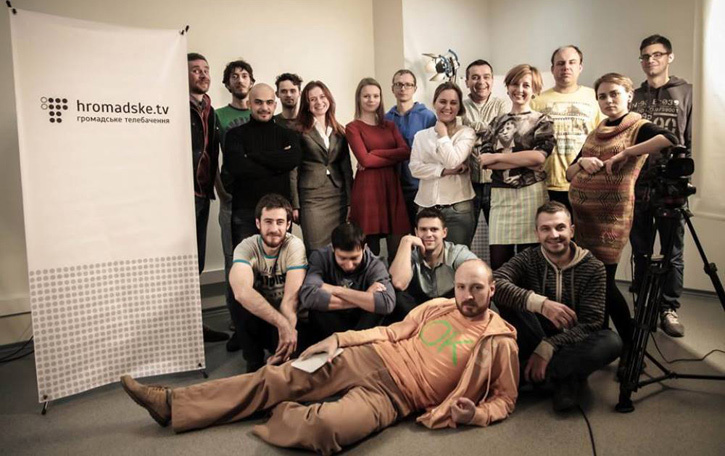
In the apartments of Ukrainians, Gromadske TV all these three months work around the clock: children are fed under this rumble, engage in household chores, swear, fall asleep, wake up-that is, even for television it is somehow too much. There are other independent television channels in Ukraine, but people watched Gromadska not only because of information: it was an act of unity, solidarity with the country, something irrational. In Russia, however, they also watched him.
“Gromadska” in translation means “public”, but I do not even want to compare it with our OTR. I just note that any imitation of civil television is costs hundreds of times more than the original. To launch Gromadsky TV required about 300 thousand dollars . That is, neither superprete, not decisions of the government, nor many years, no thousands of years - horror, if you think about it! “Just just the desire of a dozen journalists.”
The appearance of Gromadsky TV in 2014 is a logical result of the existence of independent journalism in Ukraine.
All these people who are in the studio today are ordinary, in general, journalists. They all managed to work in government and private, serious and entertainment media; Someone quarreled loudly with the authorities, someone left quietly. All of them are familiar with censorship - money and power - and with self -censorship.
Another thing is that the concepts of freedom and non-freedom of the media in Ukraine and we have are still different things. In Ukraine, even in the worst times, the media belonged to various political and financial forces, and the competition there is more honest. The people who were on the Gromadsk TV unites the fact that they all wanted more freedom. To make it clear: these are not the same (conditionally) who switched from Channel One to Rain, and those who have already left both the rain and from the Echo of Moscow. That is, it is a different level of requirements for life, so to speak. The difference is that after the next dispersal of the “unique team”, journalists in Ukraine manage to gather in the team - and not the abyss one by one.
The choice of language for a Ukrainian journalist is an important detail of identification. There was always a slippery moment: it seems to be the state language - Ukrainian, and journalists are in everyday life, communicated most often in Russian. This is basically normal for Kyiv, but still there was some hypocrisy. It is difficult for us to understand this, but it turned out that Ukrainian was only a “language of work”, a means of making money.
These are not the same (conditionally) who switched from the first channel to “rain” - and those who have already left both the rain and from the Echo of Moscow.
All leading Gromadsky TV speaks in good and, importantly, modern and living Ukrainian. It can be seen that they speak Ukrainian in life. From the "Westerners" here - as far as you can judge by reprimand - only a few people; The rest are immigrants from the middle regions of Ukraine and Kiev. There is also Mustafa Nayyem -who also speaks in Ukrainian (on Facebook, however, writes in Russian). When he occasionally confuses the words, the editor -in -chief of Gromadsky Roman Skrypin straightens him.
I assume that most people working here are the recovered bilinguals. At some point, they made a conscious choice: they decided that they would live “in Ukrainian”, and not just work. This choice is akin to “do not lie, do not steal”: for starters, they simply decided to be honest with the state language of the country. And if the conditional Tyagnibok again tries to make Ukrainization not a personal choice, but forced, thereby discredit the existential selection of such loners.
The second, very important, moment of Gromadsky TV : this is a story that the tradition of independent journalism over 23 years, since 1991, has never been interrupted. In the Russian media, it is customary to be proud of any tradition - royal, Soviet - but not democratic. It is generally customary to treat freedom as a misconception of youth, as aesthetics or “form”. From freedom, we can “grow”, from freedom you can “get tired”. In Ukraine, for some reason there is no such fatigue, although the press here at times lived hard.
Gromadska TV declares his continuity from “all independent media of Ukraine”-starting with the newspaper “Zas”, “Vidrodzhennya’s voice”, “Ukrainian Truth”, “5th channel” and TV, as well as a huge radio. The history of the latter is sad: founded in 2002, after unsuccessful attempts to get a license for broadcasting (with late Kuchma) broke up. In addition, in 2003, the editor-in-chief Alexander Krivenko died tragically. On the Gromadsk radio, they managed to work both Skrypin and Vakhtang Kipiani, and Danilo Yanevsky - the future team of Gromadsky TV .
From freedom, we can “grow”, from freedom you can “get tired”. In Ukraine, for some reason there is no such fatigue, although the press here at times lived hard.
I was familiar with Krivenko, the legend of Ukrainian journalism, - he created the "Zas", the famous Lviv newspaper, which has been released since 1989 and was still samizdatovskaya. That is, the Gromadska TV in a global sense inherits not just the traditions of independent media, but in fact dissident. Well, the traditions of Ukrainian nationalism, of course, also - is impossible to separate in Ukraine one another.
“Zas” was also famous for the literary hooliganism, love of Brutalism. This was a conscious strategy - in order to stylistically dissociate from journalism "Radiangka Ukraine." In the 1990s, in the “post-industry” they joyfully printed what happened later in the legendary “ycyclopedia of nashous Ukrainians” and what even shocked their own-delivering Ukrainian consciousness from virginity.
The Gromadska TV is not inherited by the reception, but as if the concept - there was no need to hear so many mats in reports, but no one would have occurred to anyone to be indignant or to be shifted. This is life, why to stuff it. Here the correspondent of Gromadsky TV stands on the sidelines, there are soldiers of the 25th airmobile brigade, who was traveling by train from Dnepropetrovsk to Kiev, but people dismantled the path-and the military are forced to return to the base. The correspondent asks them the same question:
- Will you shoot people?
They answer nothing.
- Will you shoot people?
They answered: "P ... to everyone."
- Will you shoot people?
They answer: "P ... will give."
Ukrainian journalism began with obsceneity as an artistic technique - and today it was transformed into non -certificate journalism, such a dialectic.
On the Maidan, when Yuri Lutsenko thanked everyone, even mentioning the kitchen, and separately the “5th channel” (opposition, belonging to Petro Poroshenko), he never mentioned Gromadska. At the same moment, Gromadske on the air reproached the leaders of the opposition for the fact that the memorial service on the Maidan turned into a pre -election campaign. Gromadske is not the voice of the oligarchs, and not the voice of politicians, and not even the voice of journalists - this is a rumble of Maidan. Gromadske works as a relay of this hum - that is, it is such an echo, an echo of Ukraine.
“For whom” the Grumadska TV , what political views expresses? They say that Mustafa Nayyem - one of the founders of Gromadsky TV - sympathizes with Klitschko as the most "unimaginated" of all politicians. Actually, because of these sympathy, Gromadske was allegedly on the Maidan and did not mention. By local standards, they are “liberal nationalists”-that is, not “UPA Heroes” serve as moral landmarks for them, but something more universal.
Studio in the center of Kyiv. There is no advertising at all, sources of financing - it seems to be grants, donations. They promised to publish reports. In Russia, in such cases, they will certainly say: "It was necessary to start with this." But in fact, this does not matter-even if it turns out that some opposition oligarch helped them. Judging by how, in which manner they talk with all politicians, without exception, even with Tyagnibok, even with Klitschko, - the Gromadska TV came off both the authorities and from the business. And, of course, they achieved this - to be as far as possible from any influence.
Spontaneity - her Fromm considered it the most important evidence in favor of being - in fact, there is the main format. "Can this be voiced on the air?" - asks Danilo Yanevsky, who is scolded for the fact that he reads from Facebook everything in a row. “You can,” they shout from somewhere. The Maidan leads on a rainy day, he turns to someone, from someone: “Anya, the hubby was driven”-and goes to world reports. The correspondent comes to the studio, removes the helmet, body armor, sits down.
This site is, as it were, rebooting all Ukrainian journalism. The media that arises at the time of danger is more tenacious than that which is for business, advertising and rating. When the correspondent goes to the night (just goes with the camera around the city and fixes), they call this “stream” - the border between activism and journalism is blurred. And when you think, what is the function of this person with a video camera, for some reason you recall the phrase from the preface to the Akhmatovsky “Requiem”: “Can you describe this?” Their work was not even described, but simply to be present at the same time. And so they were all three amazing months here - in every sense. And I envy them.