
Translated material
Modernity

Recently, a wonderful historian of Russian literature, Oleg Proskurin, published an extremely funny note “Mikhalkov and Kola” on Facebook. Her essence is briefly as follows. We are talking about the fable of the poet-laureate entitled "Ah, Coca-Cola!" This fable tells how the American exhibition, / which is illuminated by Oceanian life / (but for some reason not from all sides!), / The adultery went, / to a foreign, see, a big amateur . And in his love for everything overseas, he drank Coca-Cola, ended up in a hospital, where he was treated and ate free. Morality: He blindly bowed to a stranger, / Alas, he did not notice his own .
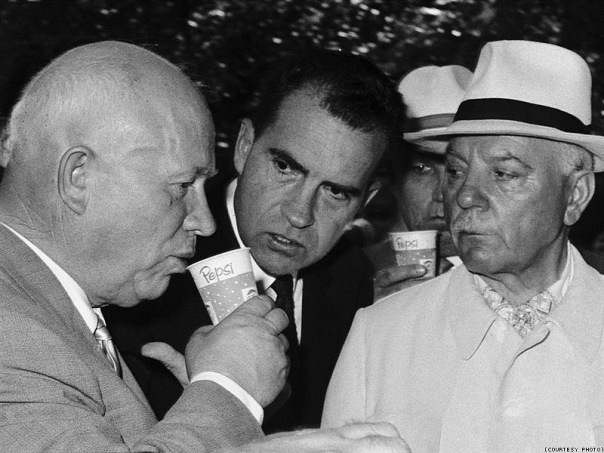
The date is 1959, when the first American exhibition in Sokolniki was held in the USSR. However, the researcher tells us, there was no Coca-Cola on it. On the contrary, there was Pepsi-Cola, who really spoke visitors for free, including N.S. Khrushchev, about which there is a photograph: http://cs10450.vkontakte.ru/u90704595/114890972/x_ba7a2b95.jpg . But the meticulous philologist goes further: it turns out that in the first version of the fable printed in No. 23 of the Crocodile magazine for 1959, no Coca-Cola was in sight, and Pepsi-Cola was presented. It’s just that then this company began to cooperate fruitfully with the USSR, so that the fable was slightly changed (instead of Pepsi, Coca became, and the fight against low worship continued). These mechanisms of evolution of the text under the pressure of changing reality are well known to us from a more famous work that came out of the same pen. “And by golly, I will ever write the biography of S.V. Mikhalkov for the series “Life of wonderful people”. And Zakhar Prilepin with his Leonov sniffs with envy, ”Proskurin concludes.
I must say that in this work in general it will take a lot of time. Here, for example, what the future biographer of Mikhalkov also notes: in the first, pepsicol, version of the fable of the eleventh and twelfth line, they look like this: so, gasping to the sounds of rock and roll, / He finally reached Pepsi Cola ... (NB historians and historians of Russian versioning: the word was not inclined; rhyme was accurate). Further, not only the recipe has changed, but also the grammar: it became to Coca-Cola (perhaps we will never know if these two changes have occurred at the same time). Low worship there or not stunted, but the word of the cola was quickly mastered and began to lean. More interesting, however, something else. If the poet was alive and was going to publish his fable again (and everything goes to the fact that the topic could again become relevant), he could well return to the exact rhyme ( rock and roll-cola ). Because since then, the grammar has changed again and the brands are now gravitating towards non-renovation: we are called not only to drink Coca-Cola , but also to buy at Euroset .
Another sign of time - Mikhalkovsky Low Polonets admires: “ Ah, what about painting! Legal! World! ”, /“ Ah, it is immediately clear that it is from there! ”, /“ Ah, ah, abstract what a skill! .. ” Well, abstractionism and Khrushchev era - this story is clear to us. But Mikhalkov also beats the language of his hero. Indeed, the words are legitimate and worldwide very characteristic. I remember legally , but looking for examples for the right value is too difficult, but then on the world building ( ruscorpora.ru ) helpfully provides them with them: well , on this once you Not I want to say " world" , " power" or more Something Neanderthal ? [Nikolai Dubov. Sky with a sheepskin (1966)]; Though He And Sings MIROVO , But Not groom ! [Anatoly Postakin. The Golden cloud spent the night (1981)]; Instead of You will beaten - You will get instead of Fine - shine ! Strength ! Mirovo ! Mirovets ! instead of I'm going By Sadovaya - I shook through Sadovaya [K.I. Chukovsky. Live as life (conversation about Russian) (1962)]; Playing With guys , Sasha I learned yourself their Expressions : “ World Take -up " ," Peace rolled " And so on . On their Jargon " World Ice Cream" - Most The best . Therefore, Sasha asks in bewilderment: - Why world war? [K.I. Chukovsky. From two to five (1933)]. As we see, Mirovo existed by that time for a long time, but the Purists did not come to terms with him, and there it left, replaced by more new , cool , etc.
But the other Mikhalkovsky lines have more disinfected my memory: here and there he gasped: / "Ah, what a stylish modern dishes!" But the truth, it was a modern word, for a long time I did not hear it. Immediately recalled the poem by Julia Drunina, read in childhood: on Gorky Street - what kind of gait! - / Beauty floats like a boat under a sail, / and in the “modern” bag, they lie / dumplings, Yesenin, a working dressing gown (the girl what you need! 1961). By the way, a work is completely humanistic at that time: a lipstick with a seditious shade, but not a style , but a girl what is needed . And not that - today, they say, lipstick, and tomorrow will betray the homeland. I remember the word modern , I heard. It seemed strange to me even then: the option with the suffix is more natural - modern . Dictionaries, by the way, and now give a modern one without litter, while reporting that this is a borrowing of the Soviet era. Meanwhile, it is found in earlier texts, albeit rarely: cured , written modern style works , interpretatives O Meaning Life ... [L.I. Axelrod (Orthodox). Karl Marx and German classical philosophy (1908)]. Yes, and Nabokov comes across a couple of times in Lolita - it is unlikely that the Soviet colleagues learned. But, indeed, our word was frequent in the 60s. With disgust: I I remember How From somewhere With West She swept Moscow Ground fashion on modern furniture . [V.A. Soloukhin. Letters from the Russian Museum (1966)]. Or with admiration: shirt u me Such warm , modern , A material - Orlon , synthetics , So say . [Andrey Bitov. Notes from the corner (1964)]. It is characteristic that it is synthetics . In the 70s, even such a store was, then it was renamed the spring. Now it would not have occurred to anyone to call the store “synthetics”. Mamardashvili and Limonov had a word about the great era. Yes, many people have. With the end of the era of the NTR, somewhere and the word modern. Not really, true. It can be a feature of an individual style - or Ukrainianism. But many people do not own this word at all.
Here it is necessary to bring morality-something about the mortality of life and the fluidity of the language. Well, okay, not a fable.