
Translated material
To admit an urbanist
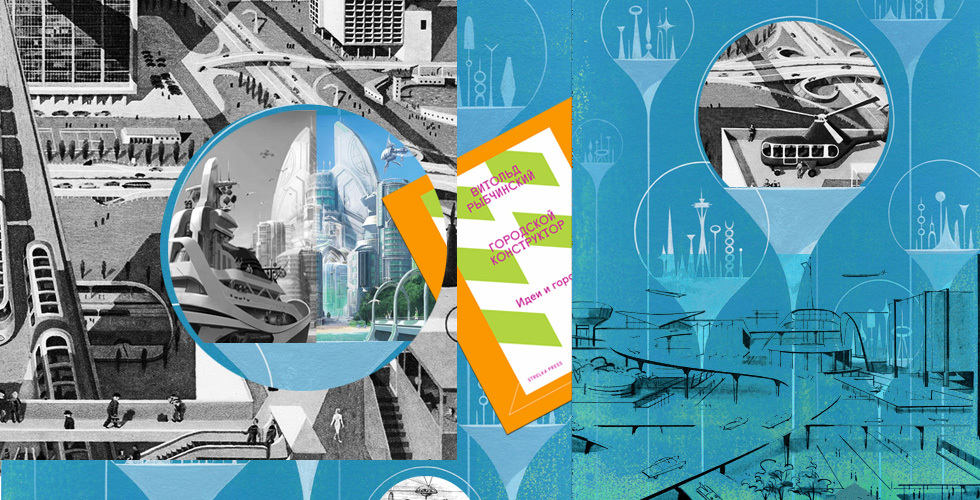
Vitold Rybchinsky is one of the world's most famous theoretical urbanist. Being a representative of the academic environment and the author of more than three hundred scientific articles devoted to architecture, housing construction and technologies, he does not shy away and more frivolous, or something, genres: Rybchinsky at different times led or leads in Slate , in Atlantic Monthly and even writes to the New Yorker . In addition, Rybchinsky writes books. In addition to the one that today, in fact, is the most famous, probably “house” and “city life” .
And these two texts, and the “city designer” just published in Russian pass in some way through the department of the history of ideas. Actually, the author is not hidden. The “house” is equipped with the subtitle “Brief History of the Idea”, and the “City Designer” is completely called the “City Designer. Ideas and Cities. " Rybchinsky-scientist is interested in architecture, environment, urbanism. Rybchinsky- the popular author of Non- fiction is interested in the history of ideas and ideas about architecture, environment, urbanism. The reader of Rybchinsky, thus, receives “two at a price of one”: a popularizer historian working with the subject of studying his other hypostasis-that is, a scientist.
 © Strelka Press
The words “theoretician” and “historian” here, of course, create a not quite true impression. The “city designer” is far from only theoretical or, so to speak, historiographical interest. A fair place in the book is occupied by Case Studies . Thus, a separate chapter is devoted, for example, “Bilbao's effect” - or rather, that Rybchinsky describes as antagonism between today's “Fashion on the“ iconic ”point development” and consistent, systemic design of the urban environment. The other chapter describes in sufficient detail the principles used by the planners when creating an Israeli mod, built recently - in the early nineties.
However, the main plot of the book is the life (and struggle) of the ideas of the main American urbanists and architects of the last century: Lewis Mamford, Jane Jackobs, Frank Lloyd Wright - and many others. According to Rybchinsky, the face of American urbanism has determined and largely continue to determine the three main ideas. The first is Charles Malford Robinson, who paid special attention to the aesthetic parameters of the urban environment and advocated planned development. The second is the idea of a city city, which Rybchinsky builds to the Englishman Ebenizer Howard. The latter was neither an architect nor an urbanist - and it’s not entirely clear who was: as Rybchinsky writes, Howard “adored innovations, especially writing machines, was interested in spiritualism, learned Esperanto and became an active member of the local discussion club, where he met socialist Sydney Webbu and young George Bernard show.” One way or another, this intellectual with an indefinite class of classes wrote an important text for our plot, namely a small book called “Tomorrow: a peaceful path to true reform”. This work was a detailed project of the new city-in fact, the “cities-garden”, combining the advantages of urban and rural life, and “the detailed economic justification of the project was based on three theses: firstly, the whole land in the city should belong to the state corporation; Secondly, the task of this corporation is to buy up cheap agricultural lands, cultivate them and invest their income in the development of a new city; And thirdly, the population of the city should not exceed 32,000 people. ” The third key idea also belongs to a foreigner - we are talking about the principle of zoning, according to which "in the modern city there should not be a mixture of different activities, it will become ordered, logical, planned." Further, Rybchinsky describes in detail a large -scale attack on the idea of the beneficiality of planning, undertaken at the very beginning of the sixties, Jane Jackobs, the author of "Life and Death of Big American Cities", and the polemic, into which the historian, sociologist and philosopher Lewis Mamford entered with her. He gave Jacobs “Orthodox as an insightful observer of urban life (“ no one can surpass it in understanding the complex structure of the metropolis ”), but did not agree with its categorical rejection of urban planning in general, as ideas. Then Rybchinsky proceeds to the next chapter of the history of ideas about cities - namely, to the polemic of Frank Lloyd Wright with Le Corbusier. Following this, the author in several chapters in great details, on various examples (shopping centers, embankments, the already mentioned “Bilbao effect”) analyzes the dynamics of relations between “urban demand” and “urban-based proposal”- or, relatively speaking, between authoritarian ( Top- Down) and liberal ( Bottom- UP) approaches to the development of cities. The last three chapters are devoted to the comprehension of the existing historical experience: Rybchinsky is trying to understand “in which cities we want to live” and “what cities do we need”.
Rybchinsky believes that successful urban planning is characterized by rejection of extremes-both authoritarian-modelist and anarchist.
The “city designer” is likely to disappoint those who are looking for some completely unexpected ideas and radical approaches in modern urbanism. It seems that it is precisely Rybchinsky’s interest in the history of ideas in this area that tells his proposals the properties of caution and balanced. The author of the book is a classic supporter of the "Middle Way", albeit not in the Buddhist sense. Rybchinsky believes that successful urban planning is characterized by rejection of extremes-both authoritarian-modelist and anarchist. Rybchinsky, on the one hand, is polemicizing with Jacobs, reminding us that "cities are developing not only in accordance with the requests of people, but also under the influence of objective needs." On the other hand, he writes that the current economic stagnation will undoubtedly lead to an increase in government spending in the public sector, which is why experts will face the temptation of grandiose projects - new options for the “radiant city” of the 21st century. This "temptation will be very strong, since state funding exempts from the restrictions imposed by the market, makes it possible, as in the good old days, to replace the urbanization based on demand, planning with the priority of the proposal (" We better know what you need ")." According to Rybchinsky, "it is necessary to fight with this temptation." However, he ends the book not quoted by the tough (but faithful) statement of the ideological property - and the call to urbanists and architects to extract lessons from his own past: “The future city will be in many ways new, different, but in order to successfully develop, it should not neglect what happened before. The connection between the past and the present, the ability to see the old again have always been an integral part of non -standard urban decisions. ”
The question of whether there is a history in the classroom (albeit the history of ideas, albeit in such a practical field as urbanism) the pragmatist “extracting lessons” is complex. The answer to him is not so obvious. However, Rybchinsky shares the traditional - and optimistic - view of this plot. Actually, his whole book is a call for moderation, judgment and intellectual honesty, which is a necessary (but, alas, insufficient) condition to learn from his own mistakes.
The weather is known which - and not only here, but also everywhere: it is difficult to imagine that this call will gain mass popularity. However, Rybchinsky, it seems, does not set himself such a task. Of course, it will not be possible to reason the whole world. But a separate architect, planner, urbanist - why not try?
Vitold Rybchinsky. City designer. Ideas and city. - M., Strelka Press, 2014