
Translated material
Harlequin counter -revolution
Olesha's “Fairy Tale” joked too subtly for the Soviet regime-he was banned only in 1936
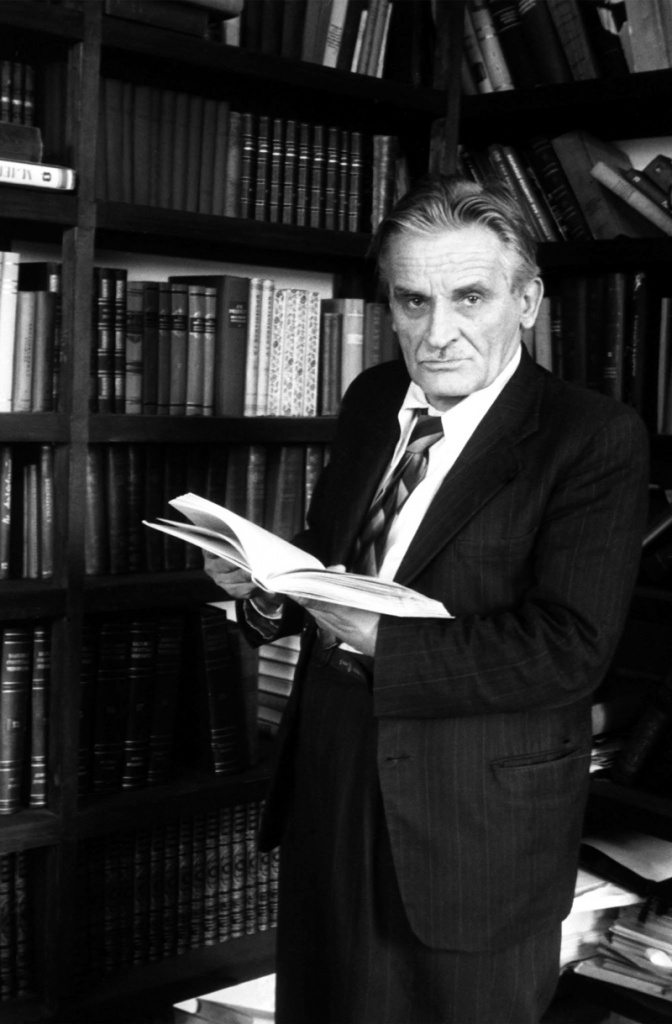 |
| Merry Gaer, Manager and Dissance Yuri Olesha near the Book Shelf. January, 1954 |
When the society ends with ammunition, and the power terribly pouts the cheeks and climbs on the head, the defenseless citizens remain the element that even “the largest state in the world” cannot stand against. And here we can give us a master class of Zlyuk, a cynic, a cheerful guar, an adapter and dissident Yuri Karlovich Olesha, who will virtually turn 115 years old.
He had a rare origin: from a family of Polish gentry. In his youth, Yuri was not left, studied at the gymnasium, wrote poetry about fairies, and not about Petrels. For two years he studied the law at the Novorossiysk (Odessa) University. And then the whites with the allies sailed, and the law ended with the legal state.
Four talented and hungry musketeers - Ilya Ilf, Valentin Kataev, Yuri Olesha and Eduard Bagritsky - ended up in the cold Odessa among the snowdrifts of military communism. At the same time, one Bagritsky admired the revolution honestly. And the three wits mocked in their early stories over the lopoha by the Soviet regime so subtle that the commissioners and their censors slammed this.
At the beginning of the 20th century, our grated musketeers moved in search of food, careers and fortune to Moscow. In 1922, Olesha was already in the capital, scraps feuilleton and signed by a pseudonym - chisel. And then he falls on the hospitable rails of the Gudok newspaper, where all our Odessans converge.
But by 1924, the evil -speaking Olesha lost the latest illusions regarding the ferocity and mediocrity of the current Soviet moment. If Bagritsky’s “mother-revolution” appears with the “trihedral frankness of the bayonet”, then Yuri Olesha decided to go around the eyelids, if not on the crooked goat, then on the circus pony. He creates his own, bloodless, theatrical, in pink silk and gold sparkles the revolution of the "three fat people." The theater is invading the palace, the colored balls of the lost seller fly there, the wise Dr. Gaspar Arneri becomes an ideologist, and the funny fat men, who are always sitting on a diet, do not cause any class hatred. And it all ends without the Cheka, executions and appeals. Enough one panther. The heir Tutti voluntarily employed in the circus, the fat people are put in a cage, the people are looking at the idea instead of executions, and the mouse eats marmalade in the chest of drawers at Aunt Ganyud.
"
The reputation died, talent wilted, but there was a laughter that crossed out their state -owned region and their revolution
"
The fairy tale was released in 1928. Criticism made a grimace: "Call to the struggle, work, a heroic example, the children of the country of Soviets will not find here." In 1930, the Moscow Art Theater ordered Olesha a staging and staged a play. And the fairy tale was translated into 17 languages.
And that's not all. In 1927, Olesha fired the liberal “Red Novy” novel “Envy”. Here, there was no stone on the stone from socialism. Antherieu is an important catering figure, ideological communist Andrei Babichev. His opponents are the despech brother Ivan Babichev and the intelligent drunken, internal emigrant Nikolai Kavalerov.
Ivan Babichev, who has been sitting in the GPU, offers to fight with pathetics, dormitories in everything and the military of the New World, offers with the help of a bourgeois private life: “Here is a pillow. Tell him: we want to live and sleep everyone on our pillow. Do not touch our pillows! Bullets stuck in a pillow. We’ll strangle you with a pillow ... ”It was difficult for the GPU.
But in 1930, Olesha writes the play “List of Blessings” about the actress, which made up a list of good deeds (very gloomy) and crimes of the Soviet government and for this disappeared. This thing has already been banned.
From 1936 to 1956, Olesha was not printed. He wrote only disgusting pro -Soviet articles in which no one believed: neither he, nor readers, nor Stalin. Until his death in 1960, Olesha drank Gorky, there was a poverty and lone. The reputation died, talent wilted, but there was a laughter that crossed out their state -owned region and their revolution.
Photo: A. Fly/ITAR-TASS