
Translated material
"I was always afraid of color"
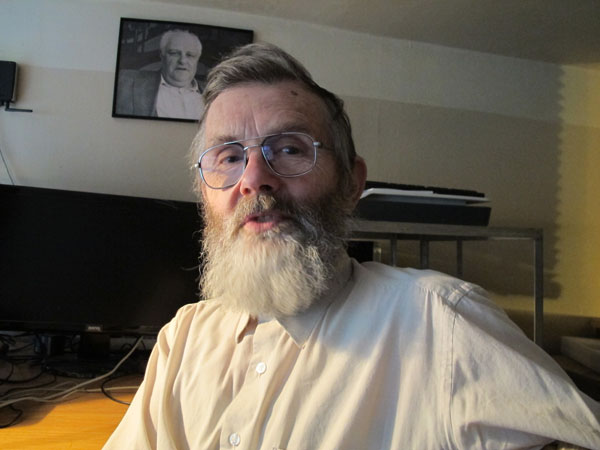
On the eve of the “Public Lecture“ Polit.ru ”on February 27, 2014, we talked with Ivan Nikolayevich Pigarev, a doctor of biological sciences, chief researcher at the Laboratory for Processing of the sensory Information of the Institute for Problems of Information of the Russian Academy of Sciences. Talked by Natalia Demina.
Why did you study sleeping?
The initial I am the physiologist of vision. After graduating from the Faculty of Biology, I came to work at the Laboratory of the Institute of Information Problems Laboratory, and I still work at this institute. Then the laboratory was called the Laboratory of Physiology of Vision. After that, many years passed, it expanded and became the laboratory of information transmission in sensory systems. My colleagues are engaged in a variety of things, but vision was always dominant.
Initially, I was engaged in the device of the visual system, starting with frogs, because then, in the 60s, interesting discoveries in this area were made. Then it was customary to do this: the frog was immobilized with special chemistry so that it did not run, did not jump. Since the frog can breathe through the skin, it does not need to do artificial respiration, it is very convenient. The immobilized frog lay, a certain artificial stimulation was served before her eyes, and they studied how visual signals were analyzed in her brain.
I always did not like this approach. It seemed to me that any system of a living organism should be investigated in its natural situation, in the conditions in which it was created in due time. Therefore, if we explore the visual system, it is better that the animal is without any immobilizer, so that it is normal, mobile, with preserved eye movements. And best of all, that it is placed in the habitat for which this little animal was designed. If this is a frog, then this is a forest, a swamp, grass.
From the very beginning, I took up the design and development of methodological techniques that would allow you to work on animals in comfortable conditions for them to make it good, but I am interested. At first it was with a frog. We were probably the first crazy researchers who recorded the activity of solitary retinal neurons from the eye of a living creature - the frog that jumped in the forest. And we followed her with a tape recorder at a certain distance and recorded the activity of neurons.
On the head of the frog stood a small "crown". It contained a micromanipulator, microelectrodrod. The microelectrod could be moved to different levels of the brain, a small amplifier hung. Then there were no transistors, it was such a distant era when there were no good field transistors. Therefore, we assembled an amplifier on a small, miniature light bulb. He hung on a fishing rod, from him there was a wire to the frog.
The frog jumped, and we followed and recorded that it works in her brain. We quickly figured out the frog. It is interesting, but we have exhausted this question for ourselves. Certain things became extremely clear. And there were no bright ideas for the next step. We decided that since the frog has a rather specific visual system, its distant analogues remain in a person, but these are very distant analogues.
How does the frog still see? In color?
We can’t even be sure how the other person sees. Whether the frog has something similar to our perception and sensation, we are not able to solve, because so far the animal does not know how to speak and cannot explain, we cannot experimentally solve this issue.
Even if we make an exact copy of her eyes?
We do not even know how the other person has sensations. We cannot determine whether your sensations of color from this table are the same as mine. But since we both say that this table is burgundy, then, having agreed, we can communicate. But we cannot have complete confidence that our internal sensations are the same.
It turns out that messages, that the owl sees this way, but the dog is so true?
Yes, these are completely incorrectly formulated statements. We cannot say what they see. We can only say which animal has color vision, and which is not. We can explore the receptors in the retina, determine how many receivers are in the retina.
So, our color vision is built on three receivers. Since the spectral sensitivity curves of all normal people are the same, then it can be concluded that if everything is the same, then the perception is the same. We are based on this faith.
But you must always remember exactly that this is the moment of faith. We can believe that we all see the same, but we can not believe. Experimentally, we are fundamentally unable to solve this issue. But then do not deal with it. However, we can say that if people in the retina have three types of cones that have different curves of spectral sensitivity, then people are able to have the so -called trichromatic vision. I can distinguish colors, and you can distinguish colors, as you have the same receivers as mine.
And the frog?
But the frog does not have, she has one type of cone. She has a dichromatic vision at best.
This means that she sees some colors, but some not?
She has a more difficult situation. She has a very specifically organized system of vision, she has specialized neurons in her eye. They sort all visual objects, their classification for four important frogs for frogs. From the retina, the frog's eye is not a picture like a person, but the location of food, shelter, obstacles and the enemy are going on. The whole world in her breaks up into these 4 concepts, incoming signals are divided into four categories.
It turned out that different categories are served by different color systems. There are channels that are absolutely colorful, they are served by just one type of cone, they cannot determine the color. Others are served by two types of cones, that is, in this case, the frog is a dichromate. But this is not my current area of research. My colleagues in IPPI can tell you more about this: Vadim Maksimov, Elena Maksimova. Vadim Viktorovich Maksimov can tell which animals what colors can distinguish.
All my life I could not stand color, so I liked frogs, they are not very “color”, it is quite possible to work with them using black and white visual stimulation.
I was always afraid of color. Physiology of color is an insanely complex field of science. When amateurs climb into it, it turns out just a nightmare. I understood this in time, tried to avoid this matter, so as not to fall into some stupid situation. But if such a need arose, then I always had qualified consultants nearby.
So we completed the study of the vision of the frogs, deciding that it is more interesting for us to go to the beasts more similar to us. In this sense, the cat has the design of the visual system of the human type. We also have everything that the cat has. But we have a little more what the cat does not have.
We have developed a special technique. For 30 years, it has been modified, but the idea remained the same. A painless fixation of the cat’s head, she sits calmly, her eyes are open, she can move her eyes, and we plunge the electrodes in different parts of the brain, for example, into her visual bark.
The visual crust of the cat is very complex, about 12 visual zones that solve different visual problems. When we began to register the activity of these zones, we began to notice such a phenomenon that the cat is sitting for an hour or three, reacts to some kind of visual stimulation, then all this is madly boring, she closes her eyes and strives to fall asleep. And at the same time we register the activity of her brain. We see that as soon as the signs of drowsiness begins, the nature of neural activity dramatically changes, reaction to visual stimuli disappears.
At the very beginning, I had one wonderful cat. He slept with his eyes open. It was very convenient. He sits, his eyes open. Suddenly, a neuron, who was in the visual bark and was responsible for visual stimulation, ceases to react to it, and we observe the typical activity of sleep. Packs of impulse discharges, between them long pauses. In addition, we began to register an electroencephalgogram in order to be able to notice the beginning of sleep.
They were carried away by what was happening to the brain at this time. It seems that everything works, as with vigor, the remarkable activity of neurons, the frequency can be higher than with vigor. Moreover, we quickly realized that during sleep, many neurons that were “silent” during wakefulness and for them could not find some specific stimulation, began to work actively in a dream. So it is better to start a researcher who is engaged in the search for neurons in the brain with a state of sleep, they work much more there. So our work with sleep began.
In fact, if it is honest to speak, then the story of my path to the physiology of sleep was a little not like that. When I was a student of Moscow State University, Professor Lyubov Abramovna Novikova, a marvelous woman and a marvelous teacher, read to us lectures on encephalography. Now, retroactively, I can understand that she told us what was done and published only a month ago, about the forefront of science. And when you are a student, and the teacher tells you something, you think that this has already been done a long time ago. In student times, the time scale is deformed in science. Only then, retroactively, you understand where, in fact, you were.
She told us about the results of the experiments, which I later saw at my cats. Firstly, we learned from her that the brain of living beings in a dream does not rest, but works more actively, but that it does incomprehensible and unknown. This is a mystery. It is characteristic that sleep has a specific drawing of an encephalogram, which at the same time has a wave -like shape, and the waves, apparently, reflect the rhythm of the incoming activity of activity. On the other hand, living creatures lose touch with the outside world and do not receive anything from the outside world. Where and how is this brain activity generated? It is incomprehensible.
When she said about it, I suddenly thought, and what's the riddle? In wakefulness, we get signals from the outside world, and in a dream - from the inner. Everything is clear! This idea was born completely like an insight. It happens. Then, when I already got the opportunity to explore a dream, I shared this idea with my colleagues, I had many friends.
In particular, we had those who were engaged in sleep professionally in Moscow. These were experts known in this area, who did a lot of interesting works. I expressed my idea. They said that my idea is complete nonsense. And I continued to engage in vision. But my idea lived, interest in sleep remained. Basically, I read the scientific literature on vision, but if I appeared in sleep, then I also read it.
Gradually, I began to develop that in this science of sleep, people often discuss sleep theories that are so funny that I would not consider them because they do not explain anything. And the very simple idea that can explain everything, no one even discusses.
Then, like all of our science, a tragic period came, restructuring, the collapse of science in Russia came. But I would not like to connect this collapse with perestroika. When it began, there was no particular collapse of science. It all started under Yeltsin, when a complete economic collapse began in the country. The organization of science remained the same, only it was very difficult to work. We still have the same salaries that we received in Soviet times, only prices jumped 3,000 times. And then I got the opportunity to leave to work in Germany. I was invited to join in one German Physiology Project, which studied the vision of monkeys.
And before leaving, I realized that it was necessary to conduct experiments on sleep here in Russia, this is my last opportunity. In Russia, I have my own laboratory, here I can do whatever I want, and in Germany I will act within the framework of laws and restrictions. So, before leaving, I decided to check my old idea. Since I thought over it for a long time, I already came up with the technique of experiments. I implanted a cat in the stomach, in the intestinal zone, stimulating electrodes. When the cat fell asleep, and a typical sleepy activity appeared in the bark, I gave a short electric impulse through these electrodes, and it turned out that in the visual bark of the cat neurons are violently hidden in response. Wow! Then I realized that my idea is not so bad, and it should be tinned with it. A couple of months before leaving, I quickly recorded the activity of a large number of neurons, sufficient to write an article.
In Kyiv, a very good international neurophysiological journal Neuroscience was published. It still exists, at one time it was created by IBRO, International Brain Research Organization, it had two editors. One is Platon Grigoryevich Kostyuk, director of the Institute of Physiology in Kiev, and the other Rudolfo Linas (Rodolfo Llinas) is an American. Kostyuk was responsible for the Eastern Bloc, the countries of folk democracy, the Soviet Union, and Linas - for the Western Hemisphere. They accepted articles for reviewing, if the editor accepted them, then the article was printed. The magazine was published in English.
I wrote my article about the first results about the dream when I had already arrived in Germany. Knowledgeable colleagues checked and corrected English. I sent the article to the magazine, it was accepted and printed. But the article received almost no echo.
Then a long, long current work went. I managed to do something in Germany. Fortunately, there I was given great freedom. My monkeys did everything that was needed in terms of vision, and in their free time they could sleep with me. And no one bother me.
How old are you when you left for Germany?
I arrived in Germany in 1993, when I was 52 years old.
Good age!
In terms of setting experiments, my activity has not yet fallen. It so happened that I always did my own experiments with my own hands.
For some reason, sleep research somehow does not inspire anyone, and vision research-on the contrary, everyone likes it, especially students. I myself remember when I came to the university. I was very interesting to lectures on sensory systems, on the physiology of vision. And if someone told me about lectures on the digestive system, on the intestines and stomach ... The general attitude towards this was as a second-grade physiology. But this was a completely wrong judgment.
If you recall the physiology of the late 19th century, then it was mainly the physiology of the gastrointestinal tract and visceral systems. Ivan Petrovich Pavlov did not receive his Nobel Prize of 1904 at all for a conditional reflex, but for the "work on the physiology of digestion." Then, when he discovered this conditional reflex, engaged in the gastrointestinal tract, everyone rushed into this area, and forgot about the gastrointestinal tract. Then, a large blow to the physiology of visceral systems was struck by the fact that it turned out that there was no representation of visceral systems in the cerebral cortex.
And what are visceral systems?
These are systems that provide the life support of our body. Wieszer - the guts that we have inside our abdomen are organs located in the abdominal cavity. The concept of visceral systems has now expanded somewhat, and now the heart and circulatory system are attributed there. It is possible that this is not a very successful term, but everything that is not connected with the brains is included there, in any case, in my view
There is a nervous system, and the sensory system, this is what is engaged in the processing of information from the outside world or from the body of the animal and the organization of behavior. And another system is what provides body vitality. All this can be included in the concept of “visceral systems” - life support systems.
And when it turned out that in the entire cortex of the brain there is no representation of any life support systems ... In Soviet science, a dramatic story was connected with this. I can tell for curiosity. After all, our scientists have already discovered this representative office. In the 50s, the student of Pavlov, Vladimir Nikolaevich Chernigovsky ( as amended 1907-1981 ) had a laboratory at the Institute of Physiology named after Pavlov in Leningrad, which was engaged in the study of representation of life support systems in the cerebral cortex.
In this laboratory, all the projections of numerous nerves that control the internal organs were spent. They found representation of the kidneys, and liver, and heart, and reproductive systems in the cerebral cortex. All this was investigated. Chernigovsky had a huge laboratory. For a long time he was the director of this institute. He was a wonderful scientist, a physiologist of the highest class.
And then such a moment came that these works were questioned. They conducted their research on animals under anesthesia. And then there was a technique for working on animals without anesthesia, it was possible to register neural activity in awake and behavioral active animals. And when they began to try to repeat these results, it turned out that there was nothing.
It turns out that all these answers that were received were visible only under anesthesia. When they began to study animals without anesthesia, it was not possible to find any representation of visceral systems in the cortex. It was concluded that all the results obtained by Chernigov was a consequence of anesthesia, and all studies in this direction were rolled up. It was very tragic for the same Chernihiv and others.
After that, interest in visceral systems in our physiology fell. Separate laboratories remained in the world, but they dealt with more practical issues. For example, they cut out a piece of intestine and studied it. In the walls of the intestine there is a complex nervous system, so the gut is a tube of continuous brains.
And the brains in quotation marks?
No, they are no different from others. The same neurons, the same ties, the same synapses.
From the school course of anatomy, we know that there is a brain, there is a spinal cord. What is it called?
And this is the third - the peripheral nervous system. It turns out that in it, along the entire gastrointestinal tract, there are as many neurons as in the spinal cord. This is a powerful nervous system. But it is not represented in our sensations. If we feel what comes to our brain from the outside world, then everything that is happening inside us is not represented in our minds.
But if you start approaching these processes strictly, from the information positions, and begin to evaluate the complexity of information processes and tasks that our life support system solves, it turns out that it is not easier than our whole intelligence than our entire visual system. What we feel and see is children's problems compared to those problems that our internal organs solve, our life support organs. And this is very interesting.
Is it possible to say that your study gives a new life to the ideas of Chernihiv?
I think yes. One and quite important, from my point of view, the meaning of our work is that we rehabilitating the research of our colleagues. Because we show that all the connections that they described really are, they are without anesthesia, but only they open in a dream.
Are anesthesia and sleep in some ways?
Anesthesia has a certain sleep model. But this is not the equivalent of sleep. And we see it perfectly. A little animal is peppy, in her cerebral cortex there is no representation of internal organs. The little animal fell asleep, she has no entrance from the outside world, but on the contrary, huge streams of signals from life support systems for all the same cortical zones are opened, and they are all involved in this activity. It turned out that with this understanding, everything begins to become in its place.
Simple household comparison. Everyone says that 90% of information about the outside world we get through the eyes. It is difficult to say who considered these interest. But, in any case, everyone will agree that we really need vision, we get a lot through it. We get it through receptors that are on the retina, through sticks and cones. We know that a person has about 1.5 million.
It turns out that only along the gastrointestinal tract there are intertereceptors, that is, the same sticks and cones as in the eye, but which feel the parameters of our internal organs, as much as sticks and cones in the eye. These are temperature receptors, mechanical receptors, chemoreceptors. That is, only along the gastrointestinal tract, we will not take the liver, other organs, as many such receptors as in the eyes. That is, the flow of information coming from these organs is commensurate with information from the organs of vision!
Now we see that almost ¾ bark is included in visual answers during wakefulness. But even during sleep in almost all parts of the cerebral cortex, we can see the answers to the stimulation of the gastrointestinal tract. That is, almost the entire bark responds to the analysis of this stimulation. In addition, there are other internal organs, and heart, and lungs.
Then it becomes completely clear that if we do not let the animal sleep, he is lost the possibility of managing and coordinating internal organs. But such a complex system is not able to work without coordination. It’s the same as cutting off our brains and release to run along the street. For a long time we do not run.
Although there are analogues, this is somnambulism, when a person has a block of consciousness, everything else works, a person goes out into the street, does a long journey, but his consciousness does not work, he does not remember anything. It is clear that if this happens in a busy city, a person will not last long. Fortunately, somnabuls quickly wake up.
We know that 8 hours of wakefulness, our internal organs can safely work without attracting the brain. They have their own brains along the entire gastrointestinal tract, but they do not know anything that happens in other parts of the body. The guts then work not only for the sake of intestines. They work to choose and send the right food to the one who needs.
Did your ideas respond with colleagues abroad?
It's hard to say. For a long time there was no reaction to them. An active block was put on the way to publications, for a long time we could not print our articles in the journals on sleep research. Foreign magazines threw out articles without even referring them to review. It was felt that some colleagues did not want to hear these ideas. But time goes. Gradually, the picture changes.
Something similar was with us, in our environment. But in our environment it was easier to live, because the rating of our institute and our laboratory was very high, I was known as a competent physiologist in visual work. It was hard to say that these works are done by a person who does not know how. Since people knew that I could do something, there was more attention to them.
In our Russian environment, these ideas have already become generally accepted. In any case, doctors meet them with great interest. Because a huge amount of data has accumulated that the pathologies of internal organs in most cases arise as a result of sleep disturbance. Interest in the field of sleep is now growing all over the world. It became clear that too many pathologies are related to sleep disturbances, but there was no theory that would explain this. Last year, we published a large article based on the results of a study of the 12-first-sheep intestine in cats and its connection with the activity of the brain in the journal "Gastroenterology". American magazine, medical, not related to sleep research. They did not have a load of ideas related to the usual hypotheses about the functions of sleep, but, on the contrary, for them there was a revelation that there are ideas that began to easily explain what was not clear before.
And in a dream, some ideas came to you, as was Mendeleev?
No (laughs) . I think that nothing came to Mendeleev in a dream. In a dream you have to sleep, and ideas should come during wakefulness.
Were there any popular science books in your childhood and youth that influenced you so that you became a biologist?
There is no biology, I rather read popular science books on physics and technology. I believed that I would be engaged in physics, even preparing to enter the physical faculty. But literally somehow at the last moment everything changed, and I spread to the biofac. In my youth, I read a lot of popular books from the field of exact sciences, not biology. All his life he could not stand botanist, zoology and classical biology. Although now he began to understand that in vain. In fact, botany is an amazing area. And now I am ready to engage in the physiology of plants, this is a very interesting topic.
I have bad books. "I am Chukchi - a writer, not a reader."
You are a wonderful storyteller, did you have a desire to become the author of a popular science book?
Our scientific works, I think, are available to many. I try to write so that it is clear not only to narrow specialists. It so happened that in our institute our ideas are much better and with great interest are perceived by physicists, mathematicians and linguists. Apresan ... Biologists are much worse. 20 years have passed, and they gradually get used to it. But at first they did not perceive me to the spirit.
There is also a psychological moment that "there is no prophet in his fatherland." They told me more than once: "You are a vision specialist, and in another area you do not understand anything, we do not need to hang noodles on our ears." On the other hand, I defended my doctoral dissertation after 15 years of vision studies, and in the field of somnology I have been working for 20 years, and I could have been protecting the second doctoral.
Please continue the phrase. A dream is ...
Sleep is the time when departments of the central nervous system (central nervous system) switch from an analysis of information coming from the outside world to an analysis of the information coming from the own body of this organism. And this definition becomes completely universal, from cilia to a person. And although the infusoria does not have central nervous systems, and in general there is a dream of the infusoria - the question is open and incomprehensible, but simple animals, like worms and drusophil, have a dream.
Is it true?
Certainly! Most of the dentologists would now ask: “Do they have these waves?” They have no sleepy waves. But sleepy waves are not a signal of the state of sleep. It is important that the waves are obtained as a result of the fact that our brain processes signals coming from the peristalt gastrointestinal system. These signals are transformed into waves of rhythmically working neurons, which are associated with rhythmically working systems. The gastrointestinal tract, heart, breathing, these are all rhythmic organs, and rhythmic signals come from the rhythmic organs. And the interference of these rhythms gives these waves of sleepy activity.
The phase of quick sleep comes, this is the same dream, it is no different from the slow. But the encephalogram is completely changing. Apparently, at this time, information from the liver, kidneys, from reproductive organs, from the brains themselves, from blood vessels, in which there are no rhythmics begins to enter the brains. The brain activity is crumbling, the pattern changes, because the nature of the incoming signals changes. And the principle remains the same. The central department of the nervous system is engaged in the processing of information coming from the internal organs.
Does Drosophila have the central department of the nervous system? Eat. Are there internal organs? Eat. She will not have such waves, because she has no intestines. She has no peristalsis. But she has heart contractions. If we plunge Drosophila or some bee in the brains and see how the background activity of neurons in a dream is rebuilt, I think that we will see manifestations of the heart rhythm. But no one did this. Or we will see ties with digestive departments.
But this definition of sleep is not universally recognized.
And when you understand what a dream is, then you can completely approach the analysis of that huge array of records, information, articles that have been accumulated in the field of sleep over the centuries. It becomes clear that a lot of this array is not very interesting. Scientists were engaged in the study of sleepy waves. They studied not the essence of the phenomenon, but a certain epiphenom.
Although sometimes it is useful. So, encephalography is the easiest way to show with a fairly good degree of accuracy when a person falls asleep and when he wakes up. This is very important for clinical somnologists. They can evaluate the length of sleep, its intermittence. In this sense, these waves of encephalograms are an important thing, and they can be studied. But when you know that these waves are not an end in itself, that producing the waves is not the task of the brain, but only a consequence of what the brains are engaged at this time, then a different understanding of the phenomenon is obtained. Then everything is simple and easy.
Thank you very much for the interview!