
Translated material
Where did dissidentiality come from?
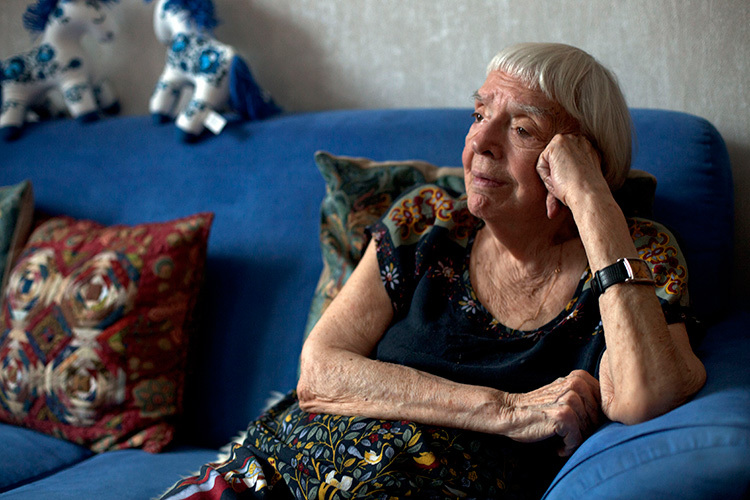
Colta.ru continues the heading "Likbez" , in which experts share with us their views on the fundamental concepts and phenomena of culture and history. Human rights activist Lyudmila Alekseeva talks about how “the so -called dissidents” appeared in the USSR, how many copies actually take Eric and whether it is possible to lie during interrogations.
The very word "dissidentity" was not invented by us, but by foreign journalists who noticed this phenomenon. In Stalin's times, he was not noticed, although it was either, but then everyone was silent, because it was very dangerous. And after the twentieth congress, it was recognized as its existence and called their word “dissent” , that is, “dissent”. They began to gradually use this word, and then we ourselves.
“Dissidentism” is a fairly wide concept meaning dissent of the 1960s. The dissenters were different: monarchists, and believers, and nationalists, and human rights activists. We all knew each other and knew those who thought differently. And they are us, and we are them. But if, say, anarchism, monarchism, religion were quite traditional for Russian society the forms of dissent, then the protection of human rights and our current were completely new. In Russia, justice in all centuries were very worried, but with the right it was never practically connected. Of course, there were some historical forerunners: Kistyakovsky, Trubetskoy, cadets ... In pre-revolutionary Russia, something was born, but did not manage to become a noticeable social current.
We, who later became a human rights activist, at first did not call ourselves at all - we simply did not know who we were, and did not know the part of our story that could be considered the forerunner: in Soviet times, all this was removed from libraries, training courses and from people's memory. And if someone remembered something, they did not say very very. Parents also did not report anything, so that we would not blurt out somewhere and would not be in the camp or under the execution with them. We did not know anything of this.
The human rights movement already existed in the West and began its beginning from the post -war time, when in Europe and America they tried to comprehend the tragic experience of the two world wars. This was not there before in the history of mankind, and people thought about it in horror. In Strasbourg, the Kassen Institute was created, in which they thought about where Europe stumbled (that these wars began) and how to make it no longer repeated. In 1948, the fruit of these thoughts was embodied in the Universal Declaration of Human Rights adopted by the United Nations. There it was about the natural rights of a person who should respect all regimes and all the rulers, that a person from birth has rights and human dignity, regardless of what country he was born and to which race and which social class belongs. The declaration was accepted by an increasing number of countries, and even the Soviet Union ratified it, but more for the outside world, so that we seem to be such a pretty democratic country. In our country, even the text of the declaration itself did not spread. I, a historian with higher education, and a person who was always interested in these issues, did not know about the existence of this document, and all our human rights movement did not have a concept about him.
The only person who knew about this and tried to talk about it is Alexander Sergeyevich Yesenin-Volpin. For human rights movement, he was like enlighteners for the French revolution. In this absolutely not giving way to reflects Soviet reality, he came to the ideas, which now seem simple and logical, and then they were very far from life and were absolutely not embodied in it. It seemed that the law should be the same for everyone, both citizens and rulers should be the reasoning of the leisure mind. His second reasoning: laws must be read as they are written, and not like our rulers interpret them. Interestingly, they were written, even the Stalinist constitution, were quite good. But we had such a joke: it says "Freedom of rallies, meetings and so on." That's right, “freedom of assembly”, but what about freedom after the meetings? The answer was quite obvious.
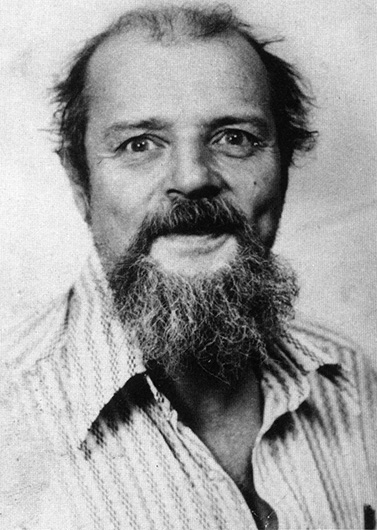 © from the archive "Memorial" Alexander Yesenin-Wolpin
Another remarkable idea of Alexander Sergeyevich (whom we called Alik) is that there is a lot of suffering and tragedies in life - from lies and nobody to lie, nobody. I said: "What, and you do not need to lie in the personnel department?" He: "No need." - "Well, this is specifically in our destruction invented!" I thought this: you don’t need to lie, but in the personnel department and in interrogations - you can, otherwise you will suffer not only you, but also others. Alik said: it is impossible to lie, but you can be silent, and if at interrogations he said: “I will not answer” - it was clear to people that they fell into a point. I could lie in interrogations and did not consider it a sin - and now I do not think.
I must say that for the first time we heard Volpin’s sermon in a very suitable place - in a crazy house in Leningrad, where he was imprisoned precisely for these thoughts, because they looked like crazy nonsense. Those who planted him there really believed that he was “that” because a normal person does not reason like that. There he sat with Vladimir Bukovsky and explained all this to him. Then he explained this to Larisa Bogoraz, and she also listened very carefully to him. And all these conversations gradually on some part of the people who disagree with the injustice that was going on around, somehow influenced.
1968, the UN announced a year of human rights around the world. Then the most prominent, active figures of the future human rights movement gathered in the country with a relative Peter Grigoryevich Grigorenko. There was Grigorenko himself, still Natasha Gorbanevskaya, Larisa Bogoraz, Krasin. I was not there, and I learned about this meeting already at interrogations. I must say that from Stalin's time we still have not very dexterous, but still caution. When we did something that could entail the persecution, we have developed such a rule: not to tell anyone about it, even to a person who you believe absolutely. Speak only to those who need it for this. And it was right, because the more people know, the faster it ceases to be a secret. In addition, if a person is called for interrogation and begin to ask about something, it is much easier for him to say that he knows nothing if he really does not know.
Therefore, Larisa, who was my best friend, did not tell me about this meeting. And these people gathered there with what idea: at that time there was no longer such a clamp as in Stalin's times, there were no mass repressions, and fear gradually weakened in people, but censorship in everything was as hard as under Stalin. Information, if it penetrated to us, then not through official sources. After 1956, they began to massively free people from the camps, and we learned a lot about that life, but we still learned from oral conversations, and not from newspapers or television. And there was a lot of such information, not only about camps.
People got out of tongues, and they stopped being afraid, they began to tell who knew what. The fact that only families were known before was now told to everyone. And we have accumulated quite a lot of knowledge about what is happening in the country. At first we simply gathered in the company and all told each other, but already in 1967 it became obvious that this is not enough, that some systematic spread of our knowledge was needed. We have already read and printed samizdat, but for some occasions and on individual issues, but here I wanted systematicity, I needed some kind of information ballot. And then, in the country, they decided that the Year of the Human Rights announced by the UN will be celebrated in the Soviet Union by the publication of such a ballot that will be released once every two months.
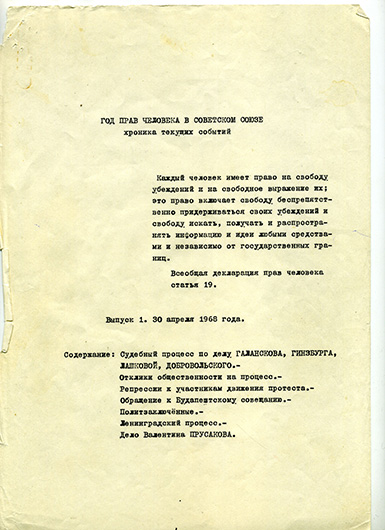 © from the archive of the "Memorial" "Chronicle of current events" No. 1
Natasha Gorbanevskaya undertook to do it. She came up with the name of the “chronicle of current events” and from the first number of this chronicle set her style: without any comments, without emotions - just a presentation of facts, but a meticulous presentation. The first ballot was released on April 30, 1968, it was on 18 typewritten pages. There were news from Moscow, Leningrad, information about the Crimean Tatars and from the camps.
The first printed number "Chronicle" brought me Pavel Litvinov. Of course, he showed me for a practical purpose. He knew that in Samizdat I learned to print rather fluently on a typewriter, and then this was not so often among us - almost everyone printed with torment with one finger. He brought and showed in the hope that I would undertake to print, that it was absolutely right - I was in full delight and said: "Of course, I will print!" She printed the bookmark and gave it to him. He told me that Natasha was doing the Chronicle, so if I have information about some events, then you can transmit her for the next numbers.
No one knows how many copies of the "chronicle" were printed. Everyone could only know how much he printed. We tried to print on cigarette paper, and not on a regular one. If you saw in the store that cigarette paper was sold, then they raked all the money that they were and purchased. Then they fled to their acquaintances, borrowed money faster and quickly to purchase as much paper as possible, as it was greater value. Galich sat: “Erica takes four copies”, and I printed seven. On papigeric paper and hitting the keys as if I score nails.
I never printed the "chronicle" at home. By that time, I was kicked out of work, and I worked as a reprint. Therefore, there was a machine on which I earned at home. Since there were already searches before, I understood that I could get a long time, and did not print at home. In the commission, I bought an old machine. It seems even the XIX century. The keys on it were located steps, it was hefty, all of iron and weighed pood. I had a large grocery bag, where I put this monster and covered it with a diaper so that it was not visible what it was. I tried to print from friends who did not do anything like that and therefore could not come to them. There were many acquaintances, they were all sympathetic, they themselves did not do anything, but they were good. If I did not have time to print everything in one day, I remained the next one, because the “chronic” became more and more voluminous.
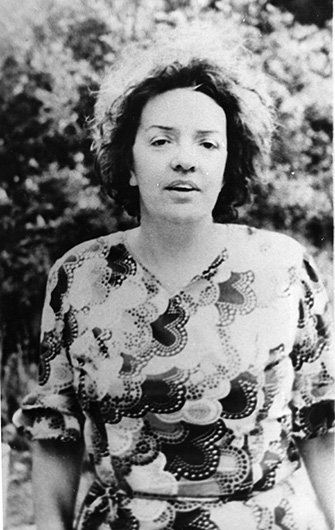 © from the archive "Memorial" Lyudmila Alekseeva
“Chronicles” began to read on the Radio “Freedom”, and if in Moscow and large cities “Freedom” they were jammed, then in some bear corners-no, and people there were well aware of the existence of “Chronicle”. And they began to come specifically in order to inform something of the editorial office, and people did not know who published the “chronicle” because there were no addresses or surnames. They simply said something from one of the active people, but he conveyed. I realized how Lenin was right when I wrote about my “spark” that the newspaper is not only a collective agitator, but also a collective organizer.
Unfortunately, Peter Yakir was the most famous for those Nemoskovsky people who wanted to report their materials in the Chronicle. He was the son of the legendary commander and himself was a very bright and talented person who hated Stalin. Yakir exposed Stalinism and talked about repressions in his lectures. His house was open to everyone, so many of those who came, went with their messages to Yakir and even considered him the leader of the movement. Unfortunately, Yakir knew what Natasha was making a “chronicle”. Unfortunately, because Yakir not only drank a lot, but was also very intemperate for the language.
How much the “chronicle” was dispersed - we do not know, but when in 1974 the case was started against the “chronicle”, the searches were carried out throughout the country, and copies were found in Riga, in Kaliningrad, and in Vladivostok. Therefore, Galich sat correctly that “Erica” takes four copies, that's all, that’s enough. ” Who wanted - knew.
In the fifth issue of the Chronicle, Natasha placed the advice: who wants to transmit information for the Chronicle, inform her to the one who gave you to read her so that he would transmit along the chain. Just do not try to go through the whole chain yourself, otherwise you will be taken for a informer. And so this information really came.
On the first page "Chronicle" it was written: "The Year of Human Rights in the USSR." But the year 1968 was over, and the “chronicle” showed its importance and its necessity, and it was necessary to somehow continue. And then they replaced this title with "the Year of Human Rights in the USSR continues."
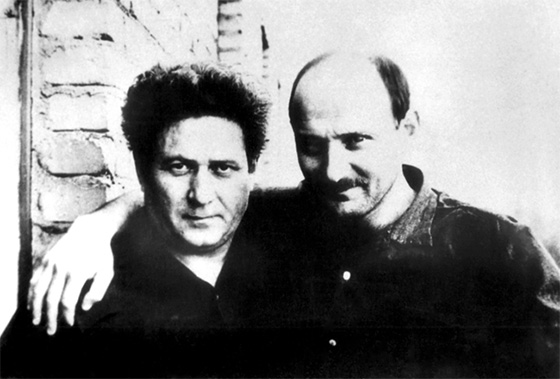 © from the archive "Memorial" Peter Yakir and Viktor Krasin
The last issue of the Chronicle was released in 1982, that is, it lasted 14 years. I must say that this broke all the records. The first experience of the periodic independent, non -certificate press in Russia was Herzen. But he published his “bell” nevertheless in London, and here it was in Moscow, and it was impossible to compare the regime. Surveillance. About once every two years they arrested the editors of the Chronicle, went out on them and arrested. But they were replaced by others, and the “chronicles” continued, maintaining the former style, their information content and expanding. Andrei Dmitrievich Sakharov said that the “chronicle” is the best that created a human rights movement, and this is true. We are very proud of the involvement in the Chronicle, and I am proud that I printed the first issue and all subsequent until 1977, when I left the country.
Over the entire period of the “chronicle” there was one solid break when Yakira was arrested in the summer of 1972. We were then given such a condition: firstly, if the next “chronicle” number comes out, then for each number they will add to Yakir and Krasin for the year, so they asked to stop the “chronicle”, and secondly, they said: “We will not look for editors, we will arrest anyone.” And it was such a hostage when some decide to print, while others who have nothing to do with it can be arrested. We argued very much. On the one hand, you can not succumb to blackmail, and on the other hand, you cannot play the fate of people. They argued, argued and could not come to the conclusion, they collected the material. The 27th release was still made-they put Ira Belogorodskaya, who had nothing to do with this, and after that a break began. The material was collected, but the "chronic" did not print. A one and a half years, in 1974, three people - Sergey Kovalev, Tatyana Velikanova, Tatyana Khodorovich - said: we, members of the initiative group, take responsibility for the exit of the Chronicle. After such a public statement, it is already impossible to arrest anyone. So the "chronicle" resumed.
What happened in the "chronicle"? All the facts of persecution due to dissent, all manifestations of dissent, arrests, courts, reports on courts, news of all the camps: who fell ill, whom they put in a schizo, who was released, hunger strikes and everything that happened there. What was the remarkable “chronicle”? She wrote not only about human rights activists, but also about believers, participants in national movements, about Catholics, Baptists, Pentecostals and Adventists. She wrote about the expelled peoples and their struggle for returning to their homeland (Crimean Tatars, Meskhi, Germans). About the movement for departure from the Soviet Union, about the Jewish movement, the German movement, about underground circles, about support from abroad. There was a section "Samizdat news." The material was very diverse.
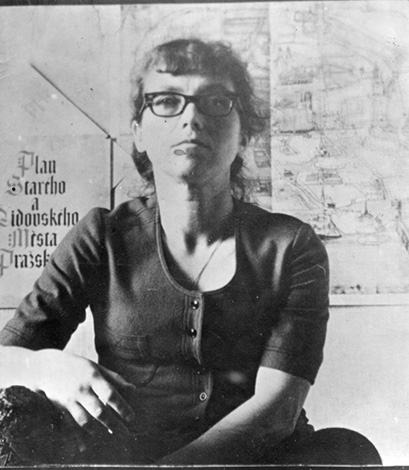 © from the archive "Memorial" Natalia Gorbanevskaya
I also sometimes transmitted something to the Chronicle, basically it was information from Ukraine. Under Khrushchev, all political ones sat in separate camps, in Mordovia. And if wives and mothers went to Mordovia on a date, then they always rode through Moscow. And we had such a division: if anyone was traveling from the Baltic republics, he stayed with Natasha Gorbanevskaya, and from Ukraine - with me. A lot of Ukrainians were planted, basically they were figures of the national movement. And I knew all these mothers and wives. When someone goes to the camp, they come to her already from other cities, they say: “Here you go through Moscow, tell me that we had such a search, they drove it out of work, and they arrested it”, etc. She comes and tells me all this, and I pass it to the Chronicle. Now she is going to the camp, her husband is on a date: “They put such a thing in a schizo, so and so sick, then there will be a hunger strike”, etc. So we received information from the camps. When they found out that someone was going again, by this time they had already bought food, fried chicken and found dry sausage and everything that could be taken. We met at the station, brought it to their place to wash and spend the night. My son chased to cross the ticket. They supplied with foods, helped to drag things and escorted. They were help, and we were information. Then, after 1974, when Solzhenitsyna was sent to the West, he created the fund for assistance to political prisoners, and we also gave money depending on the number of children.
Sent parcels to the camps. There were such prisoners who had no relatives or who had the relatives poor. We were informed that such and such could receive parcels (six months later), which means that we collect it. They sent books that they asked, made subscriptions to newspapers and magazines. They defended the queues to subscribe to the newspaper Sport or the Literary Newspaper. They made at least one subscription in each camp.
All this needed money: both for parcels and subscriptions, when they began to arrest - for lawyers. Мы сами все были выгнанные с работы, у нас ничего не было, но в Москве был очень широкий слой людей, которые работали и которые помогали деньгами. Когда Лариса Богораз попала в ссылку, я поехала к ней. Та снимала угол в избе, где жили хорошие люди, но им было велено следить за ней. Да и жить там было неудобно, ей нужен был дом. Я прямо там нашла подходящий дом, выяснила цену, отдала задаток и решила, что эти деньги соберем. Я обещала в течение двух месяцев прислать. Приезжаю — не получается такую сумму собрать, дом 1800, по-моему, стоил, а мы все получали копейки, а многие вообще ничего. Но ко мне пришел один человек и говорит: «У меня есть знакомый, он готов одолжить эту сумму, отдадите частями, когда сможете, хоть несколько лет отдавайте». Вошел в положение, спас. Дом мы ей купили. Потом, когда ссылка Ларисы кончилась, мы этот дом продали и другому ссыльному помогли.
Еще были те, кто писал письма. Я вот прямо терпеть не могу письма писать, а некоторые писали нескольким людям подряд. И так любили этих женщин! Иной раз письмо дороже всякой посылки и всяких благ. Я знаю пару случаев, когда, выйдя из лагеря, женились на этих женщинах.
Это не было какой-то организацией, это был очень прочный дружеский круг. Мы все друг друга знали и вместе делали такое дело, за которое можно было на много лет утратить свободу. То есть вверяли друг другу свою судьбу. И от этого, конечно, очень любили друг друга, доверяли, беспокоились друг о друге. Если у кого-то обыск, то все моментально начинали созваниваться и бежали туда. И даже если мы стояли под дверью, человек знал, что мы пришли. Вот так это было. А организации не было. For what? Были среди нас такие люди, как Виктор Красин, например, которые очень хотели организацию почему-то. Я сначала была против. Мы и так все делали вместе, а если объявить организацию, то всех пересажают.
Первая организация появилась в мае 1969 года. Это была «Инициативная группа по защите прав человека в СССР». И вдруг оказалось, что когда люди заявили себя организацией, то их стали воспринимать как центр правозащитного движения, которого на самом деле не было. К этой «Инициативной группе» стали обращаться со всякими проблемами, и я поняла, что заявление от организации — это намного больше, чем просто письмо, подписанное теми же людьми, но в личном качестве, поняла, что была неправа. Их, правда, тогда пересажали тут же. Насчет того, что организация — вещь опасная, никаких сомнений не было, но когда в 1976 году Юрий Федорович Орлов надумал создать Московскую Хельсинкскую группу, тогда он ко мне первой обратился, и я совершенно без колебаний согласилась, потому что я знала, что группа, организация — это нужная вещь. И действительно не ошиблась, потому что Московская Хельсинкская группа неожиданно для нас оказалась такой долгоживущей. Она была создана 12 мая 1976 года и существует до сих пор — старейшая правозащитная организация из ныне действующих.
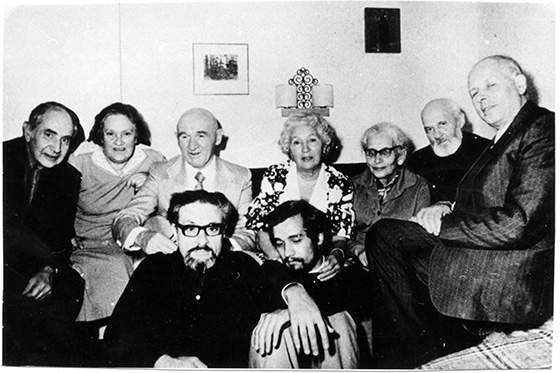 © Из архива «Мемориала» Диссиденты на квартире Петра Григоренко
Были те, которые брались перепечатывать самиздат. Был у меня друг Эрик Руденко, он никогда никаких писем не подписывал, и меня это удивляло. И однажды он признался, что у него фирма, где десяток машинисток печатают самиздат за деньги, а он это потом продает как книги. И он из осторожности ничего не подписывает, чтобы не подставить людей, которые у него работают. Наверное, он был не единственным. Был еще у меня друг, у которого даже было прозвище «Принц самиздатский» (Юлиус Телесин). Я не знаю, была ли у него какая-то там контора, но из него просто сыпался самиздат.
Все участвовали по-разному. Одна женщина, например, говорит: «Я могу стоять в очереди за дефицитными продуктами и в очереди на почту — посылки в лагерь отправлять». Конечно, такие женщины не были никакими правозащитниками, но без этой большой среды, которая деньги давала, и квартиры для печатания предоставляла, и время свое отдавала... Таких людей было очень много, очень много.
О нас очень долго молчали и только в 70-х годах стали говорить, причем используя выражения «так называемые права человека» и «так называемые диссиденты». И рассказывали о нас, что на самом деле мы — не то чьи-то агенты, не то развратники, не то еще что-нибудь.
Когда мы начинали, мы не думали и я не думала, что доживем до краха Советского Союза. Все мы считали, что это длиннее нас, поэтому целей не ставили. Цель была одна, не политическая и не общественная, а сугубо личная — прожить свою жизнь так, чтобы не было стыдно ни перед собой, ни перед детьми, ни перед близкими. Я буду жить честно, все! Если за это причитается лагерь, значит, лагерь. И поскольку цель была скромная — жить по совести, — то мы полностью своей жизнью и своими успехами были удовлетворены. Это теперь я не удовлетворена, потому что теперь есть желание, чтобы наши власти соблюдали конституцию, уважали права человека, достоинство своих граждан, а они, негодяи, не хотят. И, конечно, я досадую, и, конечно, у меня часто бывает чувство поражения. Приблизительно из десяти дел, за которые я берусь, примерно три удаются. Конечно, маленький процент, но в отличие от многих нынешних моих коллег я всегда говорю, что это прекрасный результат, потому что, когда мы начинали двадцать пять лет назад, результат был нулевой.
Надо сказать, что принятый тогда стиль жизни мы не изменили, но сейчас, я считаю, шикарно живем. Раньше о каких офисах могла быть речь? Какие там средства массовой информации? Говорят: у нас нет средств массовой информации. Hello! Я выписываю «Новую газету», «Новые Известия» и New Times , я не сижу печатаю по семь копий до боли в спине. Do you understand? Плачу довольно скромные деньги и имею все и даже до последнего времени — «Дождь» в телевизоре. Мы имеем больше, чем тогда рассчитывали. Арсений Борисович Рогинский все время говорит мне, что я неисправимый оптимист, а я отвечаю: ничего подобного, у меня просто точка отсчета другая, вот и все. Я считаю: ни фига не было — а сколько достигли?! Сейчас в День прав человека президент, видите, по телевизору приглашает к себе, и я еще думаю, пойти мне к нему или нет, потому что мне надо у себя премии выдавать. Двадцать пять лет назад на ноле работали, на ноле! Все достижения были — если в лагерь не попадешь.
Ни моей, ни Арсения Борисовича жизни не хватит, чтобы увидеть, что в каком-нибудь Мухосранске будет так же, как в Москве. Unfortunately. Но это меня тоже не огорчает, потому что каждый человек до чего-нибудь не доживает. Важно не то, до чего ты не доживешь, а важно то, как ты прожил свою жизнь. Я свою жизнь прожила так, как я хотела, и живу так, как я хочу. Начни я жизнь сначала — все бы так же сделала, абсолютно. Хотя мне тогда близкие говорили, люди, которые меня любят: лбом стену не прошибешь, ну чего ты, все живут… А я вот — так. Оказалось, видите, капля долбит камень, да.
Recorded by Julia Ryzhenko