
Translated material
Maidan in the context
Will Russia go in the footsteps of Ukraine
How the protesting machine in Ukraine arose and was functioning and is it possible to have such a development of events in other CIS countries - the New Times found out
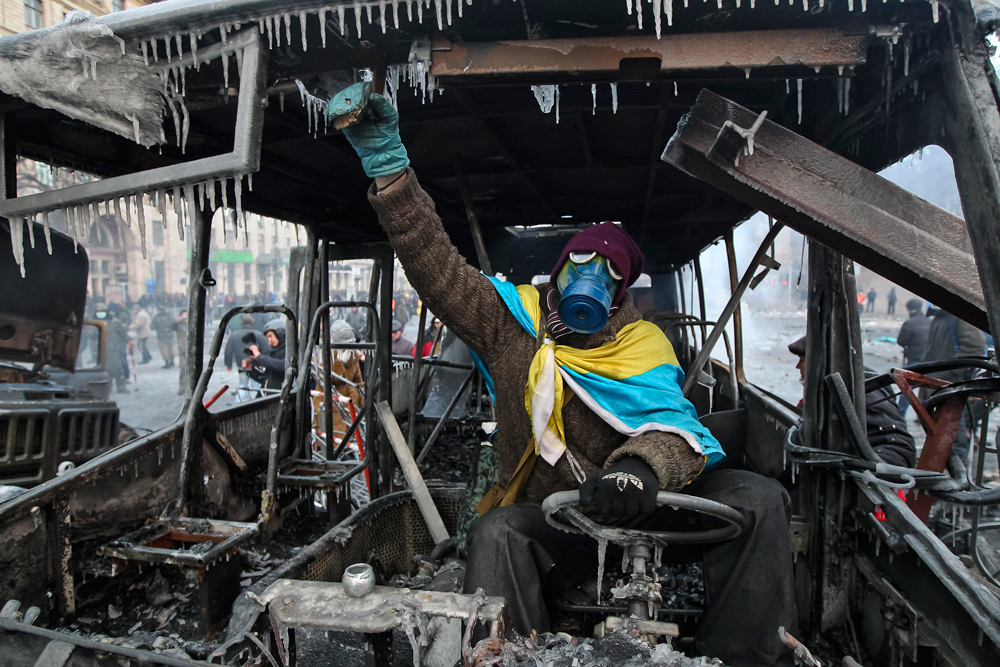
The crushing victory of the Ukrainian revolution demonstrated the inefficiency of traditional state suppression mechanisms and the level of development of horizontal connections and lower democracy unprecedented for the post -Soviet space. Trying to find familiar guidelines in this new and frightening power of reality, the pro -Kremlin media are gossiping about the repayment of protest, its organization from the outside. And what really?
Battle leaf
According to Katerina Venzhik, the editor of the Internet portal.
“The day after the students accelerate, on December 1 (2013), I was on the Maidan in the morning and transmitted reports about the situation,” she says. “When the phone sits down, you immediately find yourself in an information vacuum, and there are a huge number of people who do not have smartphones and there are simply no other sources of information. Well, except rumors, and there, as it turns out, one clicked for the other and in the end“ tanks are already “tanks. Maidan. "That is, you are standing there as in a bubble, and there is this Maidan, and what is happening around the Maidan - in politics, in parliament, in the presidential administration - this all goes into the category of rumors. This is a rather dangerous thing - the lack of reliable information. And then I realized that you need to do samizdat - just an informational leaflet that is generally done."
The first leaflet called "Maidan's case" came out the next day in Russian, which raised a question from the commandant’s office. Starting from the second number, all issues began to be made in Ukrainian. According to Katerina, the end of the news press without a political orientation turned out. Mostly only two people worked on the releases - she himself and a designer who was engaged in layout.
The main question - financing of the entire enterprise - was solved simply:
“It was a pure improvisation, like everything on the Maidan, and it was just made on my knee: I bought paper for the first issues myself, first printed on an office printer, which someone brought in one cafe next to the Maidan, and they themselves distributed. The first 900 copies were dispersed in 15 minutes,” says Katerina. “We first tried to follow the legislation along which these 900 copies are a border, which is a border that is a border that is a border that is a border that is a border that is a border that is a border that is a border. It separates the media from the media.
A few days later, large companies, secretly sympathetic opposition, paid attention to the sheet. They took over the seal on the risographs. The leaflet did not have any political position. According to Venzhik, representatives of various opposition parties tried to come to publishers, but they all received a categorical refusal. Until the end of December, 27 issues of the Maidan affairs were published, after which the need for them disappeared, according to publishers, then they made a live broadcast from television channels on the screens in the square, and established mobile Internet.
When asked why she, in addition to the main part of the time of work, needed the organization of the Maidan press, Katerina answers as follows:
“I felt really deceived. After all, we wrote about this association with the EU on our portal about this, about how it was necessary, and then this rollback happened. So many felt my only project on the Maidan. In parallel with the leaflet, I tried to do something like a press center for foreign journalists in one of the cafes-so that they could come to the equipment, so that they could come there, so that there was an office. The Internet, but it did not go, simply because the Internet is not enough for other groups from the regions, i.e. this experience has gone into the people, and now the areas are actively included, creating alternative communication channels for them, sometimes I just explain the software of the whole thing, I take it with those who can help with those who work ... ”
Maidan transport
The Maidan became not only a creative class playground, but also included ordinary people in the processes of self -organization. And one of the striking examples here is an automobile. The car has a special status in Ukraine - it is a symbol of mobility, independence and individual freedom. The possibility of an independent navigation that is not authorized by the state makes motorists with peculiar liberals from the people - easy to rise and defend their rights.
"Just 5 people gathered on November 30 on the Maidan and decided that something needs to be done - Anton, a member of the Avtomaydan, the story of its creation, says. - everyone had cars, and then it was necessary to bring food, firewood, because the traffic police did not let the traffic jams to the picket ships, so they decided to help with this and new people began to join."
Initially, there was no headquarters of the car, and the decisions were made informally: one suggested, five supported, ten agreed. However, according to Anton, after some events it became clear that coordination was needed. Avtomaydan uses the Zello Internet radio to coordinate crews. The channel was protected by a password, but open to everyone who knows it, including for special services. In January, through this radio, information was received that the so -called titles are beaten by doctors in a hospital at a serf. It was a time when the titles under the guise of Maidan activists beat windows in stores, beat passers -by and engaged in other small criminals to compromise the movement. The signal left a minibus with which the connection was lost.
3 more cars went to the rescue - and they disappeared. As it turned out later, both the first minibus and later crews arrived were blocked by the Berkut buses, which arrested activists and broke the cars. After a few more such cases, the need to verify the incoming information became obvious. So the headquarters arose, according to Anton:
“At the general meeting of Avtomaydan, 25 people were chosen in the Ukrainian house in the office and checked the incoming signals. It could be through deputies, journalists, just passers -by at the scene. Yes, of course, this delayed the process, but saved people,” he explains.
Activists began to use Zello exclusively for private messages that were transmitted to each other along the chain, i.e. A team chain appeared, where each person knew his contact and transmitted information through him. Avtomaydan, perhaps, was subjected to the most stringent power pressure among new public structures that arose during the Euromaidan. Anton believes that the authorities were afraid of the mobility of the activists: “We can transport a demonstration anywhere. On December 29, there were, for example, about 2 thousand cars. We went to Mezhigorye, to the Yanukovych residence, to the Prosecutor General, Medvedchuk, etc. That is, it is clear that it is unpleasant when several thousand protesters are under the fence of your house. Therefore, we were destroyed by a sense of false security. Cars, the rights through the court were burned out, about 50 cars were burned, I also burned it.
Anton believes that the overthrow of Yanukovych does not change anything - such structures as automatic rein, will remain and will serve as an instrument of public control.
At the same time, the Ukrainian authorities to the last could not believe that we are talking about ordinary car owners, united to protect their rights:
“We were constant pressure on us that we got money from someone, bought, etc. even when we stole Bulatov, what these people with a Moscow accent forced him to admit - that he received money from embassies, that all this was inspired from somewhere. After all, it began with us - it also begins with you,” adds Anton.
Will it begin with us?
Mysterious people with a Moscow accent became the established horror story of the Maidan and part of the emerging mythology, as well as the Russian special forces and other manifestations of Moscow long hand, which were dressed in Ukrainian form. However, they should have come up with, even if there were no questions about the budget of the Avtomaydan, posed by the kidnappers to Bulatov, reflected the actual confusion of the Kremlin. The revolution in Ukraine is frighteningly close to the entourage: personnel from clips laid out on YouTube, where Soviet aunts, which are enough in any city in the former USSR, are stormed with peaks of the same Soviet buildings of regional administrations - exactly the same as in any corner of Russia - it is difficult not to try on yourself. The massive man, whom the Surkovsky propaganda considered Dmitry Kiselev’s first channel and analytical programs, suddenly found the ability to self -organization - so far only in Ukraine.
Of course, the Maidan has its own leaders - these are the so -called hundreds of hundreds, commandant Maidan Parubiy, the head of the Right Sector, Yarosh and others, however, it cannot be said that these people lead the Maidan. They are rather like surfers who are sensitively catching a wave - because as soon as they change it, the Maidan will find new leaders. And this is, perhaps, the key difference between Ukrainian events and traditional revolutions with their narrowly party logic, closed circle of leaders and underground organizations close to military discipline. This moment was clearly visible when, on Sunday People’s Vecadan, the opposition leaders accepted the opposition leaders with an approving hum or booing them. As the Ukrainian journalist Mustafa Nayem put it, this is Zaporizhzhya Sich - with its smoking, hundreds and lower democracy.
According to the protests themselves, the reason for the political awakening of people is not in political technologies, but in the fact that there was a fracture in the mentality of the entire population of the country.
“At some point, it seems to me that people simply realized that there would be no one else to rely on and what they themselves would do,” Olga Tsylyuk explains one of the Euromaidan activists. “People just stopped believing this state. Here is a good example: we have a very difficult intersection where the regulator has always been on the Redoved Prospekt. The interception of vehicles, the tracking of the automotive industry, so the traffic controller was removed. No?"
Olga believes that in Ukraine a special mentality was formed, not like the thinking of the inhabitants of Russia or Belarus, and inherent exclusively to Ukrainians. However, not everyone on the Maidan agrees with this point of view.
Dmitry, a volunteer of automatic education with a philosophical education and a former resident of the Russian Federation, believes that the situation from Ukraine may spread to other CIS countries. He explains why the situation has gone out of control of the authorities and turned into a real revolution:
"In the early 2000s, sociological surveys conducted in the outback and in Ukraine and Russia showed that the situation will explode with social protest, as soon as the strata of society will be criminally and will become obvious to the final order for those who ended up in its bottom. The main point of application of power forces in recent years was precisely a disguise of this finally. For Ukraine, the moment of truth was the moment of the sign of the Association with the EU, When it became finally clear for the broad masses that living “like in Europe” will never work out, that only the Customs Union and further cementing of social and economic relations, which were considered by the majority of the population as unfair and temporary ”.
It seems that with all the differences, the situation in Russia is close to the Ukrainian: despite the efforts of the Russian authorities, we become obvious: the economic growth is completed and thereby the prosthetic activity of the usually passive masses receives new stimuli. A recent demonstration of workers of the closed Karelian factory Oleg Deripaska well demonstrated this new reality.
Many observers noted that the official reaction of Moscow to events in a neighboring country was unusually sluggish and indecisive. It is likely that the Kremlin simply froze, in horror, watching how one of the most important political events of the latest history unfolds - the beginning of the post -Soviet spring.