
Translated material
Life under the guillotine
Switzerland is quite rarely in the field of view of the international press. The Russian press is all the more. And indeed, what to write about there? After all, nothing happens in Switzerland, and then, we all know everything about her. About the fact that there is a referendum, which, however, is not applicable to Russia, because we just give me free rein - we are picking up this, there are still chocolate, and there is Geneva to the capital there.
Well, in general and that's it. Yes, I almost forgot: it is still impossible to get there. I often hear this word, and it reminds me of something to the Soviet pain-either the Tsekovsky distributor, or the warehouse with a shortage. By the way, we have in the Russian part of the Swissinfo.ch site, a sort of voice ... No, not America, but Switzerland, there is a heading Switzerland, which contains a lot of interesting information about the country, for example, about where the capital is actually located and what is needed to “get” here to work.
So, the column about work is the most popular. People really want to know what is needed in order to get this most coveted “ticket to Swiss life”. Why it turns out, I don't know. Let sociologists and marketers find out. I can only say that life and work abroad are often connected not only with a cultural shock, but with the need to look at a lot of things unexpectedly. And Russian brains do not like this very much. And if you still have to do this, then sometimes curious paradoxes are obtained. Approximately these are.
Once one Russian friend from Switzerland came to my Moscow. We met in the center and then went to the outskirts, to my house. This path was long and difficult. In Switzerland, during this time, one could already get from Zurich to Liechtenstein. Urban transport, and above all the metro, was clogged with gloomy passengers returning home home. My friend meekly carried out all the hardships and hardships.
Squeezed by the crowd in the subway car, he did not stop smiling with a bright smile. The climax came in the courtyard of my house, which was all at all and was forced by cars. “Iron horses” parked in some places in three, or even five rows, they stood on lawns and sidewalks, tightly blocking approaches to the entrances. Being out between two huge jeeps, my friend finally gave out a key phrase: “Damn it, well, everything is just like our Switzerland.”
For a long time I tried to understand what, in fact, my friend had in mind. Parked along the ruler of the car in Bern or Zurich somehow did not combine at all with iron-Benzine chaos in my yard. But then it dawned on me. Living for a long time, almost constantly, in Switzerland, my friend, coming to Russia, gets into the country in which I live. Actually, I, coming to Switzerland, are actually in a completely different state. They, these countries, exist in my friend in my head.
Let dear Russians imagine their own reaction to the call to raise funds to help the fraternal in the past of Tajikistan.
He created them himself, as an antidote, to neutralize a very complex cocktail of feelings, constantly seething in his mind. He lives in Switzerland, that is, what a sin to hide, is aware that he pulled out a happy ticket. But at the same time, a subconscious fear sharpens him: is it not me, am I doing anything bad to my historical homeland? My friend is a scientist, that is, a person who is accustomed, in general, to think objectively, but he suddenly allows himself an absolutely subjectivist approach to the surrounding reality.
In his daily consciousness, the Swiss stability and well -being do not play almost no normative role, but the absence in the Migros store “Well, that kefirchik, as in Russia” turns almost into fetish. Absolutely incredible conclusions are made from this fact (yes that Switzerland is complete garbage, there is not even kefir there ...), from which it remains only to shrug.
The same is the same in Russia - the transport and ecological disaster in which Moscow is located, they are taken out of the brackets of consciousness, and Tchaikovsky, Gagarin and muddy, with soaplessness, Zhigulevskoy beer from the stall at the metro station (... Yes, there, in Switzerland, will you find this? ”). And nothing can be done here.
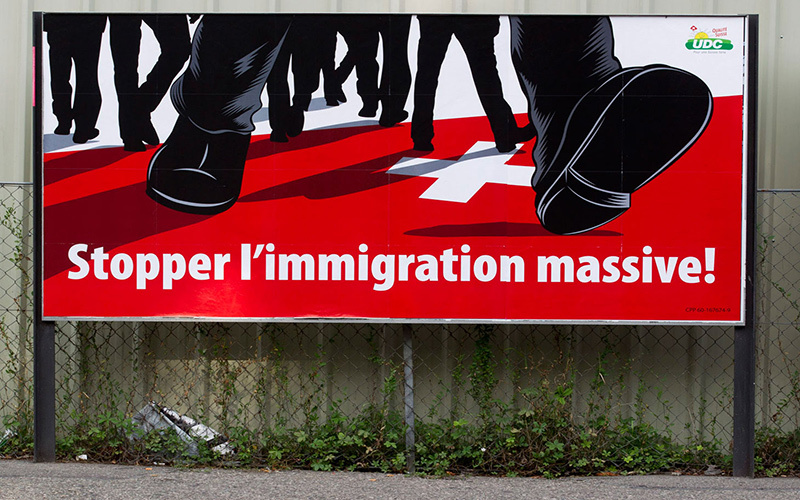
Why is this all this story? And to the fact that recently Switzerland was the same in the international press, and this was due to the referendum in the country on February 9, on which the people (he, according to the constitutional legal definition of the “sovereign”, that is, the authority from which the authorities proceeds) unexpectedly voted for the suspension of immigration to Switzerland from the EU countries. And this must be dwell on in more detail.
Because the referendum was not about the influx of migrants from Africa, say, from the same Russia, namely about the countries of the European Union surrounding the Switzerland from all sides. Currently, the cooperation between the EU and Switzerland is determined by sixteen bilateral (“bilateral”) agreements that complement the free trade agreement, concluded between the European community and Switzerland in 1972, and which are a replacement for full membership of Switzerland in the EU.
The “first package of bilateral agreements” regulates the relations of Switzerland and the European Union in areas such as trade, agriculture, transport, science and fundamental research. In accordance with the so -called principle of guillotine, the agreement of this package can only be valid in the complex. It stops acting one of them - they lose their legal force and all other package agreements.
The “Agreement on Freedom of Movement” is one of the core documents of the “first package”, and now, as a result of the referendum, on February 9, it was called into question. After all, it really implies for citizens of the EU countries to come to Switzerland, live here and look for work. There are no quotas and restrictions here and cannot be. But the people now require a quota. And the "guillotine" is about to be ready to break down.
The Russian reaction to this decision on social networks was very positive. Just enthusiastic and euphoric. Keep it up! Give you! No migrants! After that, to clarifying the question with a request to clarify the motives and the reasons for such an enthusiasm for some referendum in the country there, we admit, far from the everyday concerns of Russians, tons of stories about ... Tajiks, Biryulyovo and other "who did not want to integrate."
And then it became clear to me that all this armada of Russian supporters of Christophe Blocher, the chief strategist of the conservative Swiss People's Party, who acted as the author of the same “anti -migration initiative” (that would be an old man, actually!), Of course, tells me not about Switzerland. They talk about themselves, about their troubles, at best about Switzerland, which exists only in their minds.
To my objection, that, they say, the conditional “Tajik” in Moscow and the conditional “German” in Zurich are two completely different universes, even highly intelligent (in all seriousness) people began to pat me on the shoulder and say that I am a naive dreamer and do not know life. People, they say, are the same everywhere, and everyone in the world does not like migrants and foreigners.
And here, alas, the discussion ends - simply because its fruitful continuation requires too much knowledge. And for the philistine consciousness in Russia, there are currently only two constants - money and hatred of others, otherwise, to migrants in any case. Therefore, completely not understanding how the Swiss watches “tick”, they begin to transfer this way of thought to the Swiss.
Meanwhile, here you need to know, probably, the main thing. The Swiss is one of the most disinterested and responsive peoples in the world. They are ready to give, if not the last shirt, then a lot, you only have to declare a fundraiser for some other African country, which is dying of hunger, of course, because of the “damned colonial past”, and not because its current rulers simply decided to fill their pockets, and the people just die.
Now let the dear Russians imagine their own reaction to the call to raise funds to help the same in the past of Bratsk Tajikistan - even on condition that the money will not be stolen and really delivered to the address. Introduced? Well, exactly ...
In Switzerland, in this sense, the discourse is completely different as they say. Firstly, complete criticality to oneself. You tell, relatively speaking, about the gulag, and you immediately in response: they say, “yes in Switzerland everything is also terribly bad, it turned out in the late 1980s that they followed us and recorded information about the papers of the cards, fischen in German.” Horror is simple! ..
Secondly, the readiness to just now quit everything and go to Cambodia to take care of AIDS patients or dig wells in Sudan. How, you haven't traveled to Sudan to dig wells? Well, you, then, are not like that, you do not have an understanding of the importance of the so-called public good, a concept that is successfully destroyed in Russia under the onslaught of the victorious procession of egoistically-infantile Mancicher's hospitalism. So, of course, it was not about xenophobia and not about hatred of foreigners on February 9.
Before we talk about what fellows the Swiss, who pointed to the door to all these “blacks”, even if at first all my smart and kind Russian respondents try to teach migrants from Uzbekistan instead of campaigns in “Auchan”. And let the Moscow authorities try to invest a couple of million not in the next shopping center, but in the center of integration of migrants. In Zurich, for example, there is one, Welcome Desk is called.
In Russia, there is no understanding of the importance of the “public good”, a concept that is destroyed under the onslaught of hospitalism.
It is about completely different, namely, that the people want to manage the situation in their country. Over the past 20 years of the existence of a “bilateral” format of relations with the EU, the Swiss economy has made a strong breakthrough, largely thanks to the free influx of qualified personnel. However, from some point it turned out that the economy and concerns, thanks to the excellent frame conditions of management, received excellent business indicators, somehow broke away from the people.
The global economy, due to which Switzerland is in the first places in all conceivable world ratings, lived in the same world, simple burghers - a little in another. An alarming signals were: Thomas’s legislative initiative on the more rigid regulation of salaries of managers, the scandalous offer of socialist young animals “1:12” to make sure that the largest salary in this company exceeds the smallest more than 12 times. The authorities did not pay attention to signals, it was believed that the “bilateral path” of relations with the EU has no alternatives with all the variety.
However, the "Narodniks" of Blocher chose the right moment. The EU reputation is now worse. The once daring project of European restoration turned into a bureaucratic monster living at the expense of Germany and its readiness to plow the most and get the least. The Germans understand this, but they are silent, because after 1945 they voluntarily told themselves that they did not have the right to be Germans, but only to Europeans.
The influx of the same Germans (and not only) in Switzerland was due to precisely in constant demand here for highly qualified personnel and the opportunity for these personnel to receive adequate money for their “plowing”. They did not take into account one thing - the policy in Switzerland is determined by a very simple formula: “mood” (Stimmung) - “opinion” (Meinung) - “voting” (abstimmung) . No parties, no funds and other bureaucratic filters, sometimes changing popular will to recognize.
The mood was not very good in the country, even though Switzerland practically did not feel the global crisis. “Trucky” in morning trains (Swiss, of course, incomparable from the Moscow crowd in the subway at 08:00 in the morning), a noticeable increase in the cost of housing, and most importantly, the unwillingness of the people to follow the federal leadership in Bern, which supposedly forces Switzerland to “European” according to the bureaucratic brunussel model, which cuts down the paths of the new constitutation. Norms.
However, Brussels should also be pleased. The “bilateral” path was still a kind of semi-embossed, on the one hand, on the unwillingness of Switzerland to join the EU, and on the other hand, to the need to somehow remove trading obstacles in the path of cooperation with his most important partner. Now, Switzerland is likely to make a very simple choice in general: either full membership in the EU, or ... will fall with a whistle of guillotine.