
Translated material
Wayne McGregor: "Media is a key assistant to a modern artist"
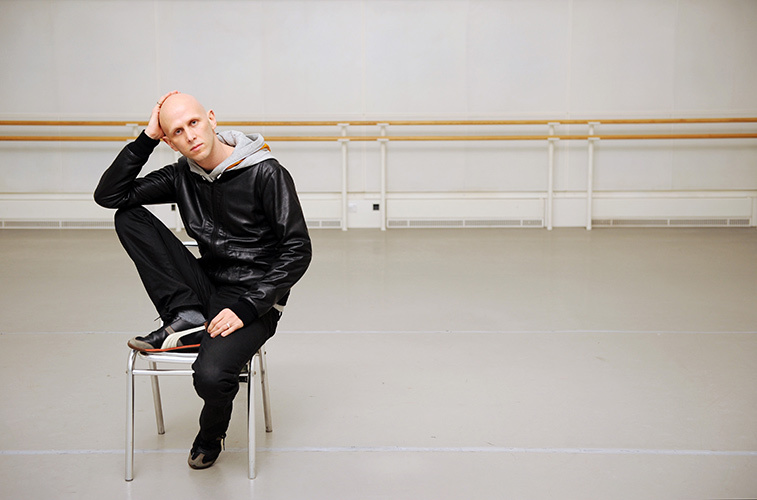
The key events of the theater on February theater in both capitals were Russian premieres of two ballets of the European choreography leader Wayne McGregor at the beginning of the 21st century: at first, the Golden Mask, as part of the out -of -end program “Contest”, brought to Moscow “ ATOMOS” , the last premiere of Random Dance , then Mariinsky Theater released its own version Infra , originally delivered in 2008 for the London Royal Ballet. Having spent only a few days in St. Petersburg, McGregor minimized communication with the press: his only detailed performance took place at a closed meeting at the Smolny Institute of Free Arts and Sciences, whose students the choreographer visited Pavel Gershenzona, at the invitation of the master's magistracy of St. Petersburg State University. The main theses of the fiery one and a half hour speech of McGregor were referred by Dmitry Renansky.
Not that I somehow deliberately try to be modern. By definition, I can’t be different by definition: I live at the beginning of the 21st century, I am interested in making art about today, about the current state of the world, trying to explore it with all the available means - not only from the arsenal of art, but, for example, with the help of instrumentation of modern science.
Every morning, entering the ballet class, I force myself to forget about what I know about the human body and about its capabilities.
I really love the classic ballet and admire his language-but why repeat what has already been done by someone else? Suppose, I adore Balanchin, but I can’t think of myself as his heir or successor: I am completely different. Each artist should go his own way, not trying to turn onto the beaten road and not paying attention to other people's opinions - although this is especially difficult today, when thousands of reviews appear after each performance on social networks, when each viewer became essentially ballet critic.
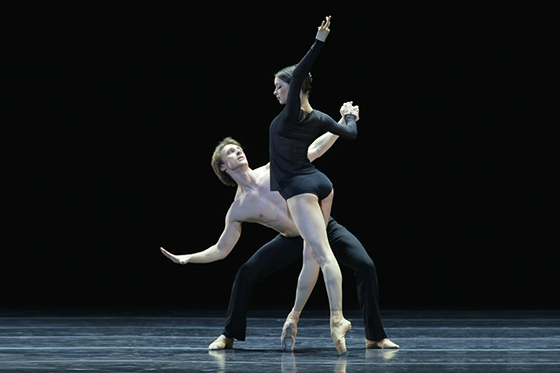 © Mariinsky Theater Scene from Ballet "Infra"
I can’t say that I have experienced some special injury when switching from the world of modern dance to the territory of academic theaters. I just had to deal with dancers of a completely different type - and nothing more. The main thing is to carefully study the physical handwriting of a particular artist and build your work, consistent with him. Yes, sometimes the horizons of people working in the academic territory are limited by professional shores - but that is why I prefer to compose steam performances with artists and designers who are not related to the world of the theater: they help to expand ballet horizons.
Working with large theater institutions, it is important to first learn the rules by which they exist - and then immediately forget these rules once and for all. I put my main performances for my own troupe Random Dance , but I also really value the cooperation with the London Royal Ballet or Paris Opera ballet - although in order to attract artists existing in the academic territory, I often have to make efforts and use all their talents. Communicating with young choreographers, I always tell them: the main thing is to know what you want, and then you will never have problems with artists or the directors of theaters.
My schedule is scheduled until 2020. The logic of each season is subordinated to the same matrix: ten weeks of vacation annually, three new ballets per season, one of which is for Random Dance , the other for the royal ballet. There are not so many time for maneuvers left, priority is given to foreign troupes with whom I have established especially close ties - like a ballet of the Paris Opera: say, next year I will put a performance for them to the music of Pierre Boulez to his anniversary. It is always important to leave something out of chance: it was thanks to the gaps in the schedule to the Bolshoi Theater that “chrome” was transferred, and “Infra” to Mariinsky.
I don’t even know what we would do without iPads and iPhones.
I compose my performances for specific dancers, so they are not sitting very well during transfer - like a jacket from someone else's shoulder. Therefore, at first I did not like to endure my old work too much - it is much more pleasant to work on new ballets. But from any not too comfortable situation, it is important to be able to extract your benefits. At a certain moment, one of the artists necessarily begins to assign a choreography, slightly changing the original,-and here you need to look at both: it is quite possible that the new one that the dancer brings to the original text will be useful to you when composing future performances.
Rinter the borders - the destiny of critics, the artists should think about how to violate them. The chief British ballet critic Clement Crispion is very fond of discussing what was the royal ballet and what is not, that it is permissible to show on his sacred scene, but what is not - at the same time he is not at all interested in the surprisingly active life that young choreographers live in Covent Garden today. And this, in essence, is normal: everyone is busy with his own business.
Theaters often turn out to be much more flexible in the perception of a new one than the audience that they focus on. It would be nice to understand once and for all: ballet is one of the forms of contemporary art, its tongue is constantly changing, there are no norms and rules recorded once and for all. What was good ten years ago should give way to a new way.
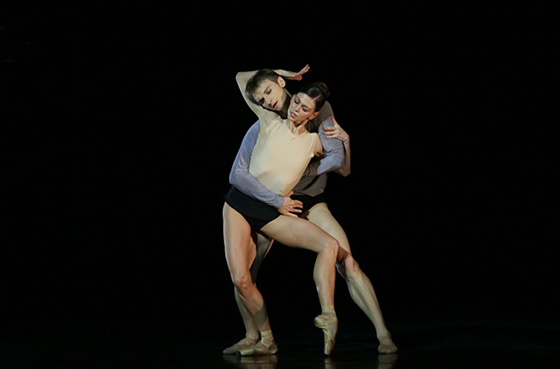 © Mariinsky Theater Scene from Ballet "Infra"
By the time I enter the rehearsal hall, work on the ballet has been going on for about two years - and I am able to be able to put the performance. But the process of “doing” the future ballet is possible only in contact with artists - it is impossible to create a new work without interaction with their energy. I set the task before the dancer, arouse his imagination, observe how he works in the proposed direction - and ultimately adjusting the plan based on his reaction.
Media is a key assistant to the contemporary artist. I don’t even know what we would do without iPads and iPhones: we all sit on social networks, and thanks to technology on all continents they speak about the same language. I remember well how at the casting of the “Chroma” in the Bolshoi Theater, the dancer came up to me with the words: “Hello, I learned your ballet by record on YouTube ” - it turned out to be Svetlana Lunkina, who then became the best performer of Chrome and generally my beloved ballerina.
Technologies allow you to show the best that is in the human body. At first, Laban , and after him, Forsyt taught us to be more attentive to body physics - and it seemed interesting to me to develop the analytical approach to dance at a new stage. In all my recent works, I try to use the latest achievements of modern science in the creative process - even those that at first glance seem to have nothing to do with art in general and dance in particular. So, in the “ atomos” just shown in Moscow, I worked tightly with biometric data: composing this performance, we studied the algorithms of human behavior in various situations and psychoemotional states.
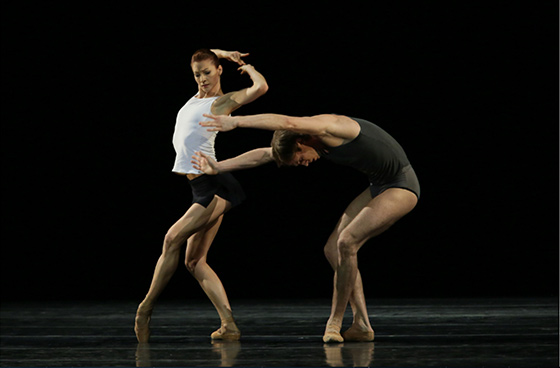 © Mariinsky Theater Scene from Ballet "Infra"
The subject of contemporary art should be the deep connection between the processes that occur within the human body, and the technologies that make them the visible essence. Modern man every minute broadcasts information about himself, his momentary impressions and sensations through Facebook, Instagram and God knows through what else - and it seems strange to me not to explore this fundamentally new situation in the life of mankind. It would be interesting to put a performance, all the spectators of which would be supplied with biometric bracelets: the counters would broadcast information about what exactly inspires or inspires the audience in what is happening on the stage (the same “like” is only more direct), and artists could interact differently with the reaction of the public to what they saw. Technologies open for me as a choreographer the exceptional opportunities in terms of building the playwright of the performance: the key task that I want to try to solve in the coming years is how to directly connect art in general and ballet in particular with human physiology.